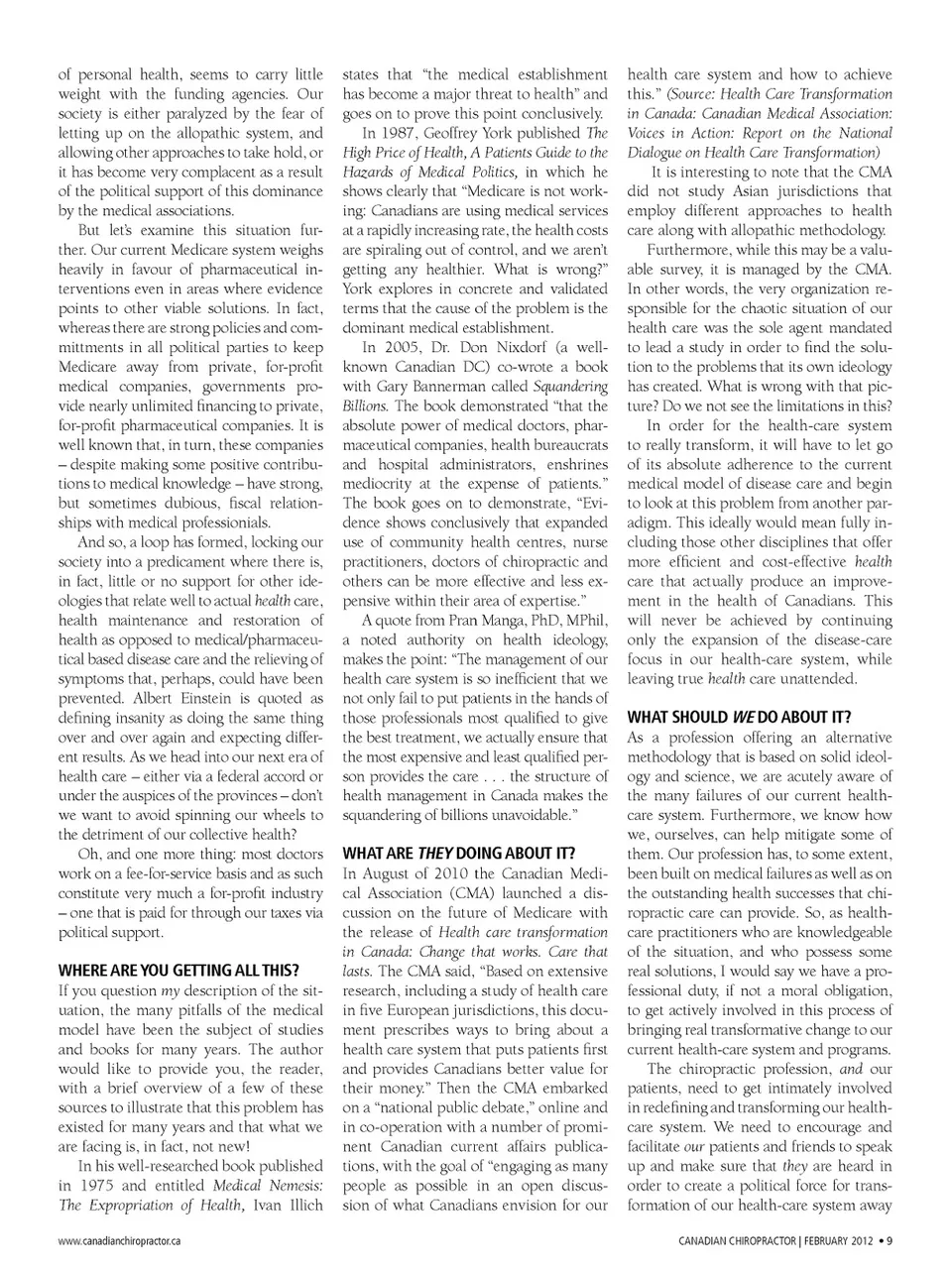
feature Health Discord, Part 1 The urgent need for a transformative voice T Dr. Henri Marcoux graduated from CMCC in 1966 and was one of the founding members of The College of Chiropractic Science. He is a Fel-low of the College of Chiropractic Orthopedists and past president of the Manitoba Chiropractors As-sociation. He was also previously a member of the Board of Direc-tors of the Canadian Chiropractic Association and a member of the Guideline Development Commit-tee of the CCA and CFCREAB. Dr. Marcoux is a well-known lecturer and teaches a seminar titled The Neuro-Dynamics of Posture, Stress and Subluxation Patterns. he Health Accord that Paul Martin and the federal Liberals proposed to the prov-inces and territories of Canada in 2004 was accepted as the plan that was sup-posed to “heal health care for a generation.” The 10-year Health Accord will be due for renewal in 2014 and the need to “heal” the system is more prominent now than it was in 2004. According to the Canadian Health Care Coalition (CHC), the federal government gave the provinces a blank cheque with “no strings attached” in 2004, meaning that there would be no significant accountability for financing the provinces, and health outcomes would have no place in the operation of the plan. Consequently, we have been financing a sys-tem that does not produce healthier Canadians. As well, every year, the provinces’ health care budgets increase significantly but our Medicare crisis continues. “Medicare is still on life support, not from lack of money, but because of weak controls on where and how the money will be spent.” says the CHC’s report titled “A 10-year plan to strengthen health care” At the time this article is being written, the federal government is saying that it may back out of the process completely, and may not even engage in re-establishing a federal health plan (i.e., will not renew the Health Accord). This leaves the provinces to either manage their health care as individual entities or work together, without federal guidance, to forge co-operative relationships for forming guidelines and strategies in, at least, some areas of their health care. This is not without precedent, as the idea of a federal-provincial accord dates back to 1999 and only crystallized into our current formal Health Accord in 2004. HOW HAS THAT WORKED OUT FOR YOU? Every year since 2004, Medicare costs in all provinces have escalated dramatically. De-spite this, overall outcomes are not necessarily positive as, in fact, we are arguably get-ting sicker. There is a demand for more doctors and an increasing need for sophisticated diagnostic and therapeutic equipment. By way of formulating a solution, there is a strong drive that does not show any signs of letting up, to train more medical doctors to fill the demand. Medical care has been widely accepted by governments as the only system that can care for the sick and ailing. Thus, although financed and managed by the provincial govern-ments, our health-care system is under the strict guidance of the medical profession. Other healing arts and alternative care approaches that demonstrate proven clinical merit and successes are, for the most part, excluded. Hence, Medicare is essentially a “disease-care” system that, I would say, is erroneously named a “health-care” system. The fact that the medical approach has not been effective in the prevention of disease, and the maintenance www.canadianchiropractor.ca Dr. Henri Marcoux, DC 8 • CANADIAN CHIROPRACTOR | FEBRUARY 2012
Chiropractic + Naturopathic Doctor February 2012: Page 8