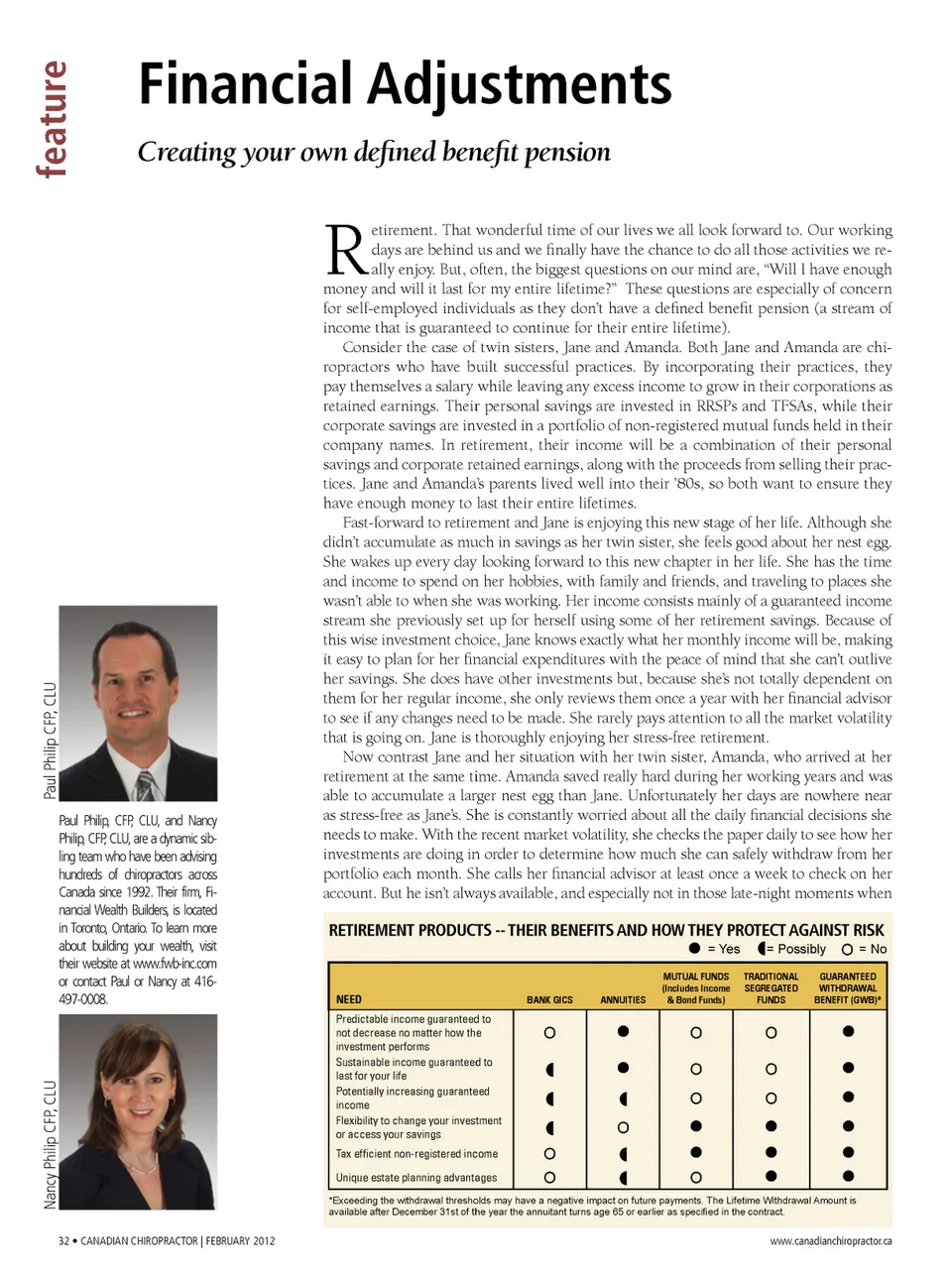
feature Financial Adjustments Creating your own defined benefit pension R Paul Philip, CFP, CLU, and Nancy Philip, CFP, CLU, are a dynamic sib-ling team who have been advising hundreds of chiropractors across Canada since 1992. Their firm, Fi-nancial Wealth Builders, is located in Toronto, Ontario. To learn more about building your wealth, visit their website at www.fwb-inc.com or contact Paul or Nancy at 416-497-0008. etirement. That wonderful time of our lives we all look forward to. Our working days are behind us and we finally have the chance to do all those activities we re-ally enjoy. But, often, the biggest questions on our mind are, “Will I have enough money and will it last for my entire lifetime?” These questions are especially of concern for self-employed individuals as they don’t have a defined benefit pension (a stream of income that is guaranteed to continue for their entire lifetime). Consider the case of twin sisters, Jane and Amanda. Both Jane and Amanda are chi-ropractors who have built successful practices. By incorporating their practices, they pay themselves a salary while leaving any excess income to grow in their corporations as retained earnings. Their personal savings are invested in RRSPs and TFSAs, while their corporate savings are invested in a portfolio of non-registered mutual funds held in their company names. In retirement, their income will be a combination of their personal savings and corporate retained earnings, along with the proceeds from selling their prac-tices. Jane and Amanda’s parents lived well into their ’80s, so both want to ensure they have enough money to last their entire lifetimes. Fast-forward to retirement and Jane is enjoying this new stage of her life. Although she didn’t accumulate as much in savings as her twin sister, she feels good about her nest egg. She wakes up every day looking forward to this new chapter in her life. She has the time and income to spend on her hobbies, with family and friends, and traveling to places she wasn’t able to when she was working. Her income consists mainly of a guaranteed income stream she previously set up for herself using some of her retirement savings. Because of this wise investment choice, Jane knows exactly what her monthly income will be, making it easy to plan for her financial expenditures with the peace of mind that she can’t outlive her savings. She does have other investments but, because she’s not totally dependent on them for her regular income, she only reviews them once a year with her financial advisor to see if any changes need to be made. She rarely pays attention to all the market volatility that is going on. Jane is thoroughly enjoying her stress-free retirement. Now contrast Jane and her situation with her twin sister, Amanda, who arrived at her retirement at the same time. Amanda saved really hard during her working years and was able to accumulate a larger nest egg than Jane. Unfortunately her days are nowhere near as stress-free as Jane’s. She is constantly worried about all the daily financial decisions she needs to make. With the recent market volatility, she checks the paper daily to see how her investments are doing in order to determine how much she can safely withdraw from her portfolio each month. She calls her financial advisor at least once a week to check on her account. But he isn’t always available, and especially not in those late-night moments when Paul Philip CFP, CLU RETIREMENT PRODUCTS --THEIR BENEFITS AND HOW THEY PROTECT AGAINST RISK ● = Yes = Possibly O = No NEED Predictable income guaranteed to not decrease no matter how the investment performs Sustainable income guaranteed to last for your life Potentially increasing guaranteed income Flexibility to change your investment or access your savings Tax efficient non-registered income Unique estate planning advantages BANK GICS ANNUITIES MUTUAL FUNDS (Includes Income & Bond Funds) TRADITIONAL SEGREGATED FUNDS GUARANTEED WITHDRAWAL BENEFIT (GWB)* O Nancy Philip CFP, CLU O O ● ● O O O O O ● ● O O ● ● ● O ● ● ● ● ● ● *Exceeding the withdrawal thresholds may have a negative impact on future payments. The Lifetime Withdrawal Amount is available after December 31st of the year the annuitant turns age 65 or earlier as specified in the contract. 32 • CANADIAN CHIROPRACTOR | FEBRUARY 2012 www.canadianchiropractor.ca
Chiropractic + Naturopathic Doctor February 2012: Page 32