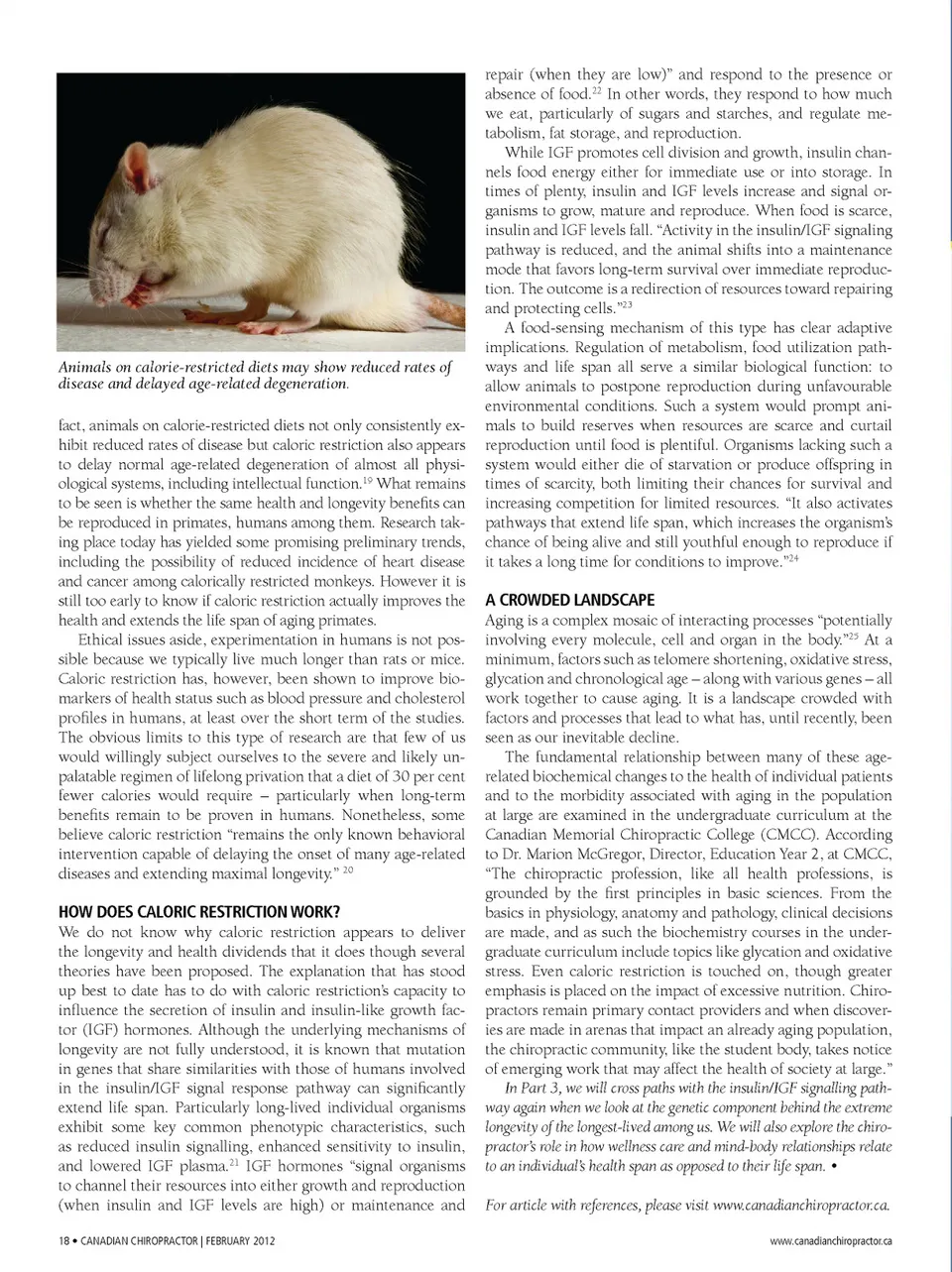
Animals on calorie-restricted diets may show reduced rates of disease and delayed age-related degeneration. fact, animals on calorie-restricted diets not only consistently ex-hibit reduced rates of disease but caloric restriction also appears to delay normal age-related degeneration of almost all physi-ological systems, including intellectual function. 19 What remains to be seen is whether the same health and longevity benefits can be reproduced in primates, humans among them. Research tak-ing place today has yielded some promising preliminary trends, including the possibility of reduced incidence of heart disease and cancer among calorically restricted monkeys. However it is still too early to know if caloric restriction actually improves the health and extends the life span of aging primates. Ethical issues aside, experimentation in humans is not pos-sible because we typically live much longer than rats or mice. Caloric restriction has, however, been shown to improve bio-markers of health status such as blood pressure and cholesterol profiles in humans, at least over the short term of the studies. The obvious limits to this type of research are that few of us would willingly subject ourselves to the severe and likely un-palatable regimen of lifelong privation that a diet of 30 per cent fewer calories would require – particularly when long-term benefits remain to be proven in humans. Nonetheless, some believe caloric restriction “remains the only known behavioral intervention capable of delaying the onset of many age-related diseases and extending maximal longevity.” 20 repair (when they are low)” and respond to the presence or absence of food. 22 In other words, they respond to how much we eat, particularly of sugars and starches, and regulate me-tabolism, fat storage, and reproduction. While IGF promotes cell division and growth, insulin chan-nels food energy either for immediate use or into storage. In times of plenty, insulin and IGF levels increase and signal or-ganisms to grow, mature and reproduce. When food is scarce, insulin and IGF levels fall. “Activity in the insulin/IGF signaling pathway is reduced, and the animal shifts into a maintenance mode that favors long-term survival over immediate reproduc-tion. The outcome is a redirection of resources toward repairing and protecting cells.” 23 A food-sensing mechanism of this type has clear adaptive implications. Regulation of metabolism, food utilization path-ways and life span all serve a similar biological function: to allow animals to postpone reproduction during unfavourable environmental conditions. Such a system would prompt ani-mals to build reserves when resources are scarce and curtail reproduction until food is plentiful. Organisms lacking such a system would either die of starvation or produce offspring in times of scarcity, both limiting their chances for survival and increasing competition for limited resources. “It also activates pathways that extend life span, which increases the organism’s chance of being alive and still youthful enough to reproduce if it takes a long time for conditions to improve.” 24 HOW DOES CALORIC RESTRICTION WORK? We do not know why caloric restriction appears to deliver the longevity and health dividends that it does though several theories have been proposed. The explanation that has stood up best to date has to do with caloric restriction’s capacity to influence the secretion of insulin and insulin-like growth fac-tor (IGF) hormones. Although the underlying mechanisms of longevity are not fully understood, it is known that mutation in genes that share similarities with those of humans involved in the insulin/IGF signal response pathway can significantly extend life span. Particularly long-lived individual organisms exhibit some key common phenotypic characteristics, such as reduced insulin signalling, enhanced sensitivity to insulin, and lowered IGF plasma. 21 IGF hormones “signal organisms to channel their resources into either growth and reproduction (when insulin and IGF levels are high) or maintenance and 18 • CANADIAN CHIROPRACTOR | FEBRUARY 2012 A CROWDED LANDSCAPE Aging is a complex mosaic of interacting processes “potentially involving every molecule, cell and organ in the body.” 25 At a minimum, factors such as telomere shortening, oxidative stress, glycation and chronological age – along with various genes – all work together to cause aging. It is a landscape crowded with factors and processes that lead to what has, until recently, been seen as our inevitable decline. The fundamental relationship between many of these age-related biochemical changes to the health of individual patients and to the morbidity associated with aging in the population at large are examined in the undergraduate curriculum at the Canadian Memorial Chiropractic College (CMCC). According to Dr. Marion McGregor, Director, Education Year 2, at CMCC, “The chiropractic profession, like all health professions, is grounded by the first principles in basic sciences. From the basics in physiology, anatomy and pathology, clinical decisions are made, and as such the biochemistry courses in the under-graduate curriculum include topics like glycation and oxidative stress. Even caloric restriction is touched on, though greater emphasis is placed on the impact of excessive nutrition. Chiro-practors remain primary contact providers and when discover-ies are made in arenas that impact an already aging population, the chiropractic community, like the student body, takes notice of emerging work that may affect the health of society at large.” In Part 3, we will cross paths with the insulin/IGF signalling path-way again when we look at the genetic component behind the extreme longevity of the longest-lived among us. We will also explore the chiro-practor’s role in how wellness care and mind-body relationships relate to an individual’s health span as opposed to their life span. • For article with references, please visit www.canadianchiropractor.ca. www.canadianchiropractor.ca
Chiropractic + Naturopathic Doctor February 2012: Page 18