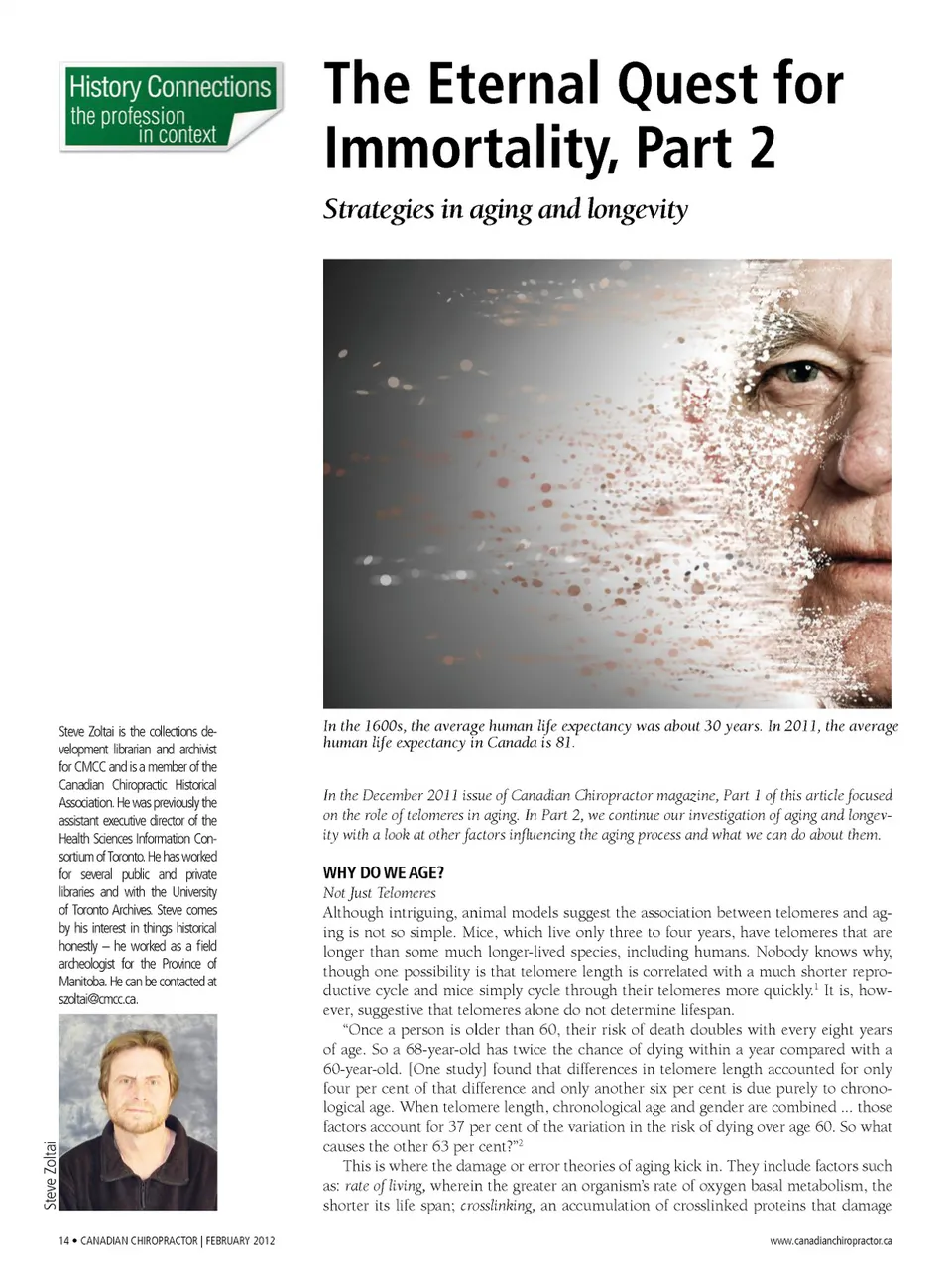
The Eternal Quest for Immortality, Part 2 Strategies in aging and longevity Steve Zoltai is the collections de-velopment librarian and archivist for CMCC and is a member of the Canadian Chiropractic Historical Association. He was previously the assistant executive director of the Health Sciences Information Con-sortium of Toronto. He has worked for several public and private libraries and with the University of Toronto Archives. Steve comes by his interest in things historical honestly – he worked as a field archeologist for the Province of Manitoba. He can be contacted at [email protected]. In the 1600s, the average human life expectancy was about 30 years. In 2011, the average human life expectancy in Canada is 81. In the December 2011 issue of Canadian Chiropractor magazine, Part 1 of this article focused on the role of telomeres in aging. In Part 2, we continue our investigation of aging and longev-ity with a look at other factors influencing the aging process and what we can do about them. WHY DO WE AGE? Not Just Telomeres Although intriguing, animal models suggest the association between telomeres and ag-ing is not so simple. Mice, which live only three to four years, have telomeres that are longer than some much longer-lived species, including humans. Nobody knows why, though one possibility is that telomere length is correlated with a much shorter repro-ductive cycle and mice simply cycle through their telomeres more quickly. 1 It is, how-ever, suggestive that telomeres alone do not determine lifespan. “Once a person is older than 60, their risk of death doubles with every eight years of age. So a 68-year-old has twice the chance of dying within a year compared with a 60-year-old. [One study] found that differences in telomere length accounted for only four per cent of that difference and only another six per cent is due purely to chrono-logical age. When telomere length, chronological age and gender are combined ... those factors account for 37 per cent of the variation in the risk of dying over age 60. So what causes the other 63 per cent?” 2 This is where the damage or error theories of aging kick in. They include factors such as: rate of living, wherein the greater an organism’s rate of oxygen basal metabolism, the shorter its life span; crosslinking, an accumulation of crosslinked proteins that damage www.canadianchiropractor.ca Steve Zoltai 14 • CANADIAN CHIROPRACTOR | FEBRUARY 2012
Chiropractic + Naturopathic Doctor February 2012: Page 14