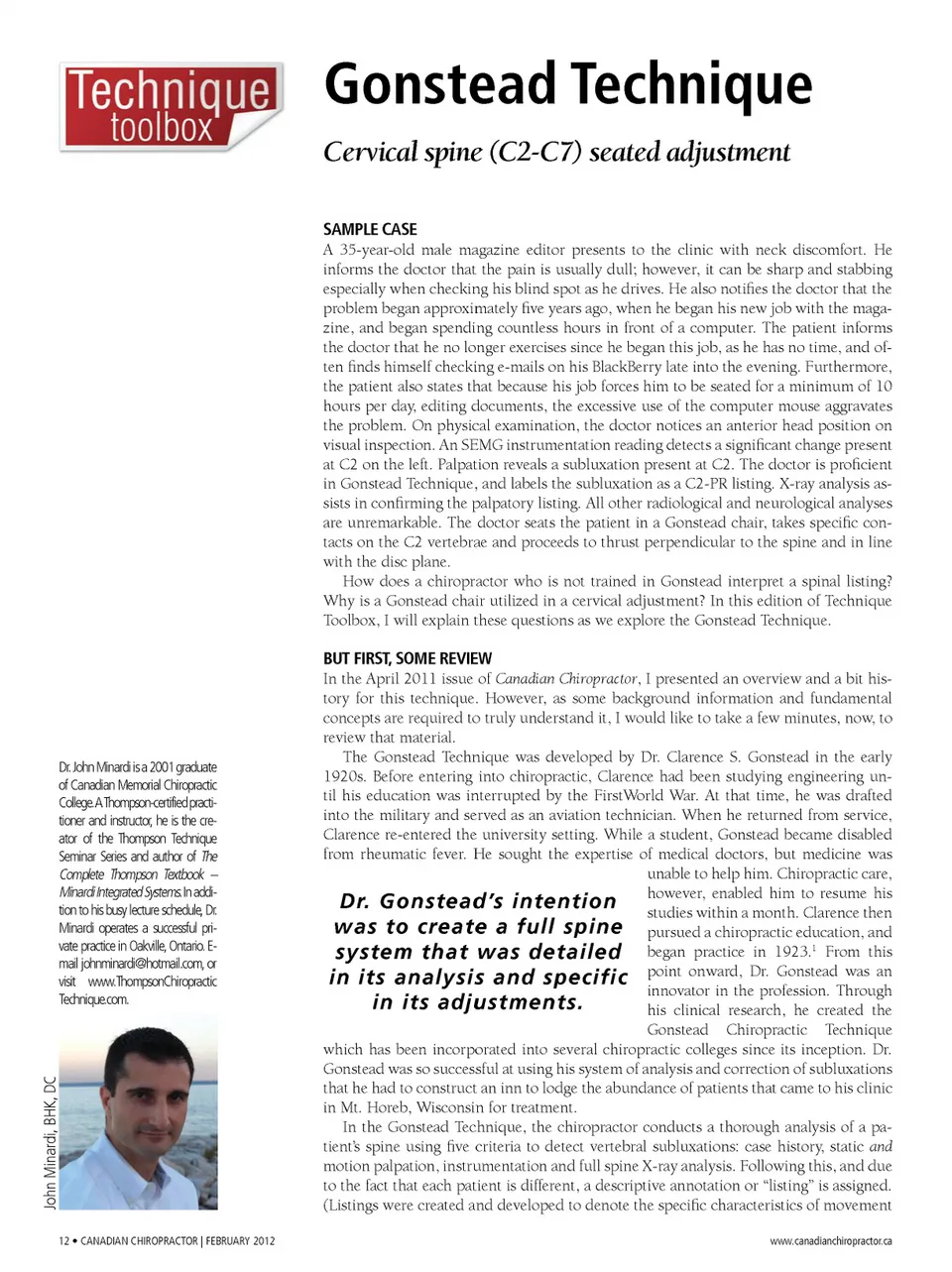
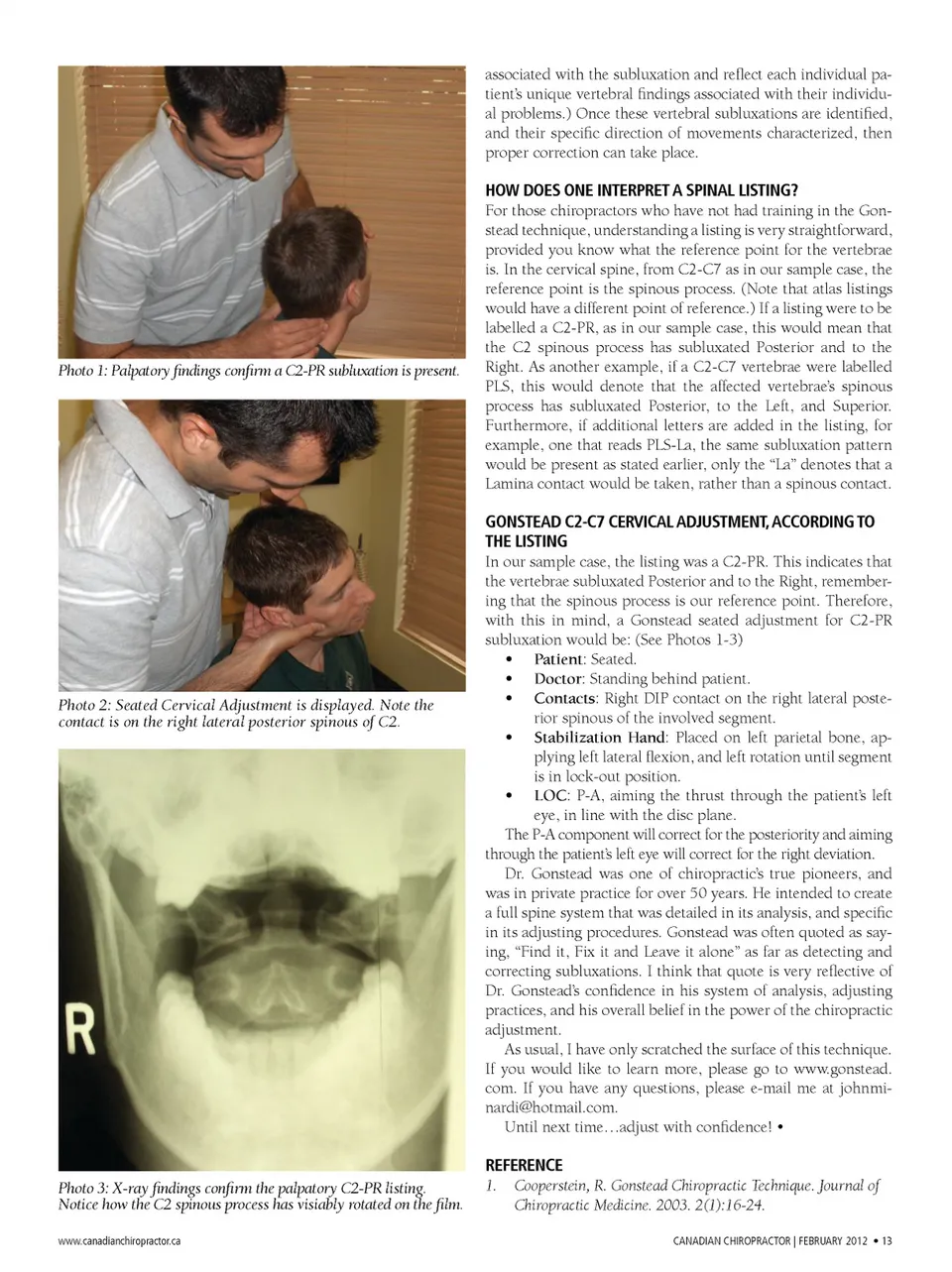
associated with the subluxation and reflect each individual pa-tient’s unique vertebral findings associated with their individu-al problems.) Once these vertebral subluxations are identified, and their specific direction of movements characterized, then proper correction can take place. Photo 1: Palpatory findings confirm a C2-PR subluxation is present. HOW DOES ONE INTERPRET A SPINAL LISTING? For those chiropractors who have not had training in the Gon-stead technique, understanding a listing is very straightforward, provided you know what the reference point for the vertebrae is. In the cervical spine, from C2-C7 as in our sample case, the reference point is the spinous process. (Note that atlas listings would have a different point of reference.) If a listing were to be labelled a C2-PR, as in our sample case, this would mean that the C2 spinous process has subluxated Posterior and to the Right. As another example, if a C2-C7 vertebrae were labelled PLS, this would denote that the affected vertebrae’s spinous process has subluxated Posterior, to the Left, and Superior. Furthermore, if additional letters are added in the listing, for example, one that reads PLS-La, the same subluxation pattern would be present as stated earlier, only the “La” denotes that a Lamina contact would be taken, rather than a spinous contact. GONSTEAD C2-C7 CERVICAL ADJUSTMENT, ACCORDING TO THE LISTING In our sample case, the listing was a C2-PR. This indicates that the vertebrae subluxated Posterior and to the Right, remember-ing that the spinous process is our reference point. Therefore, with this in mind, a Gonstead seated adjustment for C2-PR subluxation would be: (See Photos 1-3) • Patient : Seated. • Doctor : Standing behind patient. • Contacts : Right DIP contact on the right lateral poste-rior spinous of the involved segment. • Stabilization Hand : Placed on left parietal bone, ap-plying left lateral flexion, and left rotation until segment is in lock-out position. • LOC : P-A, aiming the thrust through the patient’s left eye, in line with the disc plane. The P-A component will correct for the posteriority and aiming through the patient’s left eye will correct for the right deviation. Dr. Gonstead was one of chiropractic’s true pioneers, and was in private practice for over 50 years. He intended to create a full spine system that was detailed in its analysis, and specific in its adjusting procedures. Gonstead was often quoted as say-ing, “Find it, Fix it and Leave it alone” as far as detecting and correcting subluxations. I think that quote is very reflective of Dr. Gonstead’s confidence in his system of analysis, adjusting practices, and his overall belief in the power of the chiropractic adjustment. As usual, I have only scratched the surface of this technique. If you would like to learn more, please go to www.gonstead. com. If you have any questions, please e-mail me at [email protected]. Until next time…adjust with confidence! • REFERENCE 1. Cooperstein, R. Gonstead Chiropractic Technique. Journal of Chiropractic Medicine. 2003. 2(1):16-24. CANADIAN CHIROPRACTOR | FEBRUARY 2012 • 13 Photo 2: Seated Cervical Adjustment is displayed. Note the contact is on the right lateral posterior spinous of C2. Photo 3: X-ray findings confirm the palpatory C2-PR listing. Notice how the C2 spinous process has visiably rotated on the film. www.canadianchiropractor.ca
Chiropractic + Naturopathic Doctor February 2012: Page 13