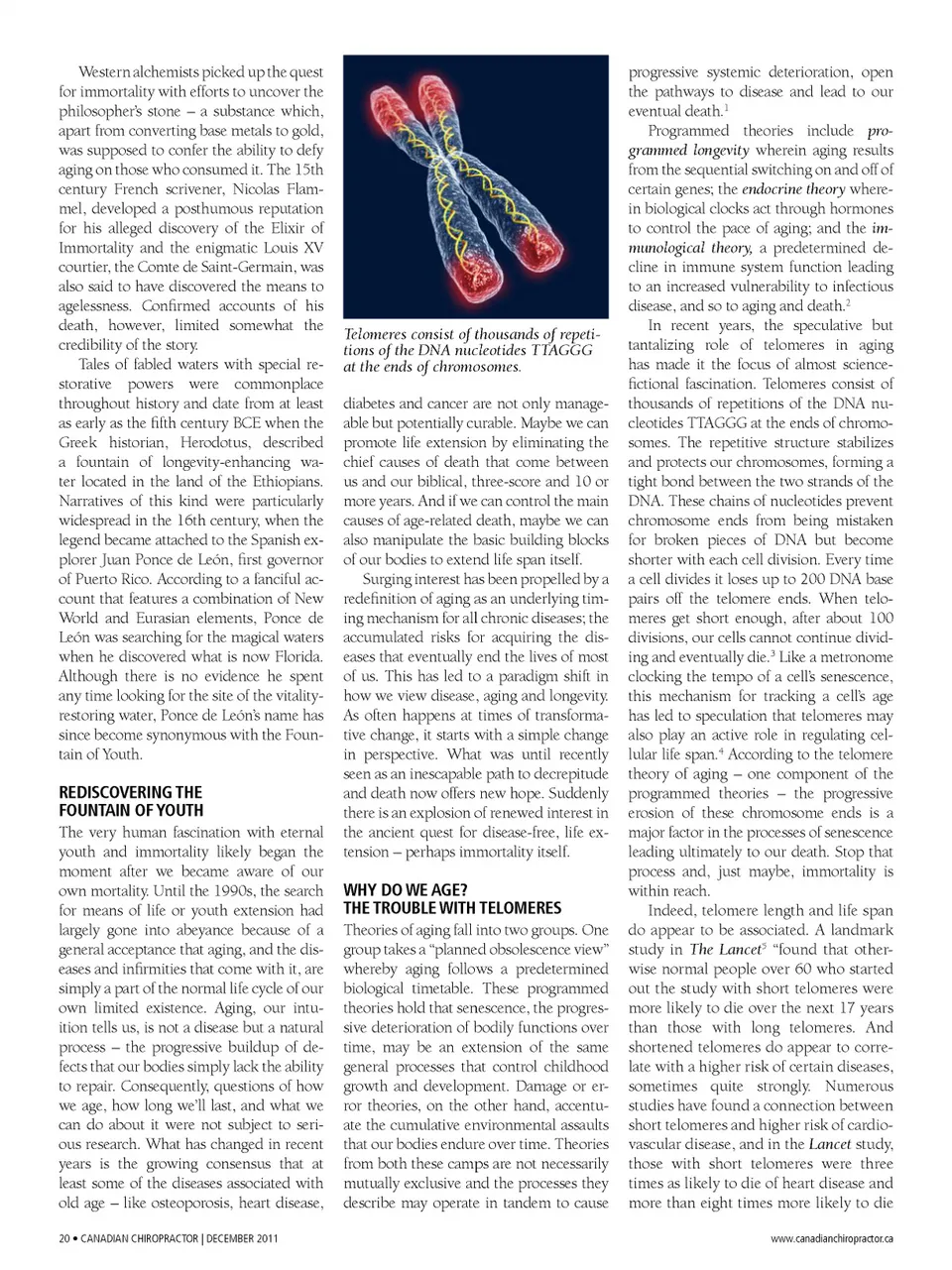
Western alchemists picked up the quest for immortality with efforts to uncover the philosopher’s stone – a substance which, apart from converting base metals to gold, was supposed to confer the ability to defy aging on those who consumed it. The 15th century French scrivener, Nicolas Flam -mel, developed a posthumous reputation for his alleged discovery of the Elixir of Immortality and the enigmatic Louis XV courtier, the Comte de Saint-Germain, was also said to have discovered the means to agelessness. Confirmed accounts of his death, however, limited somewhat the credibility of the story. Tales of fabled waters with special re -storative powers were commonplace throughout history and date from at least as early as the fifth century BCE when the Greek historian, Herodotus, described a fountain of longevity-enhancing wa -ter located in the land of the Ethiopians. Narratives of this kind were particularly widespread in the 16th century, when the legend became attached to the Spanish ex -plorer Juan Ponce de León, first governor of Puerto Rico. According to a fanciful ac -count that features a combination of New World and Eurasian elements, Ponce de León was searching for the magical waters when he discovered what is now Florida. Although there is no evidence he spent any time looking for the site of the vitality-restoring water, Ponce de León’s name has since become synonymous with the Foun -tain of Youth. Telomeres consist of thousands of repeti-tions of the DNA nucleotides TTAGGG at the ends of chromosomes. diabetes and cancer are not only manage -able but potentially curable. Maybe we can promote life extension by eliminating the chief causes of death that come between us and our biblical, three-score and 10 or more years. And if we can control the main causes of age-related death, maybe we can also manipulate the basic building blocks of our bodies to extend life span itself. Surging interest has been propelled by a redefinition of aging as an underlying tim -ing mechanism for all chronic diseases; the accumulated risks for acquiring the dis -eases that eventually end the lives of most of us. This has led to a paradigm shift in how we view disease, aging and longevity. As often happens at times of transforma -tive change, it starts with a simple change in perspective. What was until recently seen as an inescapable path to decrepitude and death now offers new hope. Suddenly there is an explosion of renewed interest in the ancient quest for disease-free, life ex -tension – perhaps immortality itself. rEDisCovEring thE fountain of youth The very human fascination with eternal youth and immortality likely began the moment after we became aware of our own mortality. Until the 1990s, the search for means of life or youth extension had largely gone into abeyance because of a general acceptance that aging, and the dis -eases and infirmities that come with it, are simply a part of the normal life cycle of our own limited existence. Aging, our intu -ition tells us, is not a disease but a natural process – the progressive buildup of de -fects that our bodies simply lack the ability to repair. Consequently, questions of how we age, how long we’ll last, and what we can do about it were not subject to seri -ous research. What has changed in recent years is the growing consensus that at least some of the diseases associated with old age – like osteoporosis, heart disease, 20 • CANADIAN CHIROpRACTOR | DECEMBER 2011 why Do wE agE? thE trouBlE with tElomErEs Theories of aging fall into two groups. One group takes a “planned obsolescence view” whereby aging follows a predetermined biological timetable. These programmed theories hold that senescence, the progres -sive deterioration of bodily functions over time, may be an extension of the same general processes that control childhood growth and development. Damage or er -ror theories, on the other hand, accentu -ate the cumulative environmental assaults that our bodies endure over time. Theories from both these camps are not necessarily mutually exclusive and the processes they describe may operate in tandem to cause progressive systemic deterioration, open the pathways to disease and lead to our eventual death. 1 Programmed theories include pro-grammed longevity wherein aging results from the sequential switching on and off of certain genes; the endocrine theory where-in biological clocks act through hormones to control the pace of aging; and the im-munological theory, a predetermined de -cline in immune system function leading to an increased vulnerability to infectious disease, and so to aging and death. 2 In recent years, the speculative but tantalizing role of telomeres in aging has made it the focus of almost science-fictional fascination. Telomeres consist of thousands of repetitions of the DNA nu -cleotides TTAGGG at the ends of chromo -somes. The repetitive structure stabilizes and protects our chromosomes, forming a tight bond between the two strands of the DNA. These chains of nucleotides prevent chromosome ends from being mistaken for broken pieces of DNA but become shorter with each cell division. Every time a cell divides it loses up to 200 DNA base pairs off the telomere ends. When telo -meres get short enough, after about 100 divisions, our cells cannot continue divid -ing and eventually die. 3 Like a metronome clocking the tempo of a cell’s senescence, this mechanism for tracking a cell’s age has led to speculation that telomeres may also play an active role in regulating cel -lular life span. 4 According to the telomere theory of aging – one component of the programmed theories – the progressive erosion of these chromosome ends is a major factor in the processes of senescence leading ultimately to our death. Stop that process and, just maybe, immortality is within reach. Indeed, telomere length and life span do appear to be associated. A landmark study in The Lancet 5 “found that other -wise normal people over 60 who started out the study with short telomeres were more likely to die over the next 17 years than those with long telomeres. And shortened telomeres do appear to corre -late with a higher risk of certain diseases, sometimes quite strongly. Numerous studies have found a connection between short telomeres and higher risk of cardio -vascular disease, and in the Lancet study, those with short telomeres were three times as likely to die of heart disease and more than eight times more likely to die www.canadianchiropractor.ca
Chiropractic + Naturopathic Doctor December 2011: Page 20