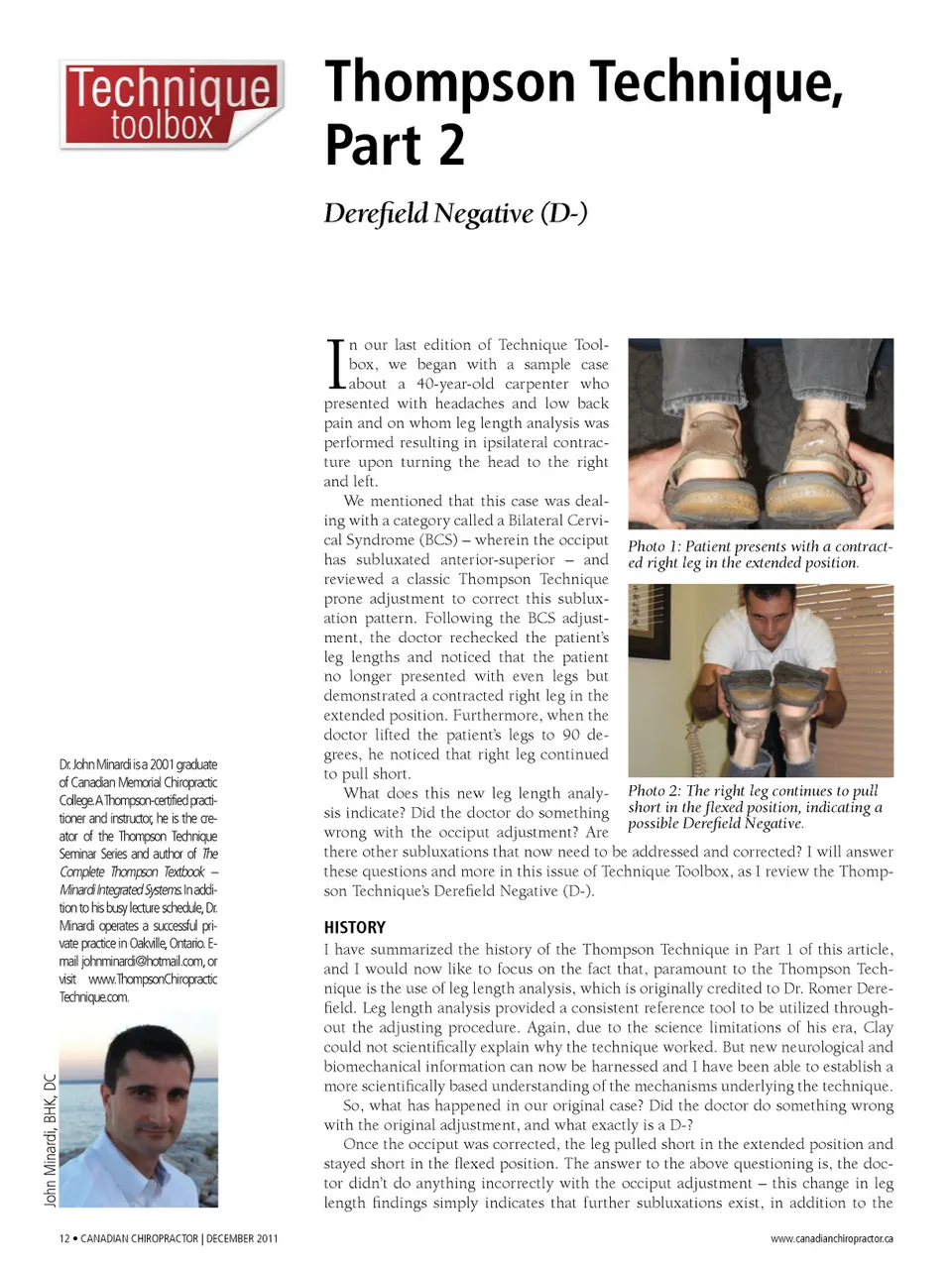
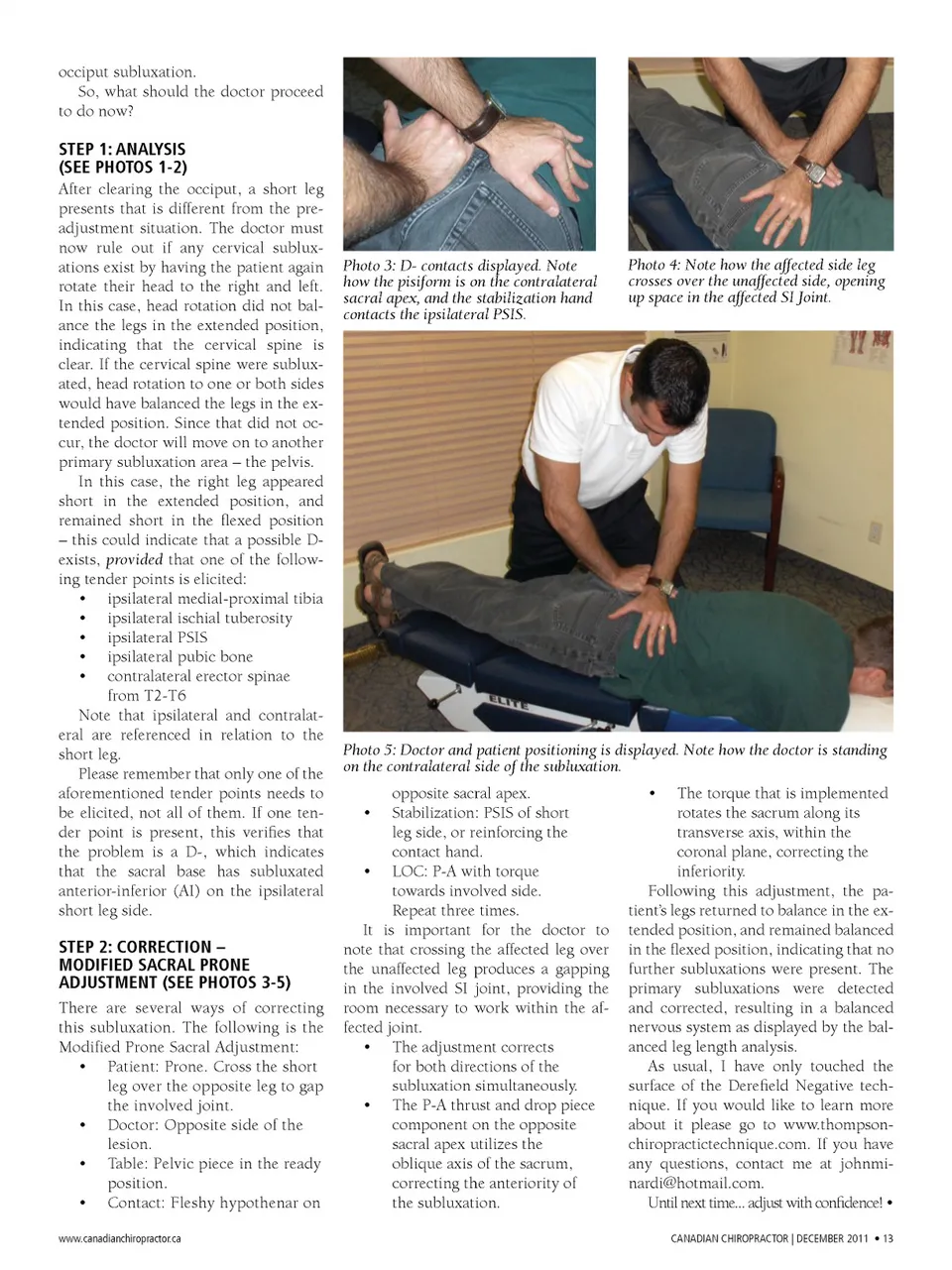
thompson technique, Part 2 Derefield Negative (D-) I Dr. John Minardi is a 2001 graduate of Canadian Memorial Chiropractic College. A Thompson-certified practi-tioner and instructor, he is the cre-ator of the Thompson Technique Seminar Series and author of The Complete Thompson Textbook – Minardi Integrated Systems. In addi -tion to his busy lecture schedule, Dr. Minardi operates a successful pri -vate practice in Oakville, Ontario. E-mail [email protected], or visit www.ThompsonChiropractic Technique.com. n our last edition of Technique Tool -box, we began with a sample case about a 40-year-old carpenter who presented with headaches and low back pain and on whom leg length analysis was performed resulting in ipsilateral contrac -ture upon turning the head to the right and left. We mentioned that this case was deal -ing with a category called a Bilateral Cervi -cal Syndrome (BCS) – wherein the occiput Photo 1: Patient presents with a contract-has subluxated anterior-superior – and ed right leg in the extended position. reviewed a classic Thompson Technique prone adjustment to correct this sublux -ation pattern. Following the BCS adjust -ment, the doctor rechecked the patient’s leg lengths and noticed that the patient no longer presented with even legs but demonstrated a contracted right leg in the extended position. Furthermore, when the doctor lifted the patient’s legs to 90 de -grees, he noticed that right leg continued to pull short. What does this new leg length analy -Photo 2: The right leg continues to pull sis indicate? Did the doctor do something short in the flexed position, indicating a possible Derefield Negative. wrong with the occiput adjustment? Are there other subluxations that now need to be addressed and corrected? I will answer these questions and more in this issue of Technique Toolbox, as I review the Thomp -son Technique’s Derefield Negative (D-). history I have summarized the history of the Thompson Technique in Part 1 of this article, and I would now like to focus on the fact that, paramount to the Thompson Tech -nique is the use of leg length analysis, which is originally credited to Dr. Romer Dere -field. Leg length analysis provided a consistent reference tool to be utilized through -out the adjusting procedure. Again, due to the science limitations of his era, Clay could not scientifically explain why the technique worked. But new neurological and biomechanical information can now be harnessed and I have been able to establish a more scientifically based understanding of the mechanisms underlying the technique. So, what has happened in our original case? Did the doctor do something wrong with the original adjustment, and what exactly is a D-? Once the occiput was corrected, the leg pulled short in the extended position and stayed short in the flexed position. The answer to the above questioning is, the doc -tor didn’t do anything incorrectly with the occiput adjustment – this change in leg length findings simply indicates that further subluxations exist, in addition to the www.canadianchiropractor.ca John Minardi, BHK, DC 12 • CANADIAN CHIROpRACTOR | DECEMBER 2011
Chiropractic + Naturopathic Doctor December 2011: Page 12