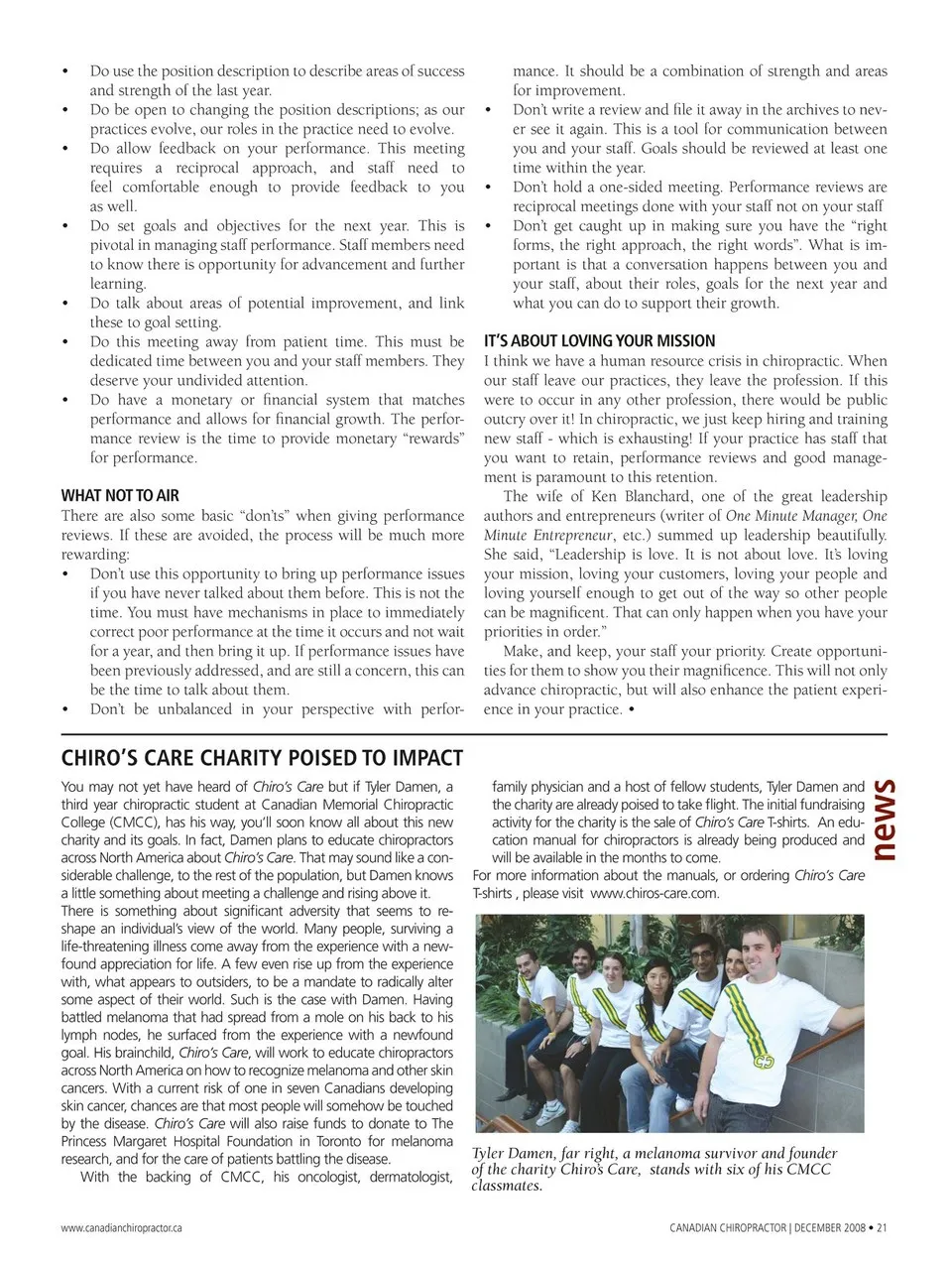
• Do use the position description to describe areas of success and strength of the last year. • Do be open to changing the position descriptions; as our practices evolve, our roles in the practice need to evolve. • Do allow feedback on your performance. This meeting requires a reciprocal approach, and staff need to feel comfortable enough to provide feedback to you as well. • Do set goals and objectives for the next year. This is pivotal in managing staff performance. Staff members need to know there is opportunity for advancement and further learning. • Do talk about areas of potential improvement, and link these to goal setting. • Do this meeting away from patient time. This must be dedicated time between you and your staff members. They deserve your undivided attention. • Do have a monetary or fi nancial system that matches performance and allows for fi nancial growth. The perfor- mance review is the time to provide monetary “rewards” for performance. WHAT NOT TOAIR There are also some basic “don’ts” when giving performance reviews. If these are avoided, the process will be much more rewarding: • Don’t use this opportunity to bring up performance issues if you have never talked about them before. This is not the time. You must have mechanisms in place to immediately correct poor performance at the time it occurs and not wait for a year, and then bring it up. If performance issues have been previously addressed, and are still a concern, this can be the time to talk about them. • Don’t be unbalanced in your perspective with perfor- CHIRO’S CARE CHARITY POISED TO IMPACT You may not yet have heard of Chiro’s Care but if Tyler Damen, a third year chiropractic student at Canadian Memorial Chiropractic College (CMCC), has his way, you’ll soon know all about this new charity and its goals. In fact, Damen plans to educate chiropractors across North America about Chiro’s Care. That may sound like a con- siderable challenge, to the rest of the population, but Damen knows a little something about meeting a challenge and rising above it. There is something about signifi cant adversity that seems to re- shape an individual’s view of the world. Many people, surviving a life-threatening illness come away from the experience with a new- found appreciation for life. A few even rise up from the experience with, what appears to outsiders, to be a mandate to radically alter some aspect of their world. Such is the case with Damen. Having battled melanoma that had spread from a mole on his back to his lymph nodes, he surfaced from the experience with a newfound goal. His brainchild, Chiro’s Care, will work to educate chiropractors across North America on how to recognize melanoma and other skin cancers. With a current risk of one in seven Canadians developing skin cancer, chances are that most people will somehow be touched by the disease. Chiro’s Care will also raise funds to donate to The Princess Margaret Hospital Foundation in Toronto for melanoma research, and for the care of patients battling the disease. With the backing of CMCC, his oncologist, dermatologist, www.canadianchiropractor.ca family physician and a host of fellow students, Tyler Damen and the charity are already poised to take fl ight. The initial fundraising activity for the charity is the sale of Chiro’s Care T-shirts. An edu- cation manual for chiropractors is already being produced and will be available in the months to come. For more information about the manuals, or ordering Chiro’s Care T-shirts , please visit www.chiros-care.com. mance. It should be a combination of strength and areas for improvement. • Don’t write a review and fi le it away in the archives to nev- er see it again. This is a tool for communication between you and your staff. Goals should be reviewed at least one time within the year. • Don’t hold a one-sided meeting. Performance reviews are reciprocal meetings done with your staff not on your staff • Don’t get caught up in making sure you have the “right forms, the right approach, the right words”. What is im- portant is that a conversation happens between you and your staff, about their roles, goals for the next year and what you can do to support their growth. IT’S ABOUT LOVING YOUR MISSION I think we have a human resource crisis in chiropractic. When our staff leave our practices, they leave the profession. If this were to occur in any other profession, there would be public outcry over it! In chiropractic, we just keep hiring and training new staff - which is exhausting! If your practice has staff that you want to retain, performance reviews and good manage- ment is paramount to this retention. The wife of Ken Blanchard, one of the great leadership authors and entrepreneurs (writer of One Minute Manager, One Minute Entrepreneur, etc.) summed up leadership beautifully. She said, “Leadership is love. It is not about love. It’s loving your mission, loving your customers, loving your people and loving yourself enough to get out of the way so other people can be magnifi cent. That can only happen when you have your priorities in order.” Make, and keep, your staff your priority. Create opportuni- ties for them to show you their magnifi cence. This will not only advance chiropractic, but will also enhance the patient experi- ence in your practice. • Tyler Damen, far right, a melanoma survivor and founder of the charity Chiro’s Care, stands with six of his CMCC classmates. CANADIAN CHIROPRACTOR | DECEMBER 2008 • 21 news
Chiropractic + Naturopathic Doctor December 08: Page 21