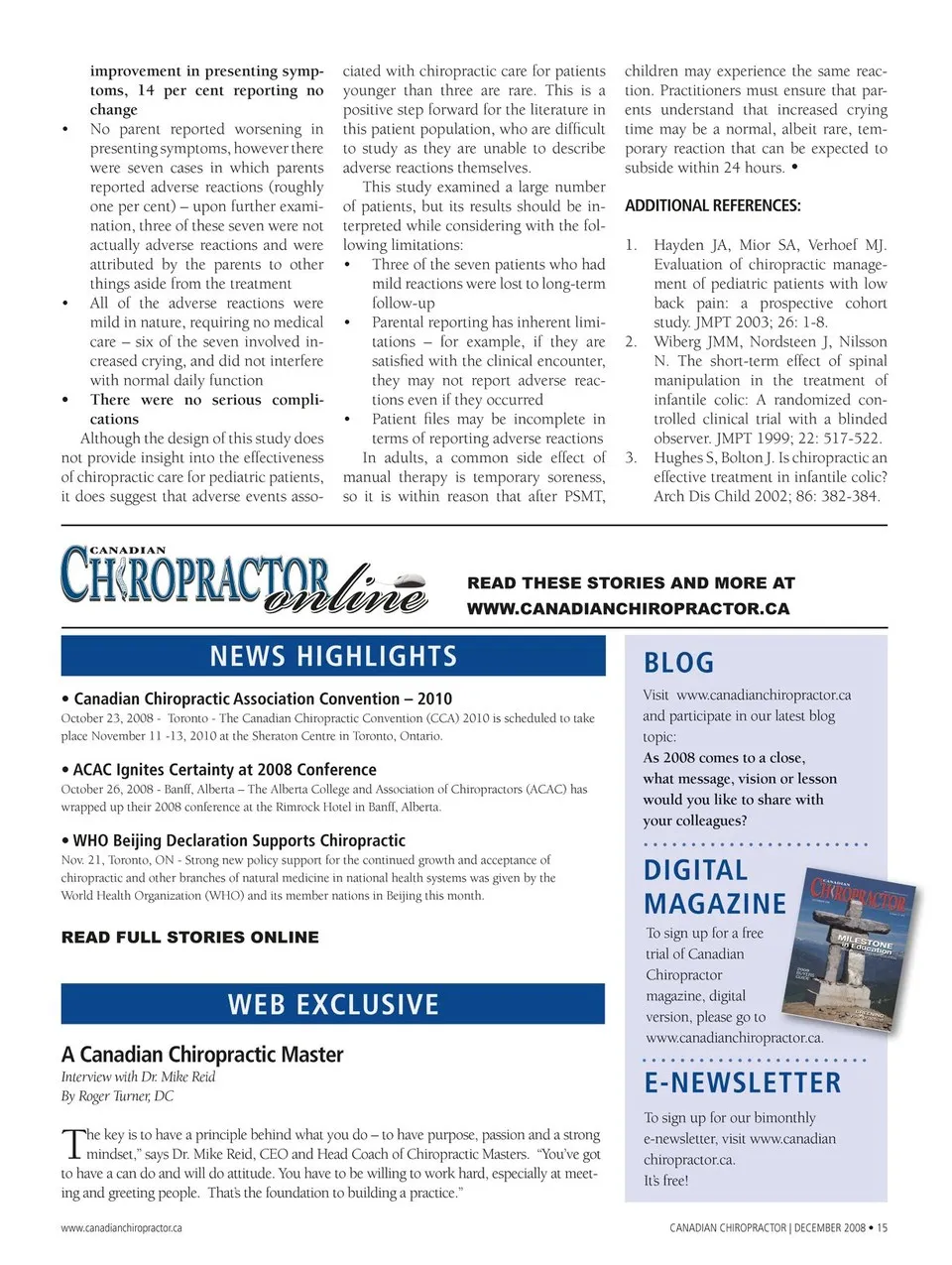
SMT for Children – Are There Adverse Effects? Study Title: Adverse effects of spinal manipulative therapy in children younger than three years: a retrospective study in a chiropractic teaching clinic. Author(s): Miller JE, Benfield K Publication information: Journal of Manipulative and Physiological Therapeutics 2008; 31: 419-423. Summary: Below paramount. To date, very few serious incidents resulting from pediatric spinal manipula- tive therapy (PSMT) have been reported in the literature. The existing literature suggests that the risk of neurological or vertebrobasilar injury from PSMT is around 1 in 250 million manipulations. However, there have been no studies on a large cohort of these patients to more accurately assess such negative side effects. This study was a retrospective review of 781 pediatric cases (all under three years of M Dr. Shawn Thistle is the founder and president of Research Review Service Inc., an online, subscription- based service designed to help busy practitioners to integrate current, relevant scientific evidence into their practice. Shawn graduated from CMCC and holds an Hon- ours Degree in Kinesiology from McMaster University. He also holds a certificate in Contemporary Medi- cal Acupuncture from McMaster University, and is a Certified Active Release Techniques (ART®) Pro- vider. For more information about the Research Review Service, visit www.researchreviewservice.com. age) presenting to the Anglo-European College of Chiropractic teaching clinic between January 2002 and December 2004. There were no exclusion criteria. Information from each fi le was extracted by recording the number of treatments received, the type of treatment administered, the outcome of treatment, and any negative or adverse events. The type of treatment was categorized as follows: • PSMT to more than one spinal region or pelvis • PSMT to the cervical, thoracic, or lumbar spine, respectively • PSMT to the pelvis • Occipital-sacral decompression technique • Upper extremity treatment • Lower extremity treatment • Massage and soft tissue work • “Other” – if a treatment did not fi t into one of the above categories (the most common here was instrument treatment) Treatment outcomes were measured by parent report of symptom change (improve- ment, no change, or worsening). Negative side effects were interpreted from parent com- ments, and were defi ned as any adverse reaction that was mild (transient and lasting less than 24 hours), moderate (requiring general practitioner/medical intervention), or severe (requiring hospitalization). PERTINENT RESULTS OF THIS STUDY INCLUDE: • 697 patients (59 per cent male) underwent 5242 treatments • The majority of patients (73 per cent) were 12 weeks of age or younger • Most infants presented treatment of colic or irritability because of biomechanical disorder, often attributed to birth trauma • 89 per cent received treatment, while 11 per cent were referred for other types of care • Common treatment types: 77 per cent received PSMT to the full spine, seven per cent occipital-sacral decompression, and six per cent PSMT to the cervical- spine only • 99 per cent reported an outcome of care – most (85 per cent) reporting an 14 • CANADIAN CHIROPRACTOR | DECEMBER 2008 www.canadianchiropractor.ca any manual therapists treat pediatric patients with increasing regularity, and there is some evidence that chiropractic care can benefi t pediatric patients1,2,3 As with patients of any age, the risk-benefi t ratio of treatment interventions is . Shawn Thistle, BKin (Hons), DC, CSCS
Chiropractic + Naturopathic Doctor December 08: Page 14