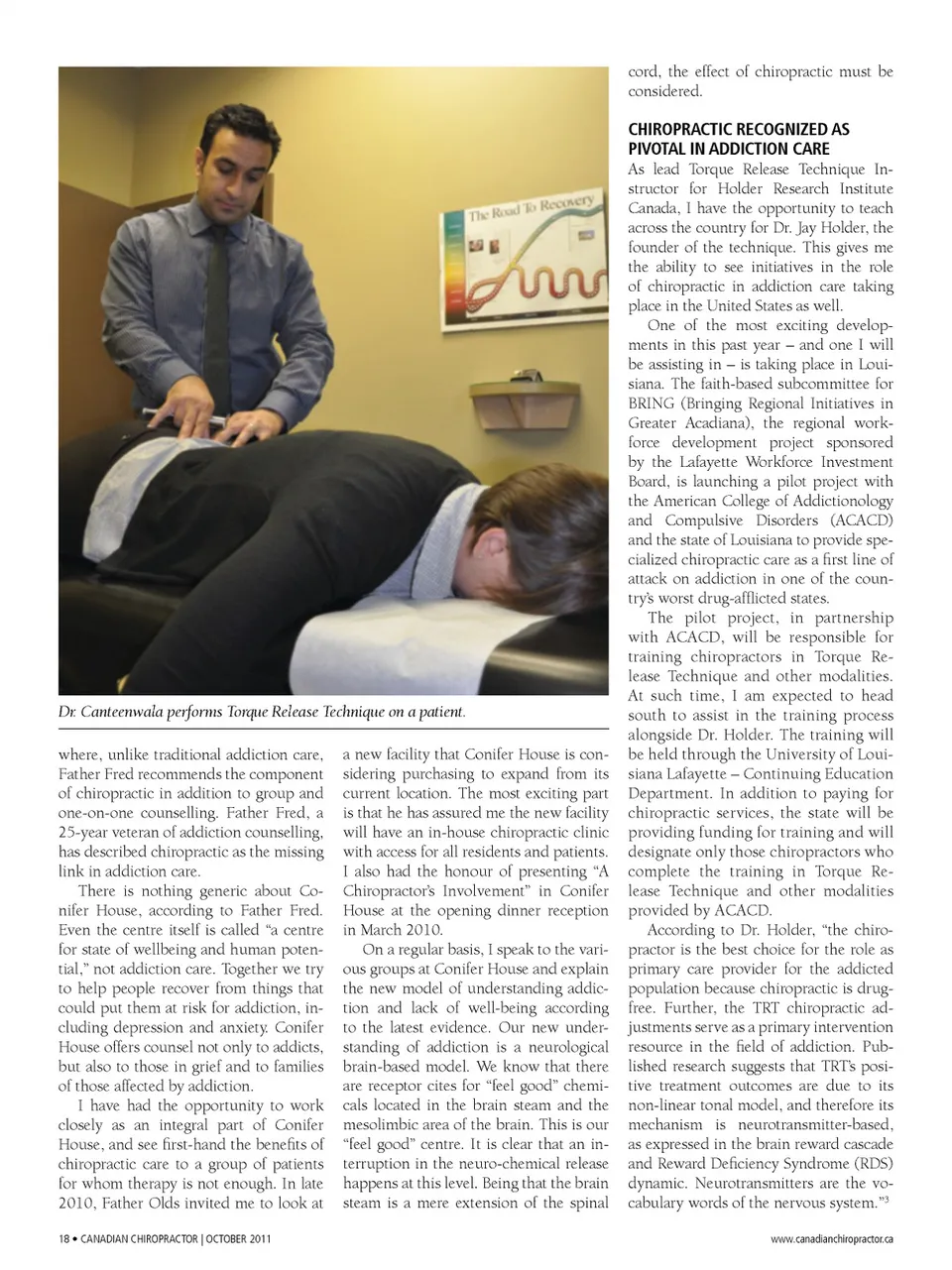
cord, the effect of chiropractic must be considered. Dr. Canteenwala performs Torque Release Technique on a patient. where, unlike traditional addiction care, Father Fred recommends the component of chiropractic in addition to group and one-on-one counselling. Father Fred, a 25-year veteran of addiction counselling, has described chiropractic as the missing link in addiction care. There is nothing generic about Co-nifer House, according to Father Fred. Even the centre itself is called “a centre for state of wellbeing and human poten-tial,” not addiction care. Together we try to help people recover from things that could put them at risk for addiction, in-cluding depression and anxiety. Conifer House offers counsel not only to addicts, but also to those in grief and to families of those affected by addiction. I have had the opportunity to work closely as an integral part of Conifer House, and see first-hand the benefits of chiropractic care to a group of patients for whom therapy is not enough. In late 2010, Father Olds invited me to look at 18 • Canadian ChiropraCtor | oCtoBEr 2011 a new facility that Conifer House is con-sidering purchasing to expand from its current location. The most exciting part is that he has assured me the new facility will have an in-house chiropractic clinic with access for all residents and patients. I also had the honour of presenting “A Chiropractor’s Involvement” in Conifer House at the opening dinner reception in March 2010. On a regular basis, I speak to the vari-ous groups at Conifer House and explain the new model of understanding addic-tion and lack of well-being according to the latest evidence. Our new under-standing of addiction is a neurological brain-based model. We know that there are receptor cites for “feel good” chemi-cals located in the brain steam and the mesolimbic area of the brain. This is our “feel good” centre. It is clear that an in-terruption in the neuro-chemical release happens at this level. Being that the brain steam is a mere extension of the spinal CHIROpRACTIC RECOGNIZED AS pIVOTAL IN ADDICTION CARE As lead Torque Release Technique In-structor for Holder Research Institute Canada, I have the opportunity to teach across the country for Dr. Jay Holder, the founder of the technique. This gives me the ability to see initiatives in the role of chiropractic in addiction care taking place in the United States as well. One of the most exciting develop-ments in this past year – and one I will be assisting in – is taking place in Loui-siana. The faith-based subcommittee for BRING (Bringing Regional Initiatives in Greater Acadiana), the regional work-force development project sponsored by the Lafayette Workforce Investment Board, is launching a pilot project with the American College of Addictionology and Compulsive Disorders (ACACD) and the state of Louisiana to provide spe-cialized chiropractic care as a first line of attack on addiction in one of the coun-try’s worst drug-afflicted states. The pilot project, in partnership with ACACD, will be responsible for training chiropractors in Torque Re-lease Technique and other modalities. At such time, I am expected to head south to assist in the training process alongside Dr. Holder. The training will be held through the University of Loui-siana Lafayette – Continuing Education Department. In addition to paying for chiropractic services, the state will be providing funding for training and will designate only those chiropractors who complete the training in Torque Re-lease Technique and other modalities provided by ACACD. According to Dr. Holder, “the chiro-practor is the best choice for the role as primary care provider for the addicted population because chiropractic is drug-free. Further, the TRT chiropractic ad-justments serve as a primary intervention resource in the field of addiction. Pub-lished research suggests that TRT’s posi-tive treatment outcomes are due to its non-linear tonal model, and therefore its mechanism is neurotransmitter-based, as expressed in the brain reward cascade and Reward Deficiency Syndrome (RDS) dynamic. Neurotransmitters are the vo-cabulary words of the nervous system.” 3 www.canadianchiropractor.ca
Chiropractic + Naturopathic Doctor October 2011: Page 18