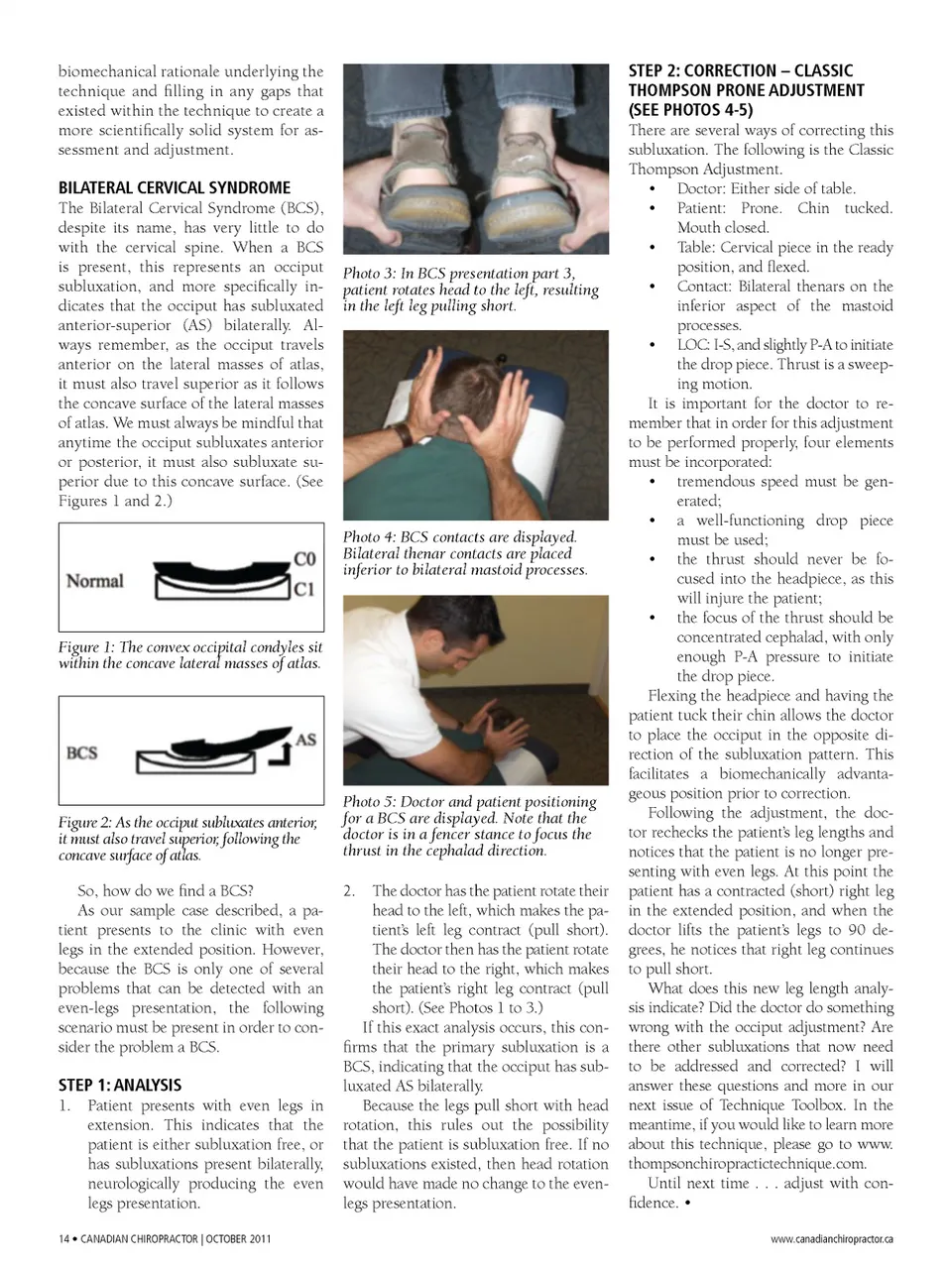
biomechanical rationale underlying the technique and filling in any gaps that existed within the technique to create a more scientifically solid system for as-sessment and adjustment. BILATERAL CERVICAL SYNDROME The Bilateral Cervical Syndrome (BCS), despite its name, has very little to do with the cervical spine. When a BCS is present, this represents an occiput subluxation, and more specifically in-dicates that the occiput has subluxated anterior-superior (AS) bilaterally. Al-ways remember, as the occiput travels anterior on the lateral masses of atlas, it must also travel superior as it follows the concave surface of the lateral masses of atlas. We must always be mindful that anytime the occiput subluxates anterior or posterior, it must also subluxate su-perior due to this concave surface. (See Figures 1 and 2.) Photo 3: In BCS presentation part 3, patient rotates head to the left, resulting in the left leg pulling short. Photo 4: BCS contacts are displayed. Bilateral thenar contacts are placed inferior to bilateral mastoid processes. Figure 1: The convex occipital condyles sit within the concave lateral masses of atlas. Figure 2: As the occiput subluxates anterior, it must also travel superior, following the concave surface of atlas. So, how do we find a BCS? As our sample case described, a pa-tient presents to the clinic with even legs in the extended position. However, because the BCS is only one of several problems that can be detected with an even-legs presentation, the following scenario must be present in order to con-sider the problem a BCS. Photo 5: Doctor and patient positioning for a BCS are displayed. Note that the doctor is in a fencer stance to focus the thrust in the cephalad direction. 2. The doctor has the patient rotate their head to the left, which makes the pa-tient’s left leg contract (pull short). The doctor then has the patient rotate their head to the right, which makes the patient’s right leg contract (pull short). (See Photos 1 to 3.) If this exact analysis occurs, this con-firms that the primary subluxation is a BCS, indicating that the occiput has sub-luxated AS bilaterally. Because the legs pull short with head rotation, this rules out the possibility that the patient is subluxation free. If no subluxations existed, then head rotation would have made no change to the even-legs presentation. STEp 1: ANALYSIS 1. Patient presents with even legs in extension. This indicates that the patient is either subluxation free, or has subluxations present bilaterally, neurologically producing the even legs presentation. 14 • Canadian ChiropraCtor | oCtoBEr 2011 STEp 2: CORRECTION – CLASSIC THOMpSON pRONE ADjUSTMENT (SEE pHOTOS 4-5) There are several ways of correcting this subluxation. The following is the Classic Thompson Adjustment. • Doctor: Either side of table. • Patient: Prone. Chin tucked. Mouth closed. • Table: Cervical piece in the ready position, and flexed. • Contact: Bilateral thenars on the inferior aspect of the mastoid processes. • LOC: I-S, and slightly P-A to initiate the drop piece. Thrust is a sweep-ing motion. It is important for the doctor to re-member that in order for this adjustment to be performed properly, four elements must be incorporated: • tremendous speed must be gen-erated; • a well-functioning drop piece must be used; • the thrust should never be fo-cused into the headpiece, as this will injure the patient; • the focus of the thrust should be concentrated cephalad, with only enough P-A pressure to initiate the drop piece. Flexing the headpiece and having the patient tuck their chin allows the doctor to place the occiput in the opposite di-rection of the subluxation pattern. This facilitates a biomechanically advanta-geous position prior to correction. Following the adjustment, the doc-tor rechecks the patient’s leg lengths and notices that the patient is no longer pre-senting with even legs. At this point the patient has a contracted (short) right leg in the extended position, and when the doctor lifts the patient’s legs to 90 de-grees, he notices that right leg continues to pull short. What does this new leg length analy-sis indicate? Did the doctor do something wrong with the occiput adjustment? Are there other subluxations that now need to be addressed and corrected? I will answer these questions and more in our next issue of Technique Toolbox. In the meantime, if you would like to learn more about this technique, please go to www. thompsonchiropractictechnique.com. Until next time . . . adjust with con-fidence. • www.canadianchiropractor.ca
Chiropractic + Naturopathic Doctor October 2011: Page 14