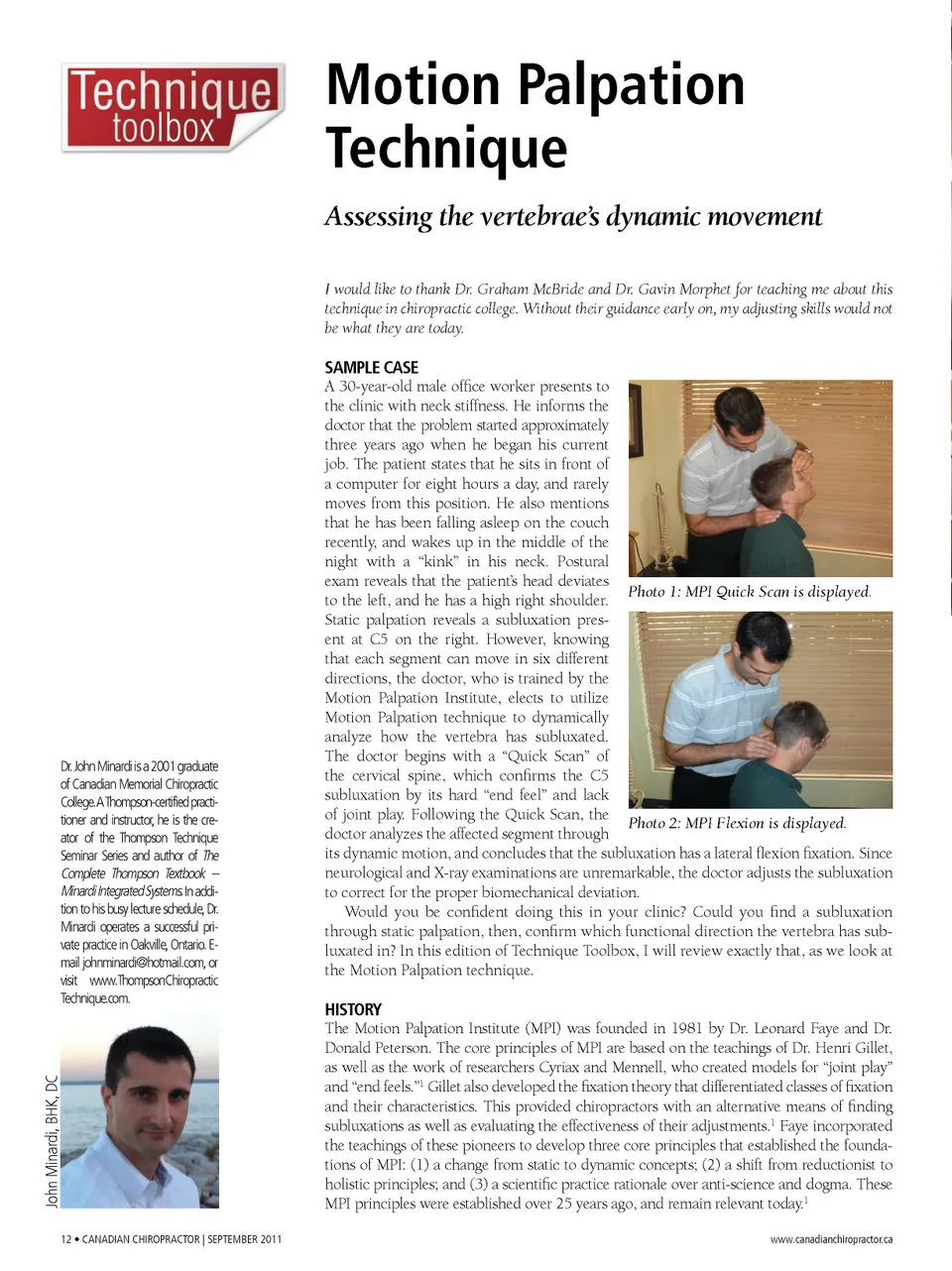
Motion Palpation Technique Assessing the vertebrae’s dynamic movement I would like to thank Dr. Graham McBride and Dr. Gavin Morphet for teaching me about this technique in chiropractic college. Without their guidance early on, my adjusting skills would not be what they are today. dr. John minardi is a 2001 graduate of Canadian memorial Chiropractic College. a thompson-certified practi-tioner and instructor, he is the cre-ator of the thompson technique Seminar Series and author of the Complete thompson textbook – minardi integrated Systems. in addi-tion to his busy lecture schedule, dr. minardi operates a successful pri-vate practice in oakville, ontario. e-mail [email protected], or visit www.thompsonChiropractic technique.com. SAMPLE CASE A 30-year-old male office worker presents to the clinic with neck stiffness. He informs the doctor that the problem started approximately three years ago when he began his current job. The patient states that he sits in front of a computer for eight hours a day, and rarely moves from this position. He also mentions that he has been falling asleep on the couch recently, and wakes up in the middle of the night with a “kink” in his neck. Postural exam reveals that the patient’s head deviates Photo 1: MPI Quick Scan is displayed. to the left, and he has a high right shoulder. Static palpation reveals a subluxation pres-ent at C5 on the right. However, knowing that each segment can move in six different directions, the doctor, who is trained by the Motion Palpation Institute, elects to utilize Motion Palpation technique to dynamically analyze how the vertebra has subluxated. The doctor begins with a “Quick Scan” of the cervical spine, which confirms the C5 subluxation by its hard “end feel” and lack of joint play. Following the Quick Scan, the Photo 2: MPI Flexion is displayed. doctor analyzes the affected segment through its dynamic motion, and concludes that the subluxation has a lateral flexion fixation. Since neurological and X-ray examinations are unremarkable, the doctor adjusts the subluxation to correct for the proper biomechanical deviation. Would you be confident doing this in your clinic? Could you find a subluxation through static palpation, then, confirm which functional direction the vertebra has sub-luxated in? In this edition of Technique Toolbox, I will review exactly that, as we look at the Motion Palpation technique. HISTORY The Motion Palpation Institute (MPI) was founded in 1981 by Dr. Leonard Faye and Dr. Donald Peterson. The core principles of MPI are based on the teachings of Dr. Henri Gillet, as well as the work of researchers Cyriax and Mennell, who created models for “joint play” and “end feels.” 1 Gillet also developed the fixation theory that differentiated classes of fixation and their characteristics. This provided chiropractors with an alternative means of finding subluxations as well as evaluating the effectiveness of their adjustments. 1 Faye incorporated the teachings of these pioneers to develop three core principles that established the founda-tions of MPI: (1) a change from static to dynamic concepts; (2) a shift from reductionist to holistic principles; and (3) a scientific practice rationale over anti-science and dogma. These MPI principles were established over 25 years ago, and remain relevant today. 1 www.canadianchiropractor.ca John minardi, bhK, dC 12 • Canadian ChiropraCtor | September 2011
Chiropractic + Naturopathic Doctor September 2011: Page 12