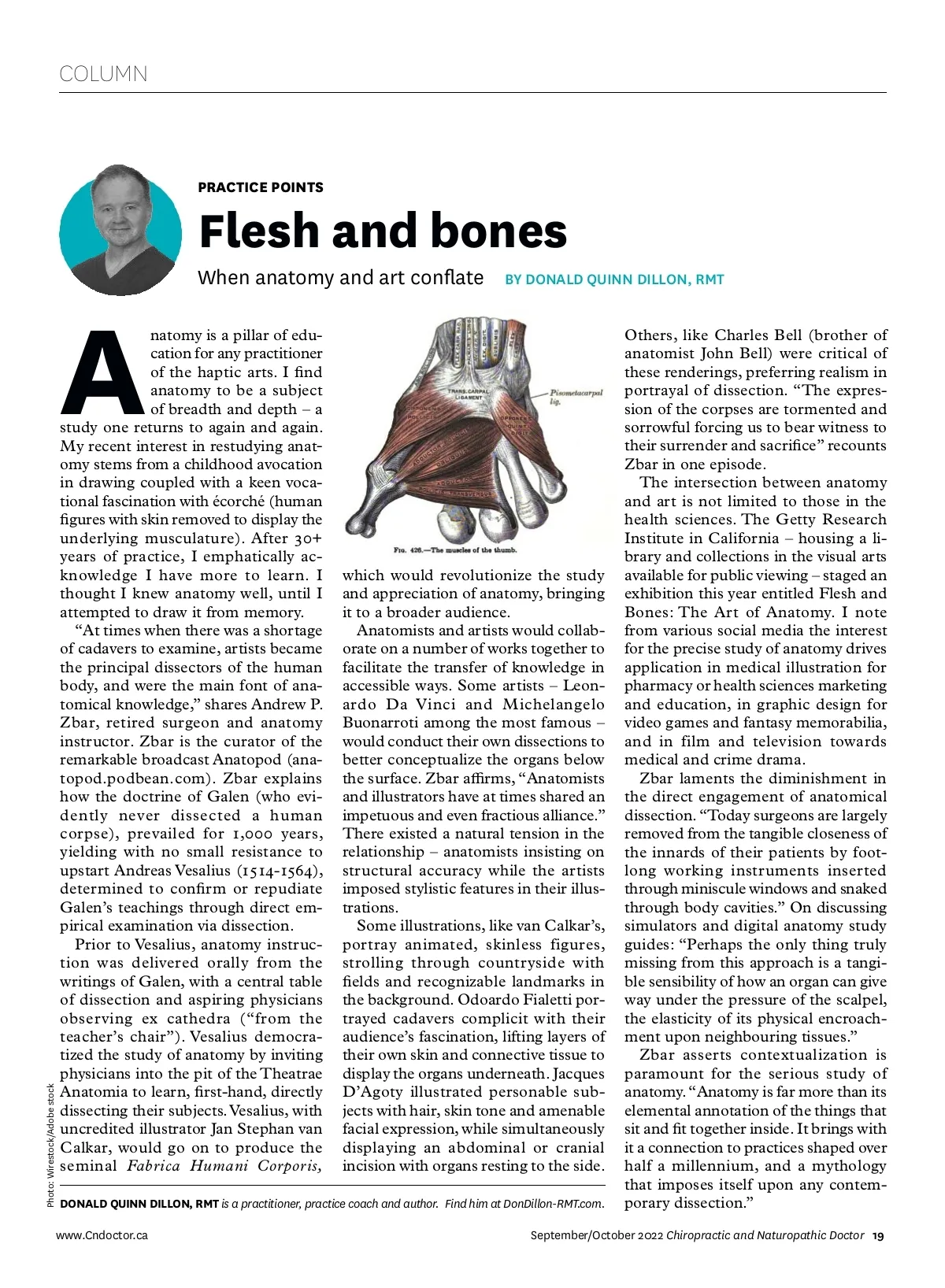
COLUMN PRACTICE POINTS Flesh and bones A When anatomy and art conflate BY DONALD QUINN DILLON, RMT Others, like Charles Bell (brother of anatomist John Bell) were critical of these renderings, preferring realism in portrayal of dissection. “The expres-sion of the corpses are tormented and sorrowful forcing us to bear witness to their surrender and sacrifice” recounts Zbar in one episode. The intersection between anatomy and art is not limited to those in the health sciences. The Getty Research Institute in California – housing a li-brary and collections in the visual arts available for public viewing – staged an exhibition this year entitled Flesh and Bones: The Art of Anatomy. I note from various social media the interest for the precise study of anatomy drives application in medical illustration for pharmacy or health sciences marketing and education, in graphic design for video games and fantasy memorabilia, and in film and television towards medical and crime drama. Zbar laments the diminishment in the direct engagement of anatomical dissection. “Today surgeons are largely removed from the tangible closeness of the innards of their patients by foot-long working instruments inserted through miniscule windows and snaked through body cavities.” On discussing simulators and digital anatomy study guides: “Perhaps the only thing truly missing from this approach is a tangi-ble sensibility of how an organ can give way under the pressure of the scalpel, the elasticity of its physical encroach-ment upon neighbouring tissues.” Zbar asserts contextualization is paramount for the serious study of anatomy. “Anatomy is far more than its elemental annotation of the things that sit and fit together inside. It brings with it a connection to practices shaped over half a millennium, and a mythology that imposes itself upon any contem-porary dissection.” Photo: Wirestock/Adobe stock natomy is a pillar of edu-cation for any practitioner of the haptic arts. I find anatomy to be a subject of breadth and depth – a study one returns to again and again. My recent interest in restudying anat-omy stems from a childhood avocation in drawing coupled with a keen voca-tional fascination with écorché (human figures with skin removed to display the underlying musculature). After 30+ years of practice, I emphatically ac-knowledge I have more to learn. I thought I knew anatomy well, until I attempted to draw it from memory. “At times when there was a shortage of cadavers to examine, artists became the principal dissectors of the human body, and were the main font of ana-tomical knowledge,” shares Andrew P. Zbar, retired surgeon and anatomy instructor. Zbar is the curator of the remarkable broadcast Anatopod (ana-topod.podbean.com). Zbar explains how the doctrine of Galen (who evi-dently never dissected a human corpse), prevailed for 1,000 years, yielding with no small resistance to upstart Andreas Vesalius (1514-1564), determined to confirm or repudiate Galen’s teachings through direct em-pirical examination via dissection. Prior to Vesalius, anatomy instruc-tion was delivered orally from the writings of Galen, with a central table of dissection and aspiring physicians observing ex cathedra (“from the teacher’s chair”). Vesalius democra-tized the study of anatomy by inviting physicians into the pit of the Theatrae Anatomia to learn, first-hand, directly dissecting their subjects. Vesalius, with uncredited illustrator Jan Stephan van Calkar, would go on to produce the seminal Fabrica Humani Corporis, which would revolutionize the study and appreciation of anatomy, bringing it to a broader audience. Anatomists and artists would collab-orate on a number of works together to facilitate the transfer of knowledge in accessible ways. Some artists – Leon-ardo Da Vinci and Michelangelo Buonarroti among the most famous – would conduct their own dissections to better conceptualize the organs below the surface. Zbar affirms, “Anatomists and illustrators have at times shared an impetuous and even fractious alliance.” There existed a natural tension in the relationship – anatomists insisting on structural accuracy while the artists imposed stylistic features in their illus-trations. Some illustrations, like van Calkar’s, portray animated, skinless figures, strolling through countryside with fields and recognizable landmarks in the background. Odoardo Fialetti por-trayed cadavers complicit with their audience’s fascination, lifting layers of their own skin and connective tissue to display the organs underneath. Jacques D’Agoty illustrated personable sub-jects with hair, skin tone and amenable facial expression, while simultaneously displaying an abdominal or cranial incision with organs resting to the side. DONALD QUINN DILLON, RMT is a practitioner, practice coach and author. Find him at DonDillon-RMT.com. www.Cndoctor.ca September/October 2022 Chiropractic and Naturopathic Doctor 19
Chiropractic + Naturopathic Doctor September/October 2022: Page 19