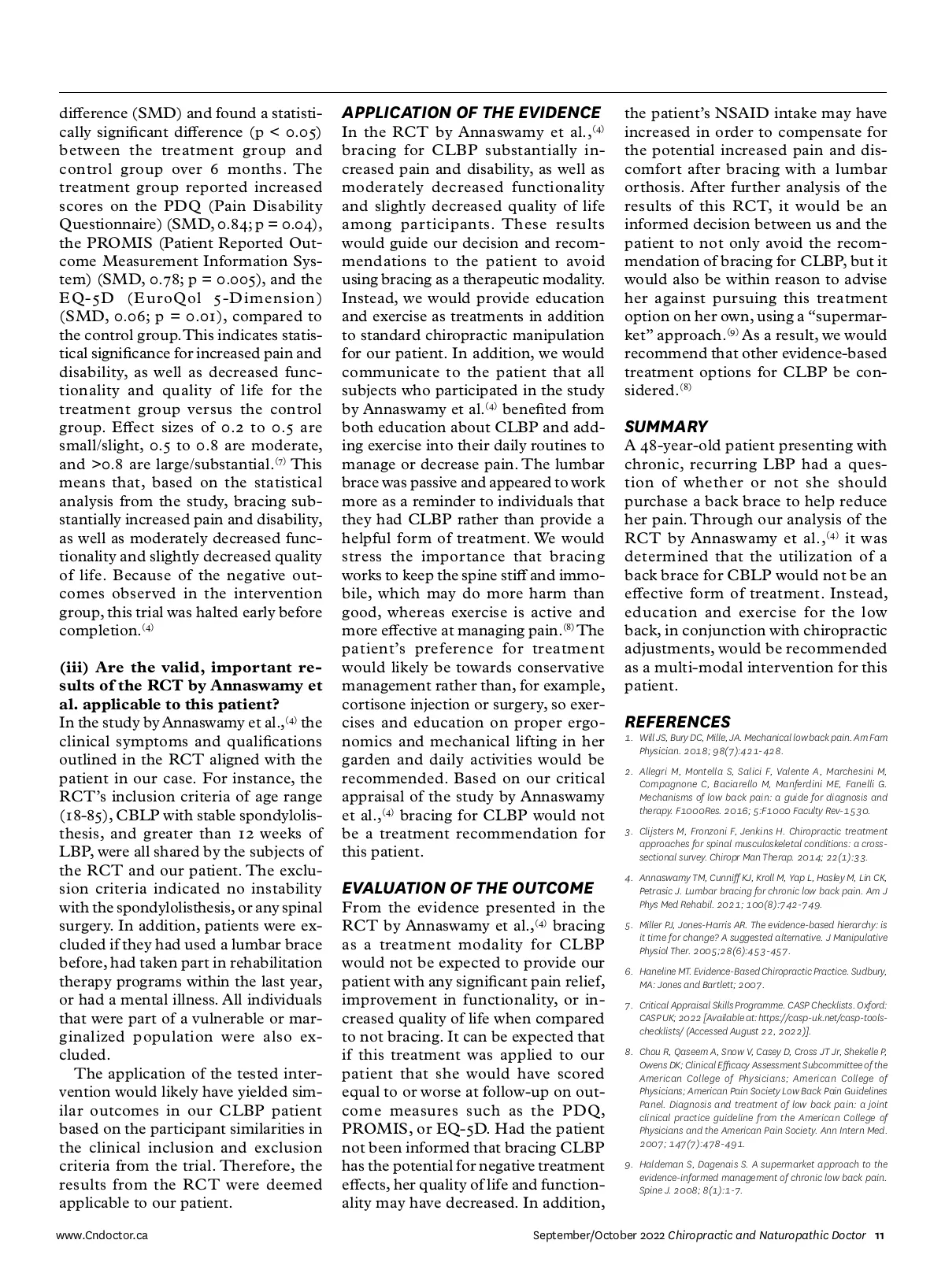
FEATURE CLINICAL QUESTION After being referred by her family phy-sician for chiropractic treatment, the patient in our case had inquired about whether or not to purchase a back brace to help with her CLBP. Her phy-sician had prescribed NSAIDs (Naproxen) and heat pad application, but these only provided mild relief. After analyzing the patient’s case his-tory and clinical presentation, we wanted to provide feedback for her on whether or not a back brace would be a good alternative treatment. To do this, we utilized the following clinical question: In a 48-year-old patient pre-senting with chronic, recurring LBP from lumbar facet joint syndrome and L4-5 grade I spondylolisthesis, is brac-ing the low back a more effective form of treatment compared to not bracing at reducing pain? P (Patient) = 48-year-old female with chronic, recurring LBP from lumbar facet joint syndrome and L4-5 grade I spondylolisthesis I (Intervention) = Bracing C (Comparison) = No bracing O (Outcome) = Reduction in pain A randomized controlled trial (RCT) is the second highest level of evidence for evaluating therapeutic modalities (5,6) (Figure 1). The database that was used in our search was through the National Library of Medicine (Pu-bMed). Since the topic of interest was about bracing and CLBP, the search terms that were used were ‘chronic low back pain’ and ‘bracing,’ initially using the Boolean term ‘AND.’ As this yielded 74 articles, we decided that additional inclusion and exclusion criteria were needed. We filtered our search to ‘human trials,’ published within the past ‘five years’; thus, articles older than five years were excluded. The age range of patients was filtered to between ‘18 and 85 years.’ All articles with children were excluded. In addi-tion to these criteria, studies had to include patients with uncomplicated CLBP, so any articles that included CLBP with radiculopathy, or had symptomatic scoliosis were not se-lected. We defined CLBP as LBP that lasted greater than 12 weeks. We also searched for systematic reviews, which would have been a higher level of research evidence than a single RCT, but none were available. Our final search yielded seven articles that were specific to our PICO question. The article chosen was an RCT from 2021 on lumbar bracing for CLBP by Annaswamy et al. (4) RCTs are the most appropriate study design for research on therapeutic modalities, such as lumbar bracing for CLBP, and is ulti-mately why we chose this article, in addition to the relevance and similari-ties between the RCT and our clinical case. STUDY DESIGNS (IN DECREASING ORDER OF EVIDENCE STRENGTH): 1. Systematic reviews and meta-analyses 2. Randomized controlled trials 3. Cohort studies 4. Case-control studies 5. Case series 6. Case reports 7. Editorials and expert opinion 8. Animal research and laboratory studies Figure 1. Hierarchy of quantitative research evidence (adapted from Haneline [6] ). Prior to utilizing lumbar bracing on our patient as a therapeutic modality, the article by Annaswamy et al. (4) was ana-lyzed using the Critical Appraisal Skills Program (CASP) for RCTs. (7) This article was appraised with regard to its validity, importance and applicability to whether or not bracing for CLBP would be a viable treatment plan for our patient. (i) Are the results of the RCT by Annaswamy et al. valid? The article by Annaswamy et al. (4) was an RCT that analyzed the effectiveness of back bracing as a treatment for pa-tients with CLBP. The study’s main objective was to analyze if there was a beneficial effect of bracing uncompli-cated CLBP in individuals with stable degenerative spondylolisthesis. The other objective was to see if there were additional symptomatic benefits to bracing CLBP in conjunction with ex-ercise and education of lumbar stabili-zation training. The study clearly fo-cused on these objectives and incorporated a specific population based on the study’s inclusion and ex-clusion criteria. The same intervention was given to all participants, with the exception of a semi-rigid back brace, the Horizon 627 one-size adjustable lumbar orthosis back brace, (4) which was also given to participants in the treatment group. All participants were randomized into either a control or treatment group using a computer-generated numbering system, numbered 1-120, to help elimi-nate systematic (confounding) bias. Although some participants dropped out before the end of the study, the reasons they discontinued the trial were CRITICAL EVALUATION OF THE EVIDENCE LITERATURE SEARCH unremarkable (e.g., time constraints, non-compliance) and accounted for. An intention-to-treat analysis was also per-formed. The treatment intervention was pragmatic because each participant in the trial was managed in a way that was similar to how they would be managed as if being treated in a chiropractic or other clinical office setting. Moreover, the treatment intervention was com-pared to usual practice (i.e., education and exercises) rather than to a placebo, and patients in the intervention group were also instructed to wear the brace as needed for symptom relief. Partici-pants and clinicians were not blinded in this study due to the nature of the inter-vention being provided (i.e., a back brace is a visibly obvious intervention). Nevertheless, based on the uniform intervention, control of systematic bias, and a clear concise research question, we deemed the study valid. (ii) Are the valid results of the RCT by Annaswamy et al. important? The valid results of this study are im-portant, in terms of the negative differ-ences at follow-up in patient-reported outcomes between the control and experimental groups. Descriptive sta-tistics were used to analyze the baseline sociodemographic characteristics of all study participants, and outcome meas-ures were collected at baseline, 6-week, 12-week and six-month time points in both the control and experimental groups. Both groups had similar socio-demographic and clinical characteris-tics at baseline. The study measured the differences in outcomes at fol-low-up as the standardized mean www.Cndoctor.ca 10 Chiropractic and Naturopathic Doctor September/October 2022
Chiropractic + Naturopathic Doctor September/October 2022: Page 10