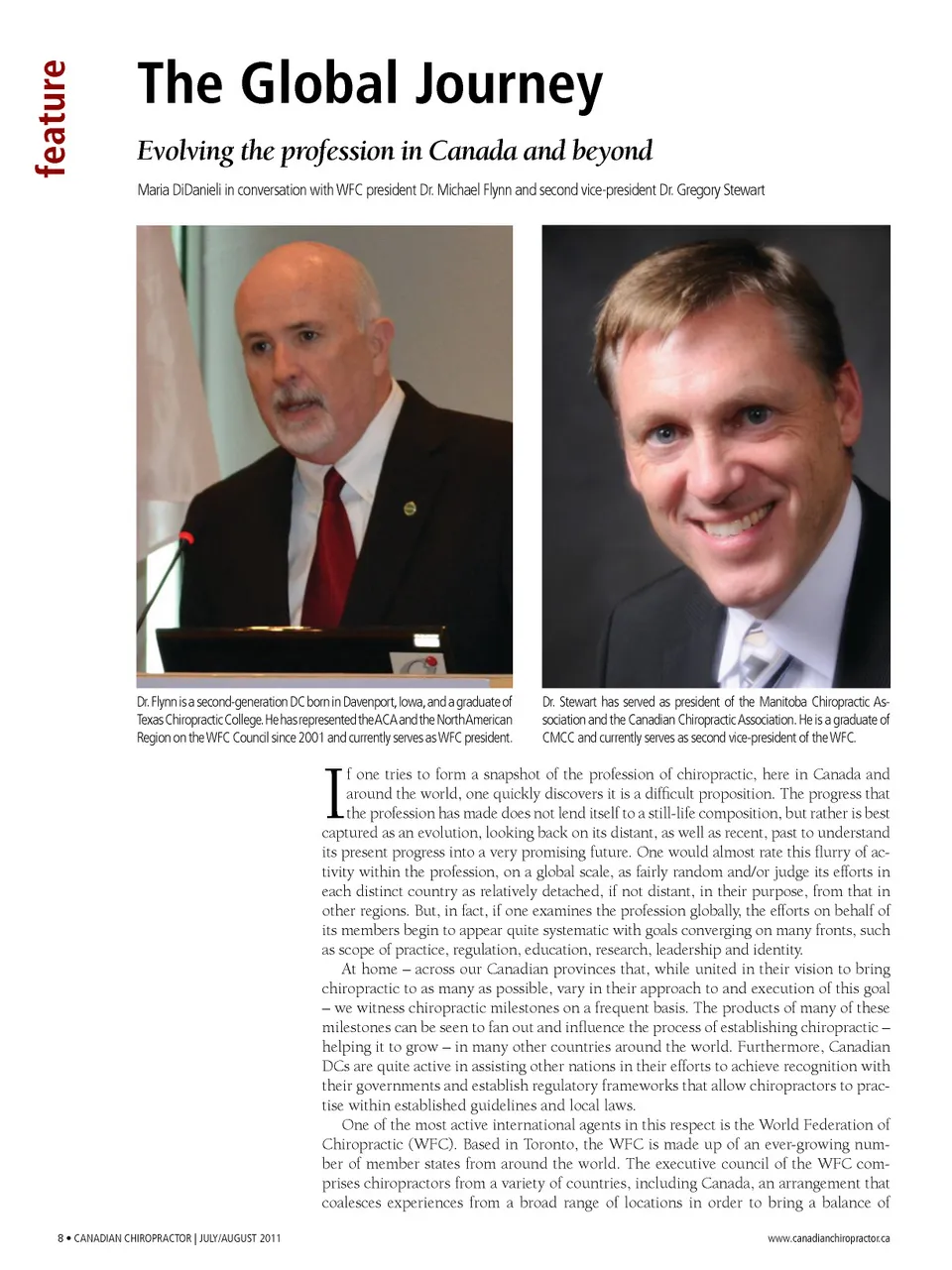
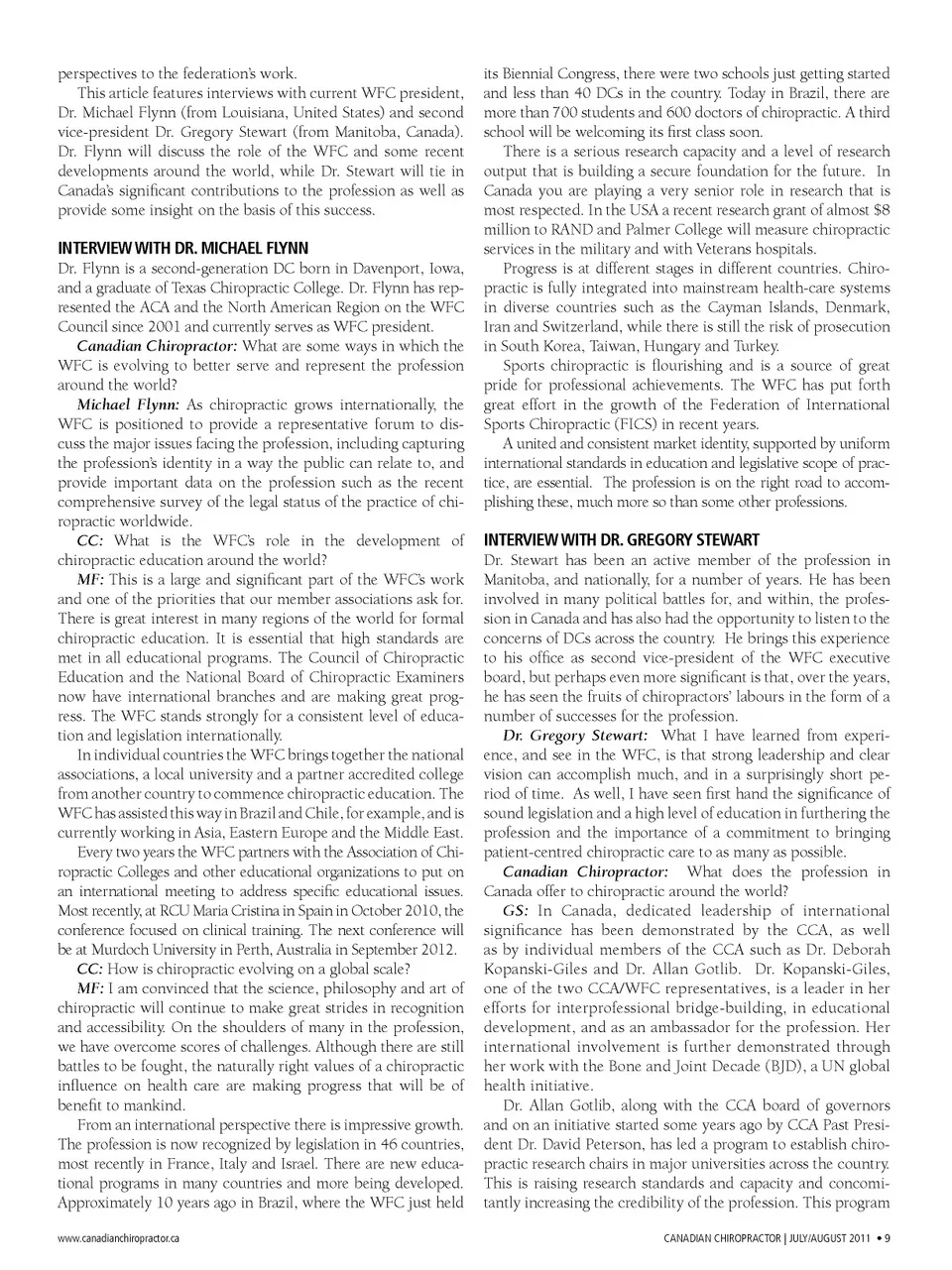
perspectives to the federation’s work. This article features interviews with current WFC president, Dr. Michael Flynn (from Louisiana, United States) and second vice-president Dr. Gregory Stewart (from Manitoba, Canada). Dr. Flynn will discuss the role of the WFC and some recent developments around the world, while Dr. Stewart will tie in Canada’s significant contributions to the profession as well as provide some insight on the basis of this success. INTERVIEW WITH DR. MICHAEL FLYNN Dr. Flynn is a second-generation DC born in Davenport, Iowa, and a graduate of Texas Chiropractic College. Dr. Flynn has rep-resented the ACA and the North American Region on the WFC Council since 2001 and currently serves as WFC president. Canadian Chiropractor: What are some ways in which the WFC is evolving to better serve and represent the profession around the world? Michael Flynn: As chiropractic grows internationally, the WFC is positioned to provide a representative forum to dis-cuss the major issues facing the profession, including capturing the profession’s identity in a way the public can relate to, and provide important data on the profession such as the recent comprehensive survey of the legal status of the practice of chi-ropractic worldwide. CC: What is the WFC’s role in the development of chiropractic education around the world? MF: This is a large and significant part of the WFC’s work and one of the priorities that our member associations ask for. There is great interest in many regions of the world for formal chiropractic education. It is essential that high standards are met in all educational programs. The Council of Chiropractic Education and the National Board of Chiropractic Examiners now have international branches and are making great prog-ress. The WFC stands strongly for a consistent level of educa-tion and legislation internationally. In individual countries the WFC brings together the national associations, a local university and a partner accredited college from another country to commence chiropractic education. The WFC has assisted this way in Brazil and Chile, for example, and is currently working in Asia, Eastern Europe and the Middle East. Every two years the WFC partners with the Association of Chi-ropractic Colleges and other educational organizations to put on an international meeting to address specific educational issues. Most recently, at RCU Maria Cristina in Spain in October 2010, the conference focused on clinical training. The next conference will be at Murdoch University in Perth, Australia in September 2012. CC: How is chiropractic evolving on a global scale? MF: I am convinced that the science, philosophy and art of chiropractic will continue to make great strides in recognition and accessibility. On the shoulders of many in the profession, we have overcome scores of challenges. Although there are still battles to be fought, the naturally right values of a chiropractic influence on health care are making progress that will be of benefit to mankind. From an international perspective there is impressive growth. The profession is now recognized by legislation in 46 countries, most recently in France, Italy and Israel. There are new educa-tional programs in many countries and more being developed. Approximately 10 years ago in Brazil, where the WFC just held www.canadianchiropractor.ca its Biennial Congress, there were two schools just getting started and less than 40 DCs in the country. Today in Brazil, there are more than 700 students and 600 doctors of chiropractic. A third school will be welcoming its first class soon. There is a serious research capacity and a level of research output that is building a secure foundation for the future. In Canada you are playing a very senior role in research that is most respected. In the USA a recent research grant of almost $8 million to RAND and Palmer College will measure chiropractic services in the military and with Veterans hospitals. Progress is at different stages in different countries. Chiro-practic is fully integrated into mainstream health-care systems in diverse countries such as the Cayman Islands, Denmark, Iran and Switzerland, while there is still the risk of prosecution in South Korea, Taiwan, Hungary and Turkey. Sports chiropractic is flourishing and is a source of great pride for professional achievements. The WFC has put forth great effort in the growth of the Federation of International Sports Chiropractic (FICS) in recent years. A united and consistent market identity, supported by uniform international standards in education and legislative scope of prac-tice, are essential. The profession is on the right road to accom-plishing these, much more so than some other professions. INTERVIEW WITH DR. GREGORY STEWART Dr. Stewart has been an active member of the profession in Manitoba, and nationally, for a number of years. He has been involved in many political battles for, and within, the profes-sion in Canada and has also had the opportunity to listen to the concerns of DCs across the country. He brings this experience to his office as second vice-president of the WFC executive board, but perhaps even more significant is that, over the years, he has seen the fruits of chiropractors’ labours in the form of a number of successes for the profession. Dr. Gregory Stewart: What I have learned from experi-ence, and see in the WFC, is that strong leadership and clear vision can accomplish much, and in a surprisingly short pe-riod of time. As well, I have seen first hand the significance of sound legislation and a high level of education in furthering the profession and the importance of a commitment to bringing patient-centred chiropractic care to as many as possible. Canadian Chiropractor: What does the profession in Canada offer to chiropractic around the world? GS: In Canada, dedicated leadership of international significance has been demonstrated by the CCA, as well as by individual members of the CCA such as Dr. Deborah Kopanski-Giles and Dr. Allan Gotlib. Dr. Kopanski-Giles, one of the two CCA/WFC representatives, is a leader in her efforts for interprofessional bridge-building, in educational development, and as an ambassador for the profession. Her international involvement is further demonstrated through her work with the Bone and Joint Decade (BJD), a UN global health initiative. Dr. Allan Gotlib, along with the CCA board of governors and on an initiative started some years ago by CCA Past Presi-dent Dr. David Peterson, has led a program to establish chiro-practic research chairs in major universities across the country. This is raising research standards and capacity and concomi-tantly increasing the credibility of the profession. This program Canadian ChiropraCtor | JULY/AUGUST 2011 • 9
Chiropractic + Naturopathic Doctor July/August 2011: Page 9