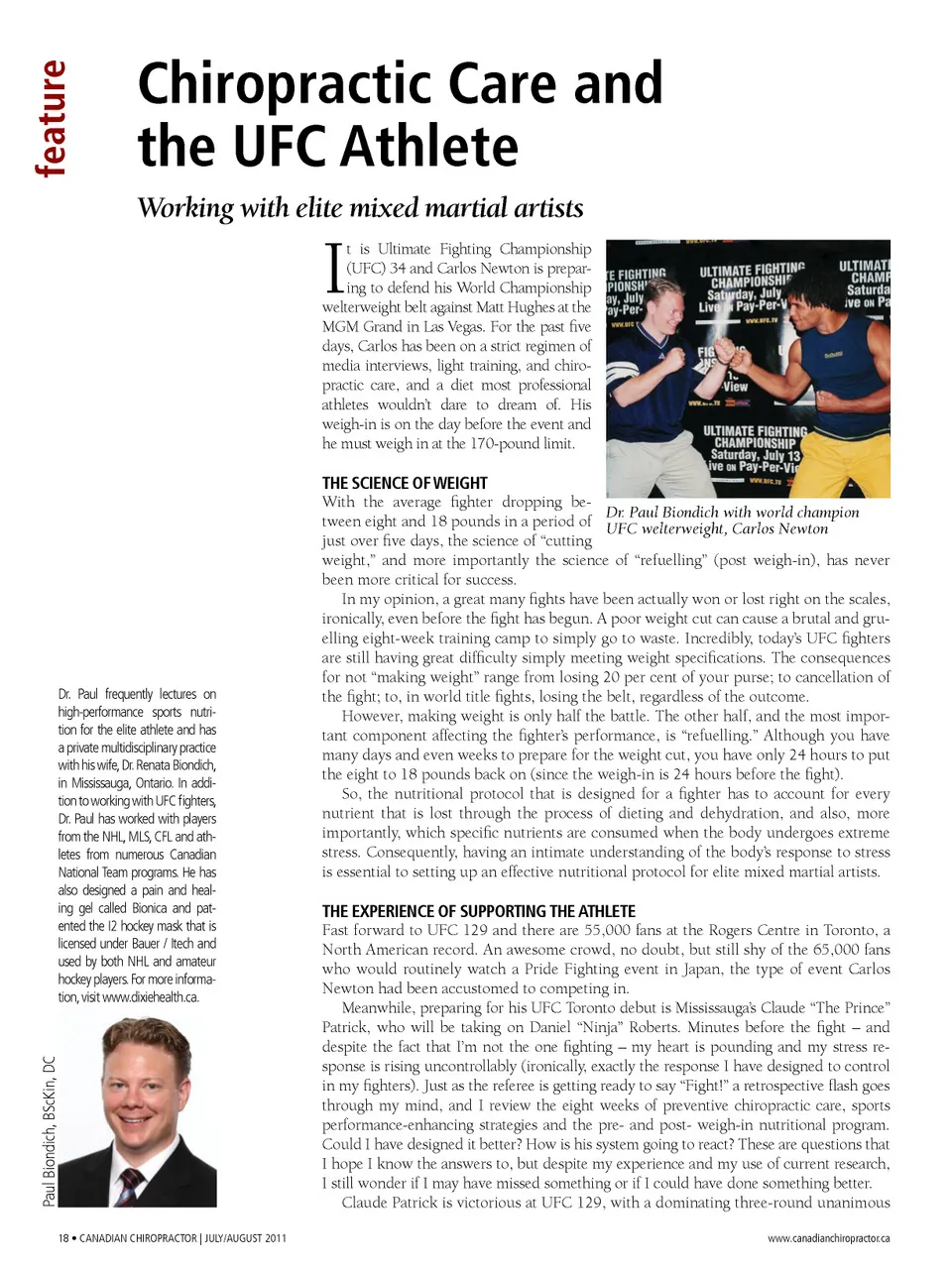
decision. Claude states that it’s the best he’s ever felt during a fight. It appears that all of the sports performance strat-egies (eight weeks of preventive care, a custom sports nutritional / supplemental program, weight-cutting strategies, post-weigh-in refuelling strategies and day-of-fight nutrition) were a success. The strategies were considered a triumph not because he won (that definitely helps, of course), but because every human per-formance system demonstrated a signifi-cant improvement over his last fight. Working with mixed martial artists (MMAs) is an incredibly exhilarating expe-rience that can come with a very sharp dou-ble-edged sword. When your athlete wins, this can put you on a professional and per-sonal high. But when he loses, it can be not only personally difficult, but also profes-sionally challenging. Rumours can start (of-ten not connected to your camp) that if you introduced new elements into the regimen too soon, and the fighter did not respond well, they – and, by extension you – were to blame for the athlete’s poor performance. There are many examples of fighters firing their entire camp after a poor performance. So, if you are interested in entering the world of mixed martial arts, be prepared for the potential highs and lows. The best way to protect yourself from this double-edged, serrated sword is to cre-ate a Kevlar suit. The strength of this Kevlar suit comes from a combination of experi-ence, your knowledge base and avoiding the deep traps that the sports nutrition industry often can create. The sports nu-trition industry spends literally billions of dollars per year brainwashing the consum-er and athlete into believing that its latest product can produce superhuman results; in fact, this is rarely the case. So, be careful not to get caught up in the hype, as you might not last longer in this field than the next sports nutrition fad does. Having said that, there is a place for sports nutrition products for the elite athlete – however, the practitioner must take the time to un-derstand the role of each product and what the actual sport performance outcomes are. This is easier said than done. ROLE OF THE CHIROPRACTOR Often it is the fighter with the least number of injuries going into the fight who has the best chance of winning – and chiropractors are best positioned to help them out. If you were to poll every single UFC www.canadianchiropractor.ca fighter – from November 12, 1993, at UFC 1 to the present – to learn how many of them were injury-free walking into their fight, the answer would be zero. UFC fight-ers and Formula One cars are very similar – they always train at full throttle. When you train at full throttle, every component gets pushed to its limit and thus must be systematically taken apart, rebuilt and then reassessed. A chiropractor’s skills and knowledge, which include chiropractic manipulation, soft-tissue techniques, mas-sage therapy, acupuncture and, of course, phytochemical sports performance nutri-tion, position him/her to be the best versed at designing a preventive program that can keep this “Formula One machine” running optimally in the octagon. How can you create an environment that provides the highest quality of sup-port for your athletes and other patients? There are many professional seminars that offer incredible knowledge and in-sight into a wide variety of practice areas, but it is the way you, the DC, interpret and use this information that can bring success or failure to your practice. Admittedly, I have come home from an inspiring seminar to try to implement many of these new advanced protocols only to be met with failure. Why? Because I stopped using my brain. There are no cookie-cutter methods that work. You have to evaluate your patients, or athletes, on a purely indi-vidual basis and customize or modify the protocol for their needs. Only then, will you start to see changes . . . hopefully. Next, you need to surround yourself with extremely competent health-care professionals. This will allow you to quickly solve the dynamic problems that arise with high-end athletes. Although I might be the front man, my success – my athlete’s success – in part, comes from a large network of incredible people. I am very fortunate to have other pro-fessionals to consult with on many of my cases: my wife, Dr. Renata Biondich, a chi-ropractor and acupuncturist; Dr. Carol Laic, a naturopath and professor of pharmacolo-gy at the Canadian College of Naturopathic Medicine in Toronto; Dr. Jason Su, a sports medicine specialist who was the ringside physician at the UFC 129 here in Toronto; and finally, Jennifer Ferreira, RMT. In addition to having a great team around you, cultivating a good relationship with a knowledgeable health-food store is also critical. Because many of my formula-tions involve single standardized herbs at very high doses, I often rely on Nature’s Source and Popeye’s Supplements to find the high-quality products I need. Having said that, I also have a favourite group of nutritional products and compa-nies that I like to use. They include but are not limited to Wobenzyme, Platinum Nat-urals, Metagenics and Seroyal/Genestra. uNDERSTANDING AND HARNESSING THE RESEARCH There is an interesting phenomenon hap-pening in North America: the perception that if the research has not been conduct-ed here, then it does not exist. Try to read research outside of North America, as there are very good reasons the Russians, the Germans and many Eastern bloc countries have been far ahead of us in so many aspects of sport nutrition, such as: mitochondrial optimization, adaptogens, oxygen enhancement, buffering mecha-nisms and aerobic/anaerobic systems. Although I use the term repeatedly, “sports nutrition” (in my opinion) is ac-tually a myth. For instance, nutritional deficiencies in a fibromyalgia patient can sometimes be incredibly similar to those in a professional athlete. They may have acquired their deficiencies from a very different mechanism, but the solutions for them can often be incredibly similar. This brings me back to the point of having a strong foundation in fundamental nutri-tion, human physiology and, obviously, the many different manual techniques available under the scope of chiropractic. Once you diagnose a problem accu-rately, selecting the right set of nutritional and chiropractic tools to advance your athlete can be quite simple. However, actually diagnosing accurately is often quite the opposite of simple -it can be ex-tremely challenging. But it is worth it for the chiropractor – and ultimately for the athlete – to understand a situation thor-oughly in order to harness the most effec-tive preparation and treatment strategies. For the elite mixed martial artist who does not already participate in preven-tive care, the chiropractor with the right strategies can offer a tremendous sports performance advantage. The sport of MMA is growing rapidly. These athletes desperately need good-quality chiroprac-tic care because an ounce of prevention in this sport can definitely be worth its weight in a World Championship Belt. • Canadian ChiropraCtor | JULY/AUGUST 2011 • 19
Chiropractic + Naturopathic Doctor July/August 2011: Page 19