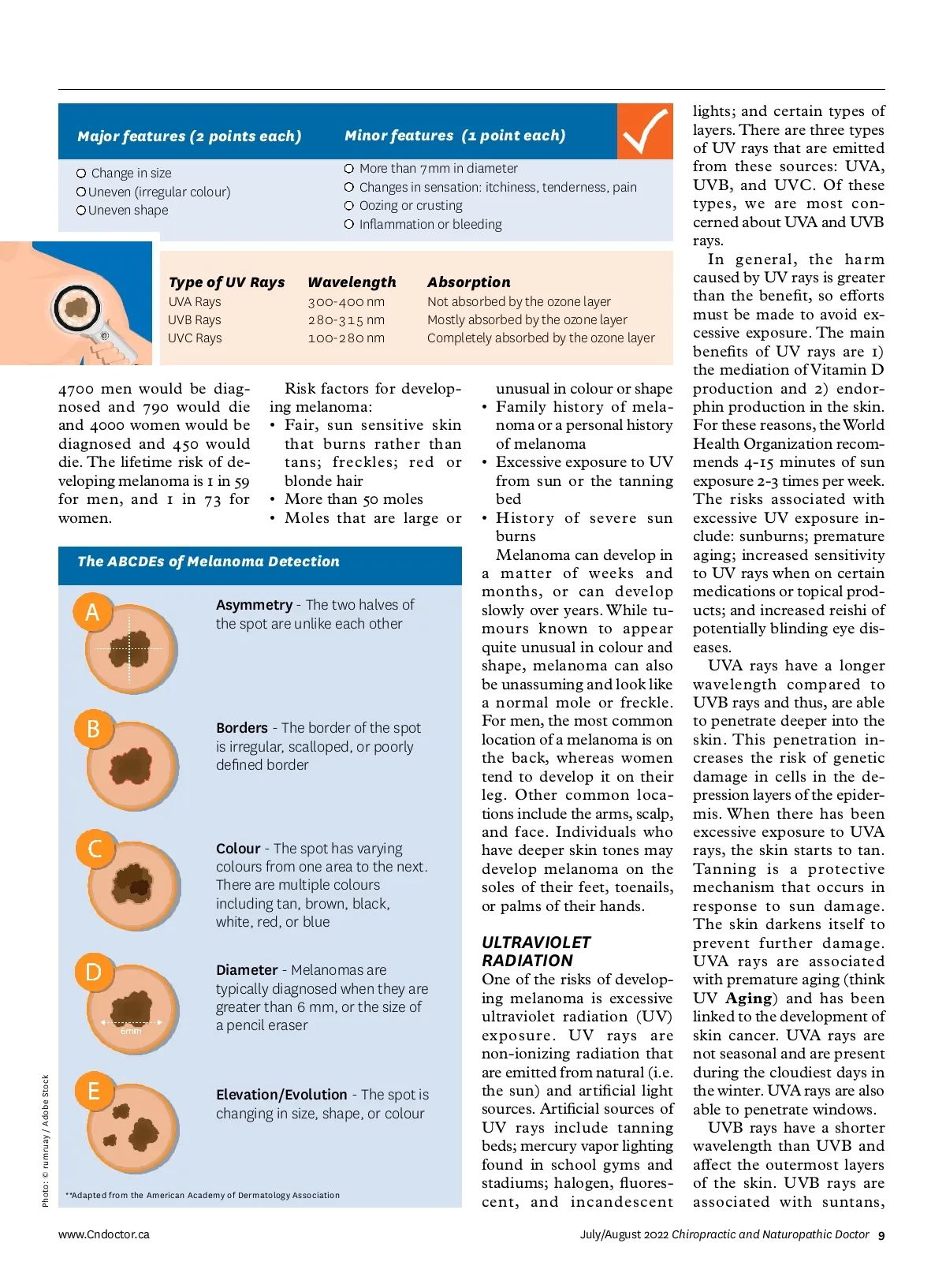
Major features (2 points each) Change in size Uneven (irregular colour) Uneven shape Minor features (1 point each) More than 7mm in diameter Changes in sensation: itchiness, tenderness, pain Oozing or crusting Inflammation or bleeding Type of UV Rays UVA Rays UVB Rays UVC Rays Wavelength 300-400 nm 280-315 nm 100-280 nm Absorption Not absorbed by the ozone layer Mostly absorbed by the ozone layer Completely absorbed by the ozone layer 4700 men would be diag-nosed and 790 would die and 4000 women would be diagnosed and 450 would die. The lifetime risk of de-veloping melanoma is 1 in 59 for men, and 1 in 73 for women. Risk factors for develop-ing melanoma: • Fair, sun sensitive skin that burns rather than tans; freckles; red or blonde hair • More than 50 moles • Moles that are large or The ABCDEs of Melanoma Detection Asymmetry -The two halves of the spot are unlike each other Borders -The border of the spot is irregular, scalloped, or poorly defined border Colour -The spot has varying colours from one area to the next. There are multiple colours including tan, brown, black, white, red, or blue Diameter -Melanomas are typically diagnosed when they are greater than 6 mm, or the size of a pencil eraser Photo: © rumruay / Adobe Stock unusual in colour or shape • Family history of mela-noma or a personal history of melanoma • Excessive exposure to UV from sun or the tanning bed • History of severe sun burns Melanoma can develop in a matter of weeks and months, or can develop slowly over years. While tu-mours known to appear quite unusual in colour and shape, melanoma can also be unassuming and look like a normal mole or freckle. For men, the most common location of a melanoma is on the back, whereas women tend to develop it on their leg. Other common loca-tions include the arms, scalp, and face. Individuals who have deeper skin tones may develop melanoma on the soles of their feet, toenails, or palms of their hands. ULTRAVIOLET RADIATION Elevation/Evolution -The spot is changing in size, shape, or colour **Adapted from the American Academy of Dermatology Association One of the risks of develop-ing melanoma is excessive ultraviolet radiation (UV) exposure. UV rays are non-ionizing radiation that are emitted from natural (i.e. the sun) and artificial light sources. Artificial sources of UV rays include tanning beds; mercury vapor lighting found in school gyms and stadiums; halogen, fluores-cent, and incandescent lights; and certain types of layers. There are three types of UV rays that are emitted from these sources: UVA, UVB, and UVC. Of these types, we are most con-cerned about UVA and UVB rays. In general, the harm caused by UV rays is greater than the benefit, so efforts must be made to avoid ex-cessive exposure. The main benefits of UV rays are 1) the mediation of Vitamin D production and 2) endor-phin production in the skin. For these reasons, the World Health Organization recom-mends 4-15 minutes of sun exposure 2-3 times per week. The risks associated with excessive UV exposure in-clude: sunburns; premature aging; increased sensitivity to UV rays when on certain medications or topical prod-ucts; and increased reishi of potentially blinding eye dis-eases. UVA rays have a longer wavelength compared to UVB rays and thus, are able to penetrate deeper into the skin. This penetration in-creases the risk of genetic damage in cells in the de-pression layers of the epider-mis. When there has been excessive exposure to UVA rays, the skin starts to tan. Tanning is a protective mechanism that occurs in response to sun damage. The skin darkens itself to prevent further damage. UVA rays are associated with premature aging (think UV Aging ) and has been linked to the development of skin cancer. UVA rays are not seasonal and are present during the cloudiest days in the winter. UVA rays are also able to penetrate windows. UVB rays have a shorter wavelength than UVB and affect the outermost layers of the skin. UVB rays are associated with suntans, www.Cndoctor.ca July/August 2022 Chiropractic and Naturopathic Doctor 9
Chiropractic + Naturopathic Doctor July/August 2022: Page 9