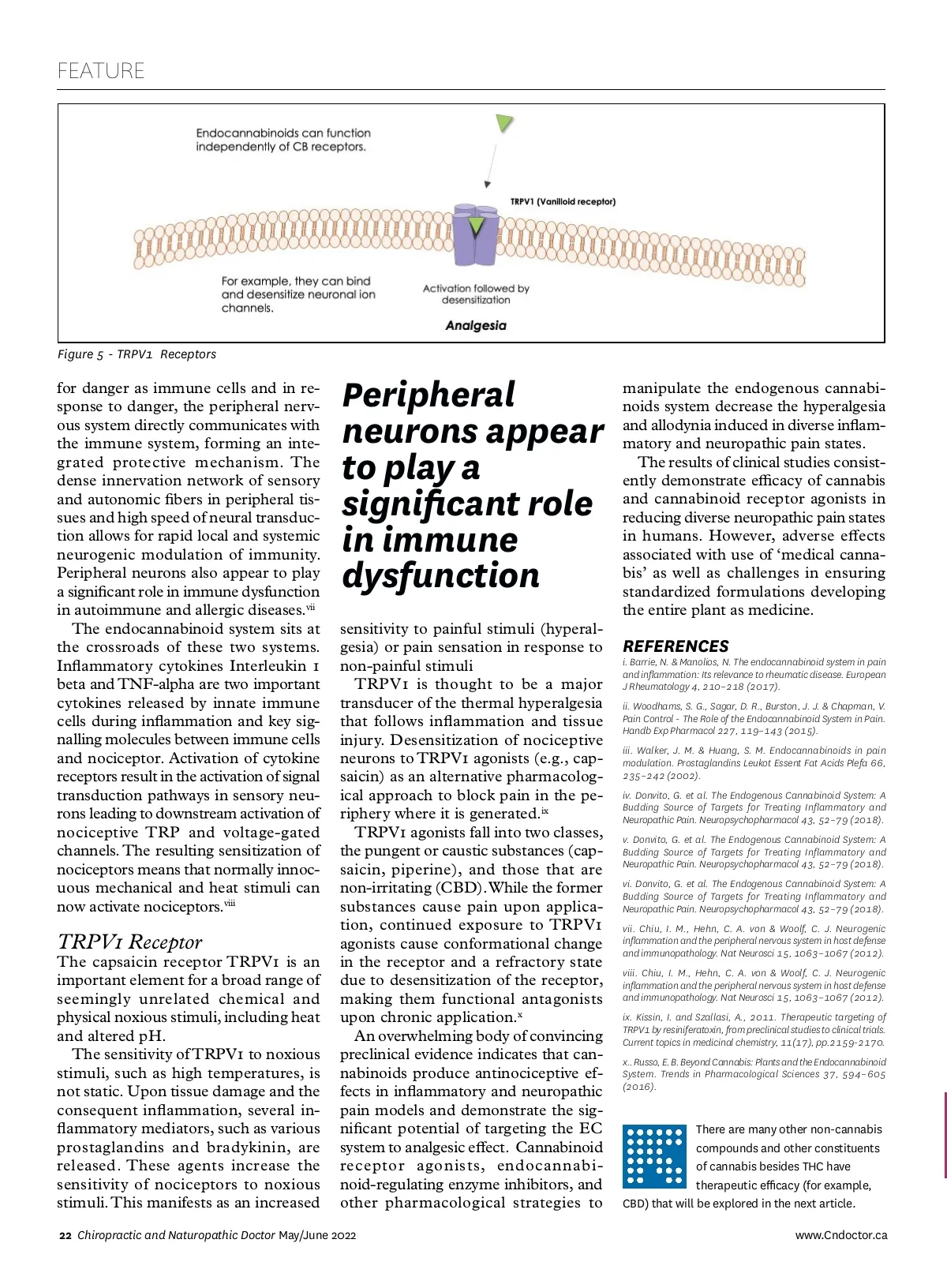
FEATURE Figure 5 -TRPV1 Receptors for danger as immune cells and in re-sponse to danger, the peripheral nerv-ous system directly communicates with the immune system, forming an inte-grated protective mechanism. The dense innervation network of sensory and autonomic fibers in peripheral tis-sues and high speed of neural transduc-tion allows for rapid local and systemic neurogenic modulation of immunity. Peripheral neurons also appear to play a significant role in immune dysfunction in autoimmune and allergic diseases. vii The endocannabinoid system sits at the crossroads of these two systems. Inflammatory cytokines Interleukin 1 beta and TNF-alpha are two important cytokines released by innate immune cells during inflammation and key sig-nalling molecules between immune cells and nociceptor. Activation of cytokine receptors result in the activation of signal transduction pathways in sensory neu-rons leading to downstream activation of nociceptive TRP and voltage-gated channels. The resulting sensitization of nociceptors means that normally innoc-uous mechanical and heat stimuli can now activate nociceptors. viii Peripheral neurons appear to play a significant role in immune dysfunction sensitivity to painful stimuli (hyperal-gesia) or pain sensation in response to non-painful stimuli TRPV1 is thought to be a major transducer of the thermal hyperalgesia that follows inflammation and tissue injury. Desensitization of nociceptive neurons to TRPV1 agonists (e.g., cap-saicin) as an alternative pharmacolog-ical approach to block pain in the pe-riphery where it is generated. ix TRPV1 agonists fall into two classes, the pungent or caustic substances (cap-saicin, piperine), and those that are non-irritating (CBD). While the former substances cause pain upon applica-tion, continued exposure to TRPV1 agonists cause conformational change in the receptor and a refractory state due to desensitization of the receptor, making them functional antagonists upon chronic application. x An overwhelming body of convincing preclinical evidence indicates that can-nabinoids produce antinociceptive ef-fects in inflammatory and neuropathic pain models and demonstrate the sig-nificant potential of targeting the EC system to analgesic effect. Cannabinoid receptor agonists, endocannabi-noid-regulating enzyme inhibitors, and other pharmacological strategies to manipulate the endogenous cannabi-noids system decrease the hyperalgesia and allodynia induced in diverse inflam-matory and neuropathic pain states. The results of clinical studies consist-ently demonstrate efficacy of cannabis and cannabinoid receptor agonists in reducing diverse neuropathic pain states in humans. However, adverse effects associated with use of ‘medical canna-bis’ as well as challenges in ensuring standardized formulations developing the entire plant as medicine. REFERENCES i. Barrie, N. & Manolios, N. The endocannabinoid system in pain and inflammation: Its relevance to rheumatic disease. European J Rheumatology 4, 210–218 (2017). ii. Woodhams, S. G., Sagar, D. R., Burston, J. J. & Chapman, V. Pain Control -The Role of the Endocannabinoid System in Pain. Handb Exp Pharmacol 227, 119–143 (2015). iii. Walker, J. M. & Huang, S. M. Endocannabinoids in pain modulation. Prostaglandins Leukot Essent Fat Acids Plefa 66, 235–242 (2002). iv. Donvito, G. et al. The Endogenous Cannabinoid System: A Budding Source of Targets for Treating Inflammatory and Neuropathic Pain. Neuropsychopharmacol 43, 52–79 (2018). v. Donvito, G. et al. The Endogenous Cannabinoid System: A Budding Source of Targets for Treating Inflammatory and Neuropathic Pain. Neuropsychopharmacol 43, 52–79 (2018). vi. Donvito, G. et al. The Endogenous Cannabinoid System: A Budding Source of Targets for Treating Inflammatory and Neuropathic Pain. Neuropsychopharmacol 43, 52–79 (2018). vii. Chiu, I. M., Hehn, C. A. von & Woolf, C. J. Neurogenic inflammation and the peripheral nervous system in host defense and immunopathology. Nat Neurosci 15, 1063–1067 (2012). viii. Chiu, I. M., Hehn, C. A. von & Woolf, C. J. Neurogenic inflammation and the peripheral nervous system in host defense and immunopathology. Nat Neurosci 15, 1063–1067 (2012). ix. Kissin, I. and Szallasi, A., 2011. Therapeutic targeting of TRPV1 by resiniferatoxin, from preclinical studies to clinical trials. Current topics in medicinal chemistry, 11(17), pp.2159-2170. x.. Russo, E. B. Beyond Cannabis: Plants and the Endocannabinoid System. Trends in Pharmacological Sciences 37, 594–605 (2016). TRPV1 Receptor The capsaicin receptor TRPV1 is an important element for a broad range of seemingly unrelated chemical and physical noxious stimuli, including heat and altered pH. The sensitivity of TRPV1 to noxious stimuli, such as high temperatures, is not static. Upon tissue damage and the consequent inflammation, several in-flammatory mediators, such as various prostaglandins and bradykinin, are released. These agents increase the sensitivity of nociceptors to noxious stimuli. This manifests as an increased There are many other non-cannabis compounds and other constituents of cannabis besides THC have therapeutic efficacy (for example, CBD) that will be explored in the next article. www.Cndoctor.ca 22 Chiropractic and Naturopathic Doctor May/June 2022
Chiropractic + Naturopathic Doctor June 2022: Page 22