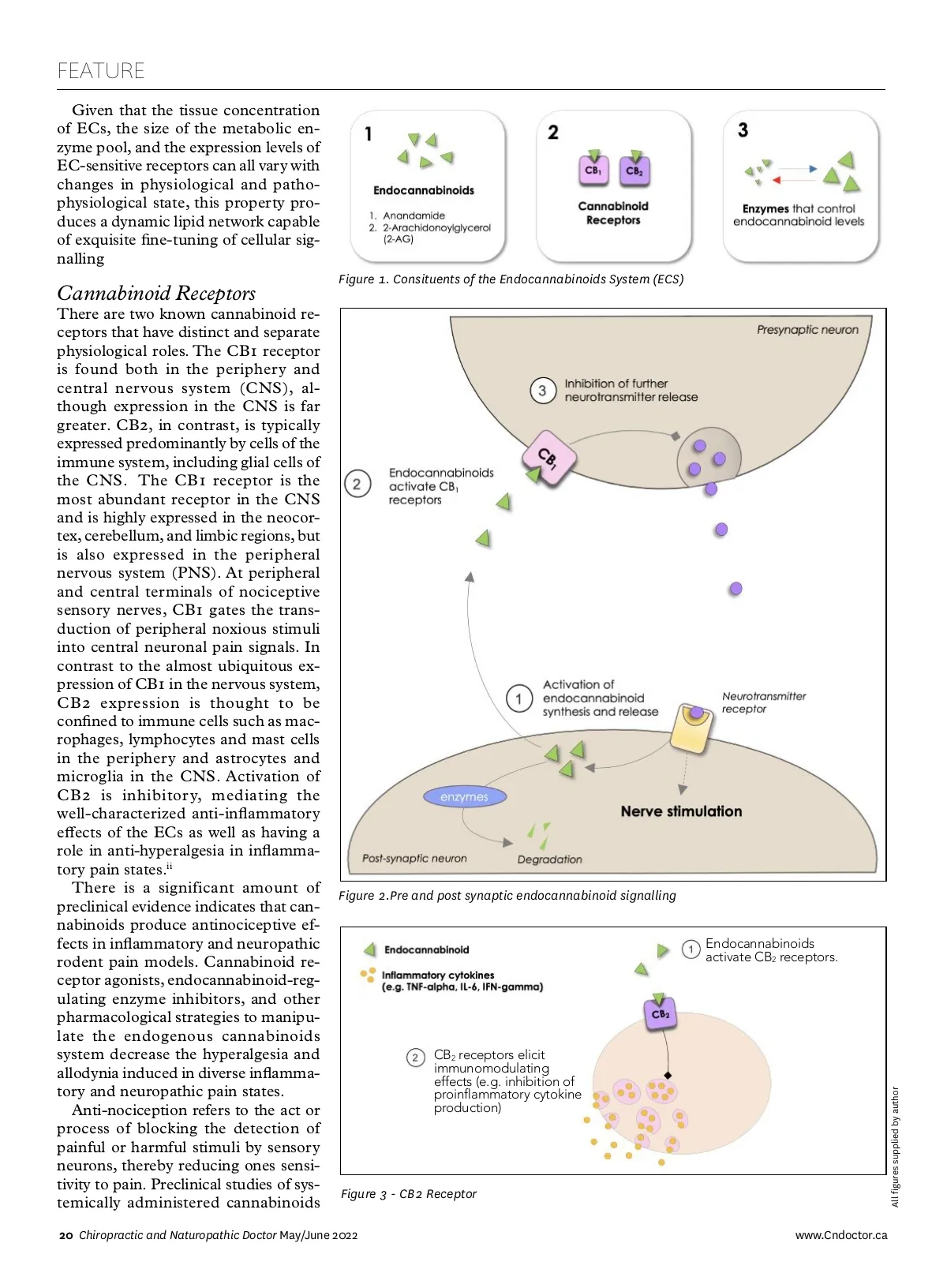
response. For example, THC and AEA suppress proinflammatory cytokines and enhance anti-inflammatory cy-tokines in both innate and adaptive immune responses. After an injury, neuronal inflamma-tion and repair mechanisms of neural tissues induce a state of peripheral hy-perexcitability in nociceptors that syn-apse with neurons found within the dorsal horn of the spinal cord. This hy-perexcitability leads to loss of activity of inhibitory neurons that results in a dra-matic functional alteration of neurons in the dorsal horn of the spinal cord. When this loop persists in an enduring way, it results in a persistent pain, which is often resistant to treatments. v Manipulation of the endocannabinoid system can result in anti-inflammatory effects. The endogenous cannabinoid (endo-cannabinoid) system modulates neu-ronal and immune cell function, both of which play key roles in pain. The cannabinoid receptors, type 1 and 2, as well as biosynthetic and catabolic en-zymes are potential therapeutic targets. Cannabinoid receptor agonists as well as inhibitors of endocannabinoid-reg-ulating enzymes fatty acid amide hy-drolase and monoacylglycerol lipase produce reliable antinociceptive effects and offer opioid-sparing antinocicep-tive effects in myriad preclinical inflam-matory and neuropathic pain models. Endogenous cannabinoids (Anan-damide and 2-AG) are enzymatically regulated, produced, and released on demand. These endocannabinoids acti-vate CB1 and CB2 receptors. Another important pathway involves the binding of Anandamide which activates tran-sient receptor potential cation channel subfamily V member 1 (TRPV1) which is a key point of intersection between the nervous and immune systems The peripheral nervous and immune systems are traditionally thought of as serving separate functions. However, nociceptive neurons possess many of the same molecular recognition pathways Figure 4-The endocannabinoid system and inflammatory signals have noted anti-nociception as a prominent feature in various models of pain. iii The analgesic effects of cannabinoids and their ligands are primarily medi-ated by the cannabinoid receptor 1 (CB1) via inhibition of presynaptic gamma-aminobutyric acid (GABA) and glutamatergic transmission. Within the nervous system, GABA transmis-sion suppresses neuronal excitability. The results of clinical studies con-sistently demonstrate the efficacy of cannabis and cannabinoid receptor agonists in reducing diverse neuro-pathic pain states in humans. However, adverse effects associated with use of “medical cannabis” as well as chal-lenges in ensuring standardized plant constituents and concerns related to inhaling combustion products of smoked cannabis are significant issues iv www.Cndoctor.ca Chronic pain, whether inflammatory or neuropathic, is a complicated condi-tion that not only diminishes the qual-ity of life but also comes at great eco-nomic cost. The mechanisms of pathological pain are complex and characterized by both peripheral and central neuronal alterations and neu-roimmune activation, which modulates in the initiation and maintenance of chronic pain. Manipulation of the endocannabi-noid system can result in anti-inflam-matory effects, primarily through suppression of cytokine production, inhibition of cell proliferation, and in-duction of cell apoptosis. Endocannab-inoids mediate inflammation by regu-lating cytokines at different steps throughout the inflammatory The Role of the ECS in Neuropathic and Inflammatory Pain May/June 2022 Chiropractic and Naturopathic Doctor 21
Chiropractic + Naturopathic Doctor June 2022: Page 21