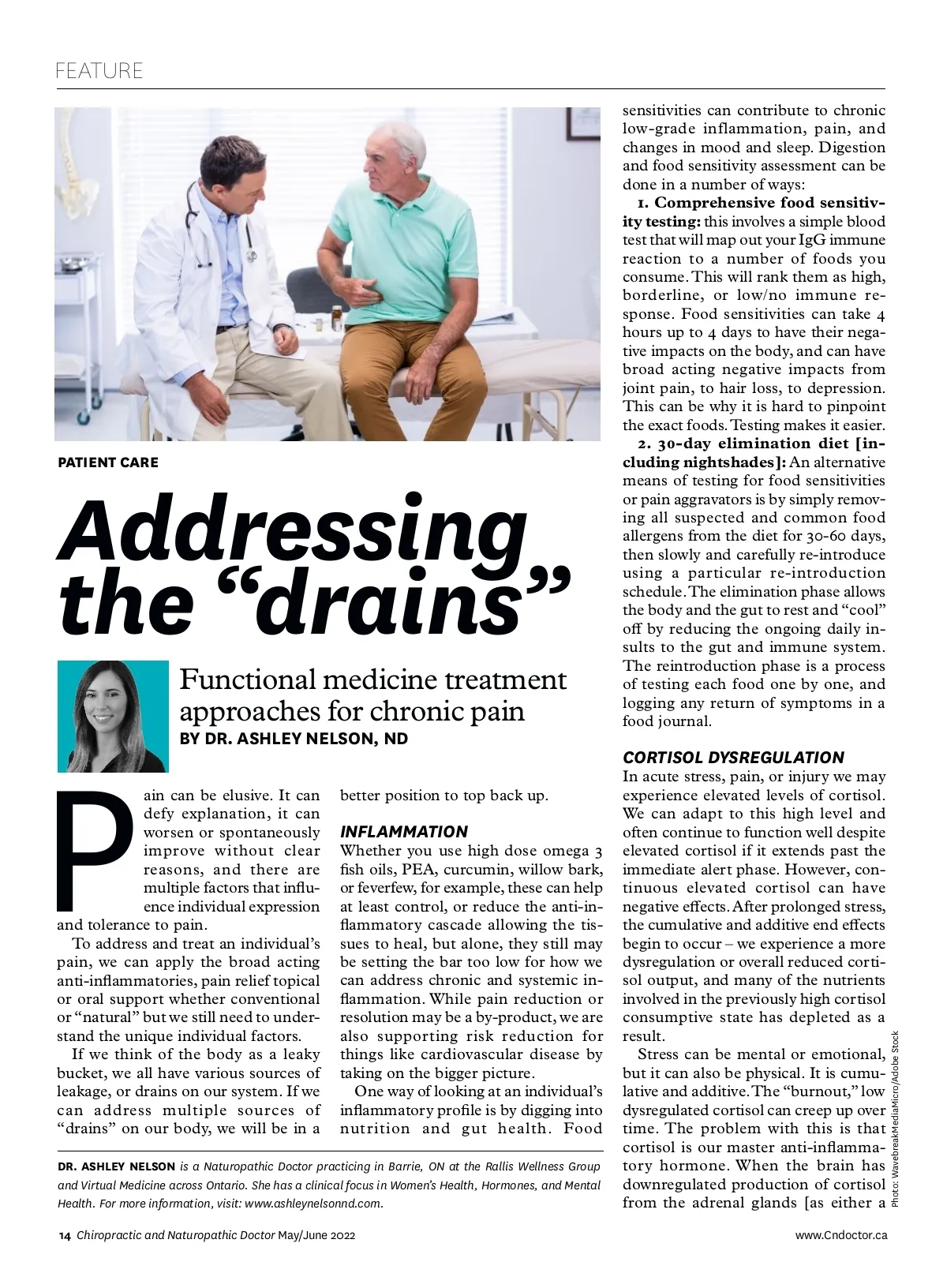
“Amino acids and adequate protein are important for energy, pain and healing...” means to protect us from too much cortisol, and/or lack of nutrients to continue this consumptive process of high cortisol output], it does reduce some risk, but does not come without its own associated costs. The low, dys-regulated cortisol output can translate into chronic fatigue, dizziness, autoim-mune issues, worsened pain, poor sleep, low mood/motivation, and so on. The conventional system views cortisol in terms of the extremes of disease – Addison’s disease [clinical cortisol deficiency] and Cushing’s disease [clinical cortisol excess], but it fails to appreciate the in-between that many people suffer from by the very nature of our lives and environment. In order to combat this component of chronic pain, it is worth investigating: 1. 4-point cortisol testing using saliva or urine throughout the day. The advantage of saliva or urine is the accuracy, ease of testing and ability to assess several points throughout the day. It eliminates the potential of falsely elevated levels due to fear or apprehen-sion with blood draws. It is also a more practical means of getting four samples throughout the day. A conventional approach of looking at only one morn-ing blood sample, or 24-hour urine collection will also only represent either a brief window in the former, and an average of total cortisol in the latter. This won’t capture the dysregulated pattern of inappropriate highs and lows throughout the day. By understanding an individual cortisol curve, it allows us to better target the dysregulation, whether someone is still in a high cor-tisol output state and we need to calm and support cortisol metabolism, or on the burnout stage and we need to focus on building the body back up with high dose nutrients and advanced adrenal support. 2. Nutrient therapy : If our body is taxed and depleted in the very minerals that keep our muscles relaxed and the nervous system in rest/digest as www.Cndoctor.ca opposed to the fight/flight state, then we will be fighting an uphill battle. Magnesium is one of these minerals that is often depleted, but also critical for the muscles, and nervous system. Amino acids and adequate protein are important for both pain, injury and healing, but also supports mood and sleep. Vitamin C is another building block for collagen and ligaments often heavily depleted in chronic stress and chronic pain. Testing these individual nutrients of suspicion and then replac-ing with the adequate dose for that individual and in the right form is a key component to give the body the tools it needs to heal. 3. IV nutrient therapy can be another way that NDs and func-tional medicine practitioners sup-port a depleted body. It allows for direct absorption, bypassing the gut, for high dose nutrient replacement, particularly when there are a number of depletions. 4. Mental emotional work: If this is part of the picture when it comes to cortisol dysregulation and chronic pain, it will serve as a major barrier to healing. Counselling, practicing medi-tation, guided imagery, cognitive be-havioural therapy, practicing letting go – these can all support the mental emotional piece of the puzzle when it comes to pain reduction, and removing barriers to healing. CIRCULATION There’s a saying that “pain is the prayer of better blood” – in Traditional Chi-nese Medicine, this can be described as Blood or Qi Stagnation. It’s describ-ing that inadequate circulation and flow both of our blood vessels and lymphatic system can contribute to pain conditions. Circulation is impor-tant for a number of reasons: 1. It brings blood to the area of injury or pain. This means the tissue receives oxygen and nutrients required for healthy cellular functioning 2. It brings blood away from the area of injury or pain, which means waste products, toxins, and old white blood cells are taken away from the area of injury 3. Healthy circulation also in-volves healthy lymphatic circula-tion. Our lymph is essential to our immune materials and when we have damage, the lymphatic system needs to reach the area of damage, and it needs to be able to clear away the “junk.” However, when we are injured, nat-urally, we move less. Less movement, creates less circulation. Less movement means we’re not getting our heart rate up, which also means less circulation. All of this, while it can initially serve as a protective function, long term, can worsen recovery and healing. So, if you’re in pain, what can you do to improve circulation? 1. Contrast showers: A simple, at-home strategy. Start with 3 minutes of a hot shower, followed by 30 sec-1 min of cold. Then switching back to hot, and repeating this cycle three times, ending on cold. This can be so effective because it promotes longer vasodilation and improvement of blood flow. 2. Topical castor oil: not only does it act as an anti-inflammatory, but it also improves circulation. It can be applied with heat to the affected area. 3. Low-level laser light therapy has also been studied for its utility in pain management. By applying certain wavelengths of light, it can improve circulation, healing, and cellular me-tabolism. 4. Herbal medicine: There are also a number of herbs and spices which promote circulation, and lymphatic flow. Some of these include cayenne, ginger, rosemary, and blue flag. While we can dive deep into the world of pain management from a conventional lens – acetaminophen, NSAIDs, opiods, injection therapy, corticosteroids, and the more “natural” counterparts like turmeric – these tools and way of approaching pain will likely be less effective if there are other drains on the system. They can serve their place in the acute and early stages of pain, but as with anything, if we are not giving the body all the tools and sup-ports it requires we will be missing opportunity for further improvement and health optimization. May/June 2022 Chiropractic and Naturopathic Doctor 15
Chiropractic + Naturopathic Doctor June 2022: Page 15