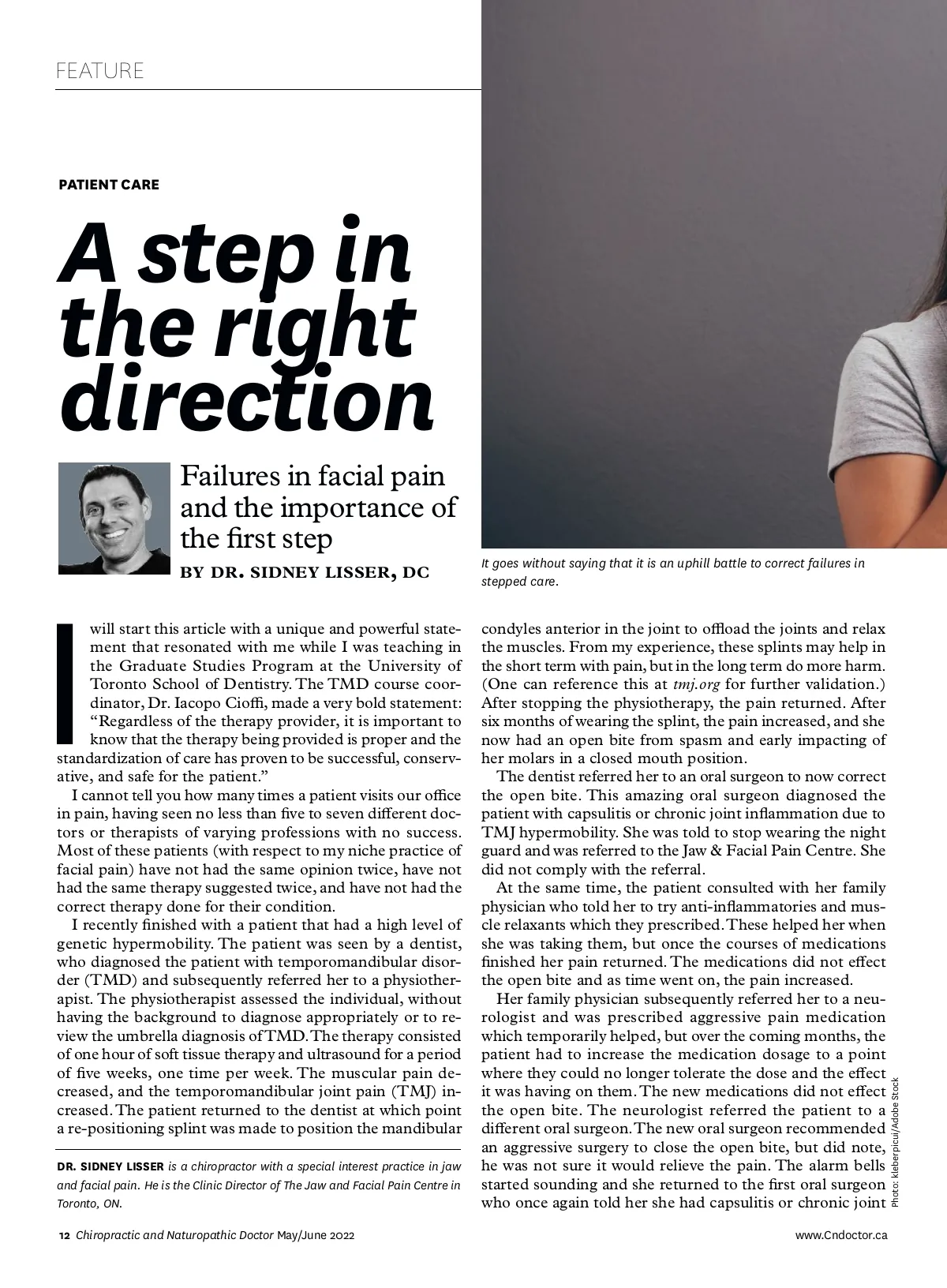
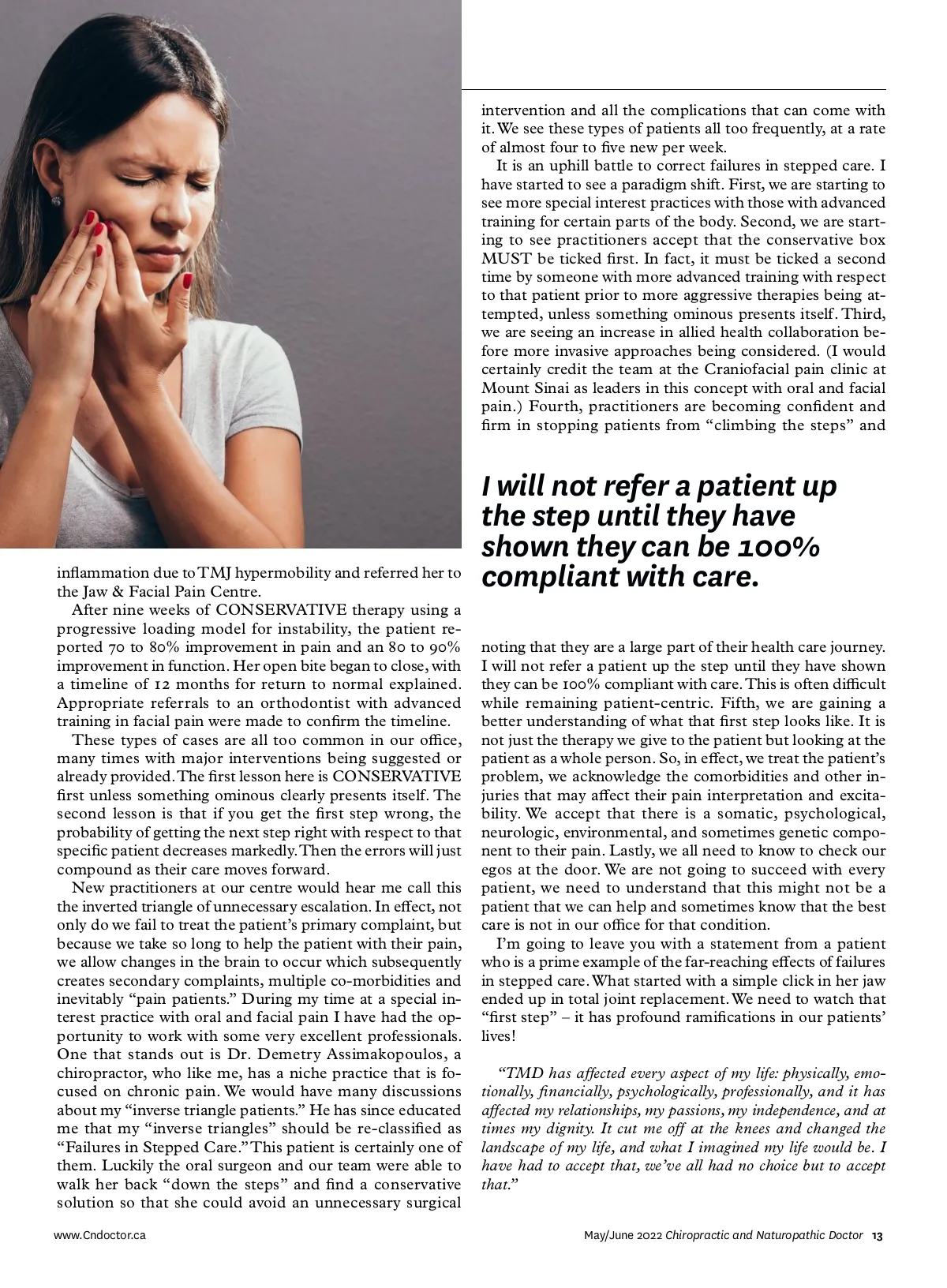
intervention and all the complications that can come with it. We see these types of patients all too frequently, at a rate of almost four to five new per week. It is an uphill battle to correct failures in stepped care. I have started to see a paradigm shift. First, we are starting to see more special interest practices with those with advanced training for certain parts of the body. Second, we are start-ing to see practitioners accept that the conservative box MUST be ticked first. In fact, it must be ticked a second time by someone with more advanced training with respect to that patient prior to more aggressive therapies being at-tempted, unless something ominous presents itself. Third, we are seeing an increase in allied health collaboration be-fore more invasive approaches being considered. (I would certainly credit the team at the Craniofacial pain clinic at Mount Sinai as leaders in this concept with oral and facial pain.) Fourth, practitioners are becoming confident and firm in stopping patients from “climbing the steps” and inflammation due to TMJ hypermobility and referred her to the Jaw & Facial Pain Centre. After nine weeks of CONSERVATIVE therapy using a progressive loading model for instability, the patient re-ported 70 to 80% improvement in pain and an 80 to 90% improvement in function. Her open bite began to close, with a timeline of 12 months for return to normal explained. Appropriate referrals to an orthodontist with advanced training in facial pain were made to confirm the timeline. These types of cases are all too common in our office, many times with major interventions being suggested or already provided. The first lesson here is CONSERVATIVE first unless something ominous clearly presents itself. The second lesson is that if you get the first step wrong, the probability of getting the next step right with respect to that specific patient decreases markedly. Then the errors will just compound as their care moves forward. New practitioners at our centre would hear me call this the inverted triangle of unnecessary escalation. In effect, not only do we fail to treat the patient’s primary complaint, but because we take so long to help the patient with their pain, we allow changes in the brain to occur which subsequently creates secondary complaints, multiple co-morbidities and inevitably “pain patients.” During my time at a special in-terest practice with oral and facial pain I have had the op-portunity to work with some very excellent professionals. One that stands out is Dr. Demetry Assimakopoulos, a chiropractor, who like me, has a niche practice that is fo-cused on chronic pain. We would have many discussions about my “inverse triangle patients.” He has since educated me that my “inverse triangles” should be re-classified as “Failures in Stepped Care.” This patient is certainly one of them. Luckily the oral surgeon and our team were able to walk her back “down the steps” and find a conservative solution so that she could avoid an unnecessary surgical www.Cndoctor.ca I will not refer a patient up the step until they have shown they can be 100% compliant with care. noting that they are a large part of their health care journey. I will not refer a patient up the step until they have shown they can be 100% compliant with care. This is often difficult while remaining patient-centric. Fifth, we are gaining a better understanding of what that first step looks like. It is not just the therapy we give to the patient but looking at the patient as a whole person. So, in effect, we treat the patient’s problem, we acknowledge the comorbidities and other in-juries that may affect their pain interpretation and excita-bility. We accept that there is a somatic, psychological, neurologic, environmental, and sometimes genetic compo-nent to their pain. Lastly, we all need to know to check our egos at the door. We are not going to succeed with every patient, we need to understand that this might not be a patient that we can help and sometimes know that the best care is not in our office for that condition. I’m going to leave you with a statement from a patient who is a prime example of the far-reaching effects of failures in stepped care. What started with a simple click in her jaw ended up in total joint replacement. We need to watch that “first step” – it has profound ramifications in our patients’ lives! “TMD has affected every aspect of my life: physically, emo-tionally, financially, psychologically, professionally, and it has affected my relationships, my passions, my independence, and at times my dignity. It cut me off at the knees and changed the landscape of my life, and what I imagined my life would be. I have had to accept that, we’ve all had no choice but to accept that.” May/June 2022 Chiropractic and Naturopathic Doctor 13
Chiropractic + Naturopathic Doctor June 2022: Page 13