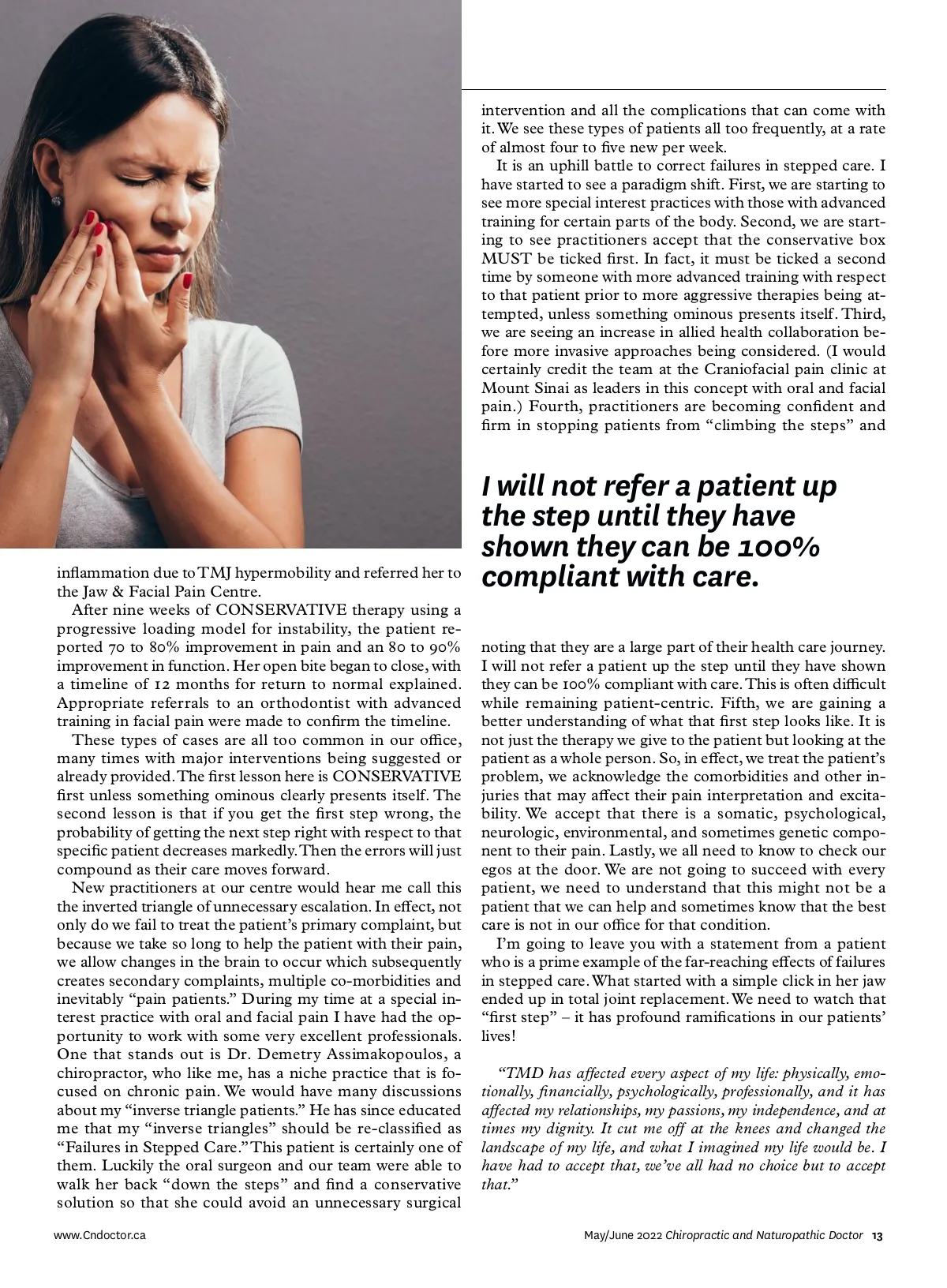
FEATURE PATIENT CARE A step in the right direction I Failures in facial pain and the importance of the first step by dr . sidney lisser , dc It goes without saying that it is an uphill battle to correct failures in stepped care. DR. SIDNEY LISSER is a chiropractor with a special interest practice in jaw and facial pain. He is the Clinic Director of The Jaw and Facial Pain Centre in Toronto, ON. 12 Chiropractic and Naturopathic Doctor May/June 2022 www.Cndoctor.ca Photo: kleberpicui/Adobe Stock will start this article with a unique and powerful state-ment that resonated with me while I was teaching in the Graduate Studies Program at the University of Toronto School of Dentistry. The TMD course coor-dinator, Dr. Iacopo Cioffi, made a very bold statement: “Regardless of the therapy provider, it is important to know that the therapy being provided is proper and the standardization of care has proven to be successful, conserv-ative, and safe for the patient.” I cannot tell you how many times a patient visits our office in pain, having seen no less than five to seven different doc-tors or therapists of varying professions with no success. Most of these patients (with respect to my niche practice of facial pain) have not had the same opinion twice, have not had the same therapy suggested twice, and have not had the correct therapy done for their condition. I recently finished with a patient that had a high level of genetic hypermobility. The patient was seen by a dentist, who diagnosed the patient with temporomandibular disor-der (TMD) and subsequently referred her to a physiother-apist. The physiotherapist assessed the individual, without having the background to diagnose appropriately or to re-view the umbrella diagnosis of TMD. The therapy consisted of one hour of soft tissue therapy and ultrasound for a period of five weeks, one time per week. The muscular pain de-creased, and the temporomandibular joint pain (TMJ) in-creased. The patient returned to the dentist at which point a re-positioning splint was made to position the mandibular condyles anterior in the joint to offload the joints and relax the muscles. From my experience, these splints may help in the short term with pain, but in the long term do more harm. (One can reference this at tmj.org for further validation.) After stopping the physiotherapy, the pain returned. After six months of wearing the splint, the pain increased, and she now had an open bite from spasm and early impacting of her molars in a closed mouth position. The dentist referred her to an oral surgeon to now correct the open bite. This amazing oral surgeon diagnosed the patient with capsulitis or chronic joint inflammation due to TMJ hypermobility. She was told to stop wearing the night guard and was referred to the Jaw & Facial Pain Centre. She did not comply with the referral. At the same time, the patient consulted with her family physician who told her to try anti-inflammatories and mus-cle relaxants which they prescribed. These helped her when she was taking them, but once the courses of medications finished her pain returned. The medications did not effect the open bite and as time went on, the pain increased. Her family physician subsequently referred her to a neu-rologist and was prescribed aggressive pain medication which temporarily helped, but over the coming months, the patient had to increase the medication dosage to a point where they could no longer tolerate the dose and the effect it was having on them. The new medications did not effect the open bite. The neurologist referred the patient to a different oral surgeon. The new oral surgeon recommended an aggressive surgery to close the open bite, but did note, he was not sure it would relieve the pain. The alarm bells started sounding and she returned to the first oral surgeon who once again told her she had capsulitis or chronic joint
Chiropractic + Naturopathic Doctor June 2022: Page 12