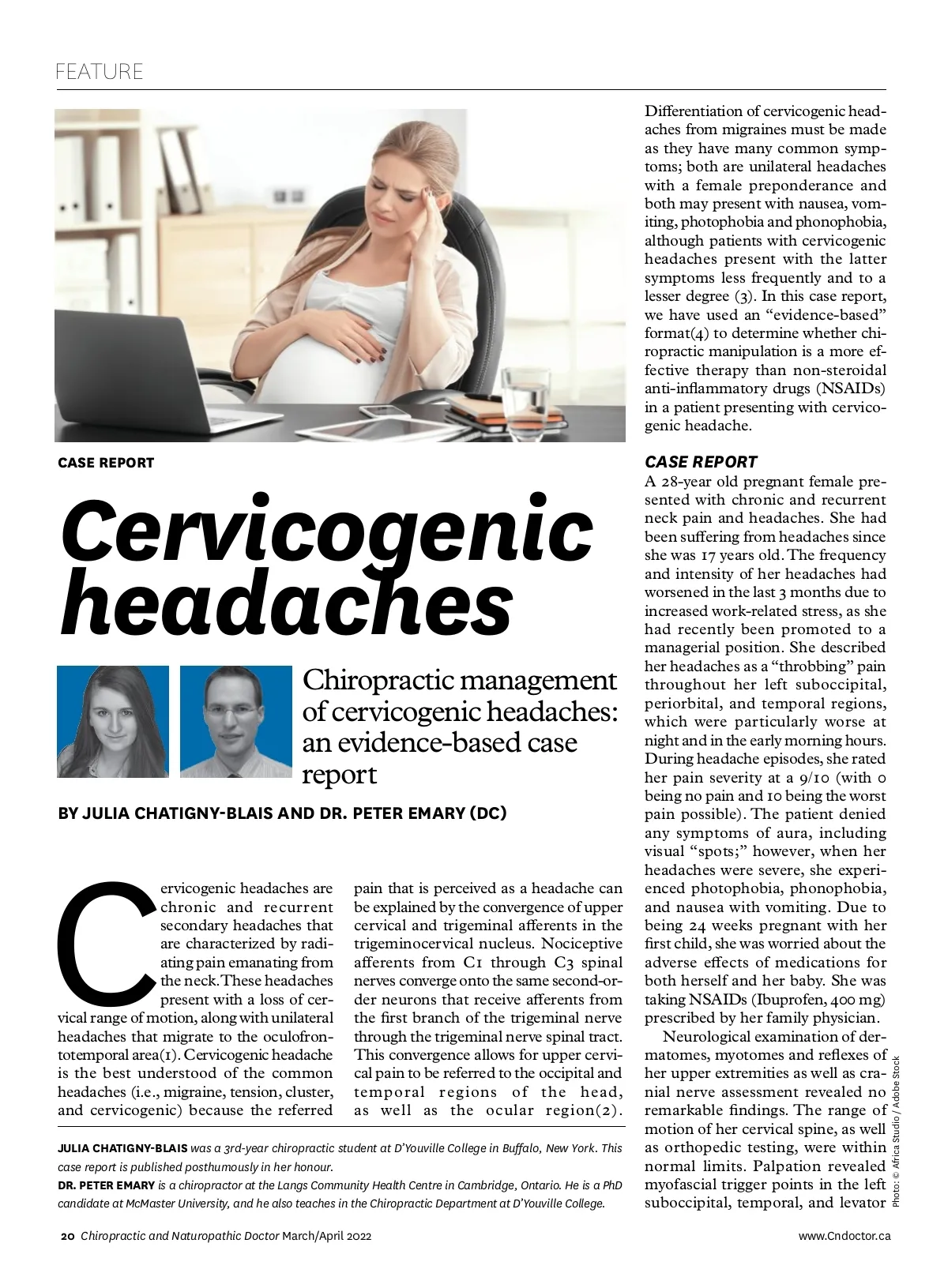
FEATURE Differentiation of cervicogenic head-aches from migraines must be made as they have many common symp-toms; both are unilateral headaches with a female preponderance and both may present with nausea, vom-iting, photophobia and phonophobia, although patients with cervicogenic headaches present with the latter symptoms less frequently and to a lesser degree (3). In this case report, we have used an “evidence-based” format(4) to determine whether chi-ropractic manipulation is a more ef-fective therapy than non-steroidal anti-inflammatory drugs (NSAIDs) in a patient presenting with cervico-genic headache. CASE REPORT Cervicogenic headaches Chiropractic management of cervicogenic headaches: an evidence-based case report CASE REPORT JULIA CHATIGNY-BLAIS was a 3rd-year chiropractic student at D’Youville College in Buffalo, New York. This case report is published posthumously in her honour. DR. PETER EMARY is a chiropractor at the Langs Community Health Centre in Cambridge, Ontario. He is a PhD candidate at McMaster University, and he also teaches in the Chiropractic Department at D’Youville College. 20 Chiropractic and Naturopathic Doctor March/April 2022 www.Cndoctor.ca Photo: © Africa Studio / Adobe Stock C BY JULIA CHATIGNY-BLAIS AND DR. PETER EMARY (DC) ervicogenic headaches are chronic and recurrent secondary headaches that are characterized by radi-ating pain emanating from the neck. These headaches present with a loss of cer-vical range of motion, along with unilateral headaches that migrate to the oculofron-totemporal area(1). Cervicogenic headache is the best understood of the common headaches (i.e., migraine, tension, cluster, and cervicogenic) because the referred pain that is perceived as a headache can be explained by the convergence of upper cervical and trigeminal afferents in the trigeminocervical nucleus. Nociceptive afferents from C1 through C3 spinal nerves converge onto the same second-or-der neurons that receive afferents from the first branch of the trigeminal nerve through the trigeminal nerve spinal tract. This convergence allows for upper cervi-cal pain to be referred to the occipital and temporal regions of the head, as well as the ocular region(2). A 28-year old pregnant female pre-sented with chronic and recurrent neck pain and headaches. She had been suffering from headaches since she was 17 years old. The frequency and intensity of her headaches had worsened in the last 3 months due to increased work-related stress, as she had recently been promoted to a managerial position. She described her headaches as a “throbbing” pain throughout her left suboccipital, periorbital, and temporal regions, which were particularly worse at night and in the early morning hours. During headache episodes, she rated her pain severity at a 9/10 (with 0 being no pain and 10 being the worst pain possible). The patient denied any symptoms of aura, including visual “spots;” however, when her headaches were severe, she experi-enced photophobia, phonophobia, and nausea with vomiting. Due to being 24 weeks pregnant with her first child, she was worried about the adverse effects of medications for both herself and her baby. She was taking NSAIDs (Ibuprofen, 400 mg) prescribed by her family physician. Neurological examination of der-matomes, myotomes and reflexes of her upper extremities as well as cra-nial nerve assessment revealed no remarkable findings. The range of motion of her cervical spine, as well as orthopedic testing, were within normal limits. Palpation revealed myofascial trigger points in the left suboccipital, temporal, and levator
Chiropractic + Naturopathic Doctor March/April 2022: Page 20