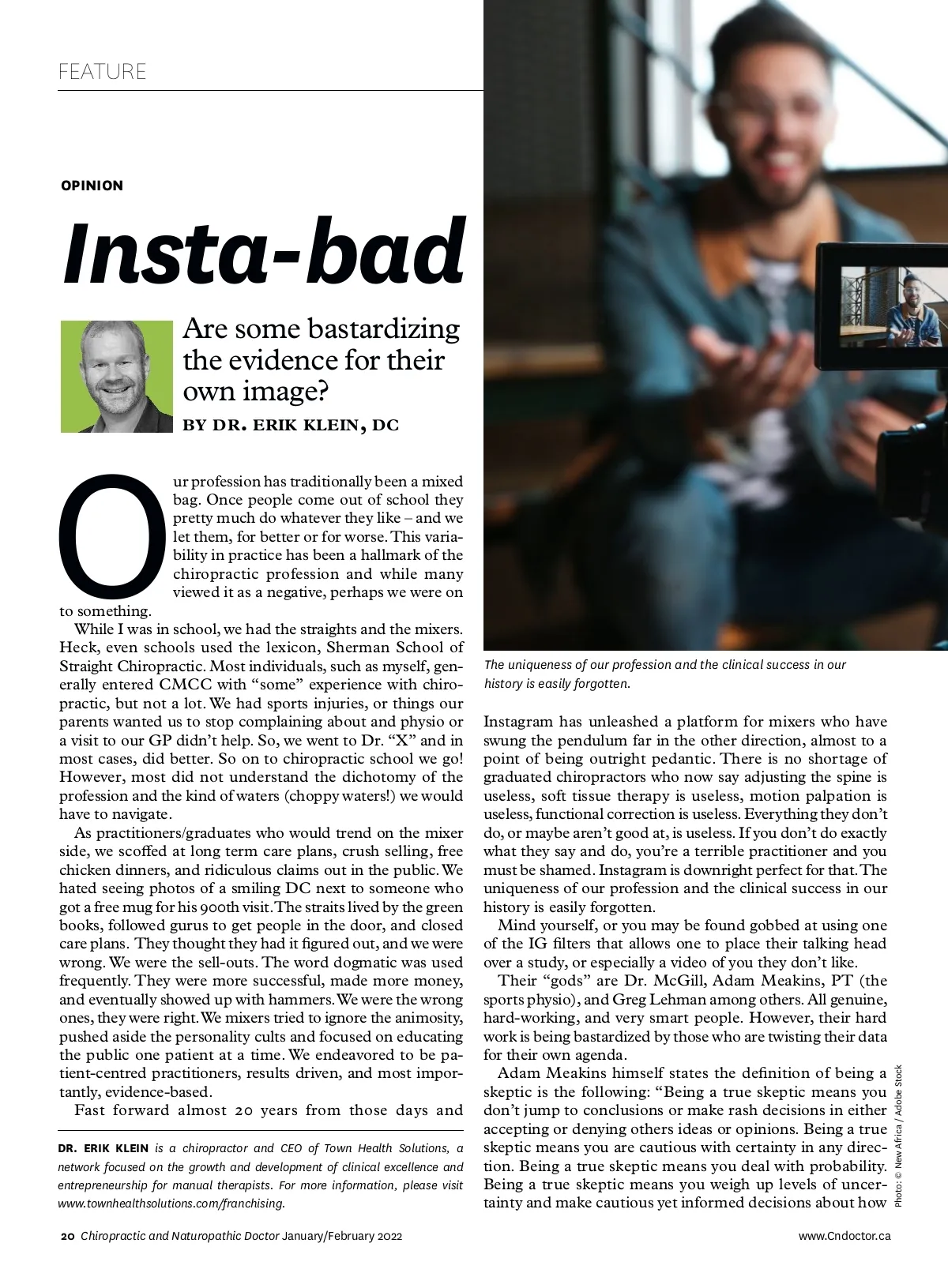
FEATURE OPINION Insta-bad O Are some bastardizing the evidence for their own image? by dr . erik klein , dc ur profession has traditionally been a mixed bag. Once people come out of school they pretty much do whatever they like – and we let them, for better or for worse. This varia-bility in practice has been a hallmark of the chiropractic profession and while many viewed it as a negative, perhaps we were on DR. ERIK KLEIN is a chiropractor and CEO of Town Health Solutions, a network focused on the growth and development of clinical excellence and entrepreneurship for manual therapists. For more information, please visit www.townhealthsolutions.com/franchising. 20 Chiropractic and Naturopathic Doctor January/February 2022 www.Cndoctor.ca Photo: © New Africa / Adobe Stock to something. While I was in school, we had the straights and the mixers. Heck, even schools used the lexicon, Sherman School of Straight Chiropractic. Most individuals, such as myself, gen-erally entered CMCC with “some” experience with chiro-practic, but not a lot. We had sports injuries, or things our parents wanted us to stop complaining about and physio or a visit to our GP didn’t help. So, we went to Dr. “X” and in most cases, did better. So on to chiropractic school we go! However, most did not understand the dichotomy of the profession and the kind of waters (choppy waters!) we would have to navigate. As practitioners/graduates who would trend on the mixer side, we scoffed at long term care plans, crush selling, free chicken dinners, and ridiculous claims out in the public. We hated seeing photos of a smiling DC next to someone who got a free mug for his 900th visit. The straits lived by the green books, followed gurus to get people in the door, and closed care plans. They thought they had it figured out, and we were wrong. We were the sell-outs. The word dogmatic was used frequently. They were more successful, made more money, and eventually showed up with hammers. We were the wrong ones, they were right. We mixers tried to ignore the animosity, pushed aside the personality cults and focused on educating the public one patient at a time. We endeavored to be pa-tient-centred practitioners, results driven, and most impor-tantly, evidence-based. Fast forward almost 20 years from those days and The uniqueness of our profession and the clinical success in our history is easily forgotten. Instagram has unleashed a platform for mixers who have swung the pendulum far in the other direction, almost to a point of being outright pedantic. There is no shortage of graduated chiropractors who now say adjusting the spine is useless, soft tissue therapy is useless, motion palpation is useless, functional correction is useless. Everything they don’t do, or maybe aren’t good at, is useless. If you don’t do exactly what they say and do, you’re a terrible practitioner and you must be shamed. Instagram is downright perfect for that. The uniqueness of our profession and the clinical success in our history is easily forgotten. Mind yourself, or you may be found gobbed at using one of the IG filters that allows one to place their talking head over a study, or especially a video of you they don’t like. Their “gods” are Dr. McGill, Adam Meakins, PT (the sports physio), and Greg Lehman among others. All genuine, hard-working, and very smart people. However, their hard work is being bastardized by those who are twisting their data for their own agenda. Adam Meakins himself states the definition of being a skeptic is the following: “Being a true skeptic means you don’t jump to conclusions or make rash decisions in either accepting or denying others ideas or opinions. Being a true skeptic means you are cautious with certainty in any direc-tion. Being a true skeptic means you deal with probability. Being a true skeptic means you weigh up levels of uncer-tainty and make cautious yet informed decisions about how
Chiropractic + Naturopathic Doctor January/February 2022: Page 20