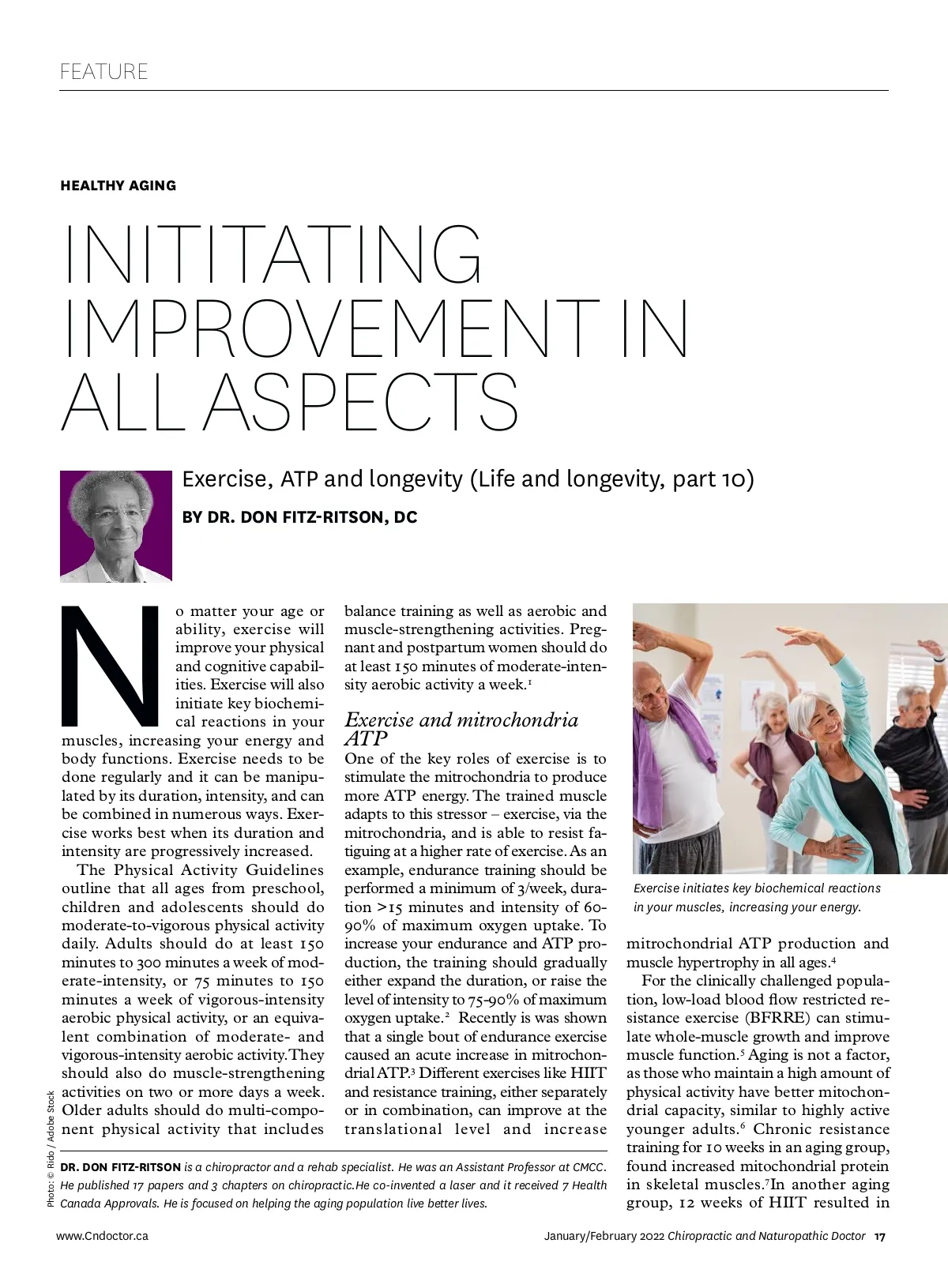
FEATURE HEALTHY AGING INITITATING IMPROVEMENT IN ALL ASPECTS Exercise, ATP and longevity (Life and longevity, part 10) BY DR. DON FITZ-RITSON, DC N Photo: © Rido / Adobe Stock o matter your age or ability, exercise will improve your physical and cognitive capabil-ities. Exercise will also initiate key biochemi-cal reactions in your muscles, increasing your energy and body functions. Exercise needs to be done regularly and it can be manipu-lated by its duration, intensity, and can be combined in numerous ways. Exer-cise works best when its duration and intensity are progressively increased. The Physical Activity Guidelines outline that all ages from preschool, children and adolescents should do moderate-to-vigorous physical activity daily. Adults should do at least 150 minutes to 300 minutes a week of mod-erate-intensity, or 75 minutes to 150 minutes a week of vigorous-intensity aerobic physical activity, or an equiva-lent combination of moderate-and vigorous-intensity aerobic activity. They should also do muscle-strengthening activities on two or more days a week. Older adults should do multi-compo-nent physical activity that includes balance training as well as aerobic and muscle-strengthening activities. Preg-nant and postpartum women should do at least 150 minutes of moderate-inten-sity aerobic activity a week. 1 One of the key roles of exercise is to stimulate the mitrochondria to produce more ATP energy. The trained muscle adapts to this stressor – exercise, via the mitrochondria, and is able to resist fa-tiguing at a higher rate of exercise. As an example, endurance training should be performed a minimum of 3/week, dura-tion >15 minutes and intensity of 60-90% of maximum oxygen uptake. To increase your endurance and ATP pro-duction, the training should gradually either expand the duration, or raise the level of intensity to 75-90% of maximum oxygen uptake. 2 Recently is was shown that a single bout of endurance exercise caused an acute increase in mitrochon-drial ATP. 3 Different exercises like HIIT and resistance training, either separately or in combination, can improve at the translational level and increase Exercise and mitrochondria ATP Exercise initiates key biochemical reactions in your muscles, increasing your energy. DR. DON FITZ-RITSON is a chiropractor and a rehab specialist. He was an Assistant Professor at CMCC. He published 17 papers and 3 chapters on chiropractic.He co-invented a laser and it received 7 Health Canada Approvals. He is focused on helping the aging population live better lives. www.Cndoctor.ca mitrochondrial ATP production and muscle hypertrophy in all ages. 4 For the clinically challenged popula-tion, low-load blood flow restricted re-sistance exercise (BFRRE) can stimu-late whole-muscle growth and improve muscle function. 5 Aging is not a factor, as those who maintain a high amount of physical activity have better mitochon-drial capacity, similar to highly active younger adults. 6 Chronic resistance training for 10 weeks in an aging group, found increased mitochondrial protein in skeletal muscles. 7 In another aging group, 12 weeks of HIIT resulted in January/February 2022 Chiropractic and Naturopathic Doctor 17
Chiropractic + Naturopathic Doctor January/February 2022: Page 17