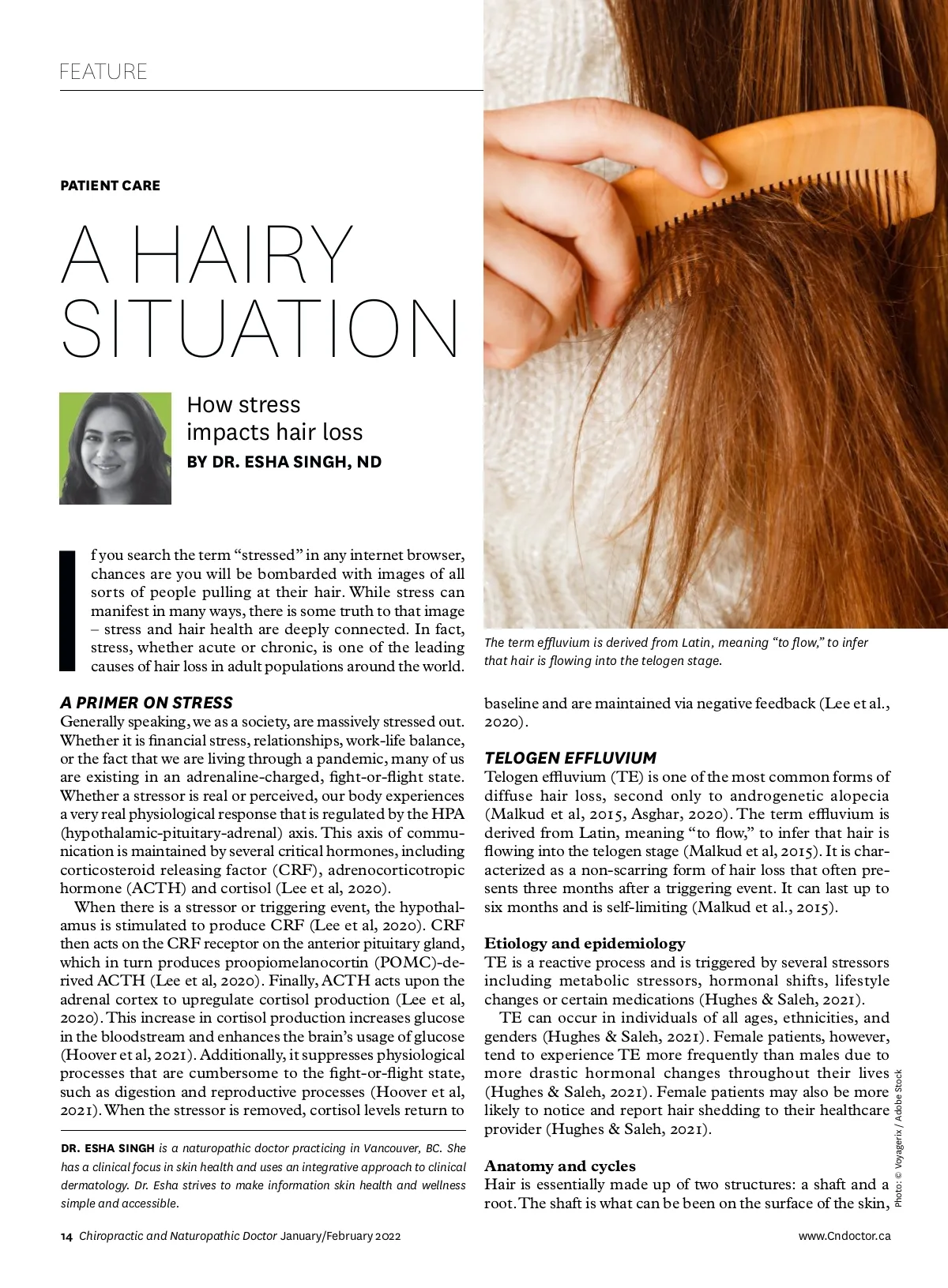
while the root is deeper down in the dermis and is surrounded by the hair follicle (informedhealth.org, 2006). The hair fol-licle is made up of mesenchymal-derived dermal papilla cells (DPCs) and epithelial-derived root sheets (Lee et al, 2020). The interaction between these two tissues regulates hair growth and development and maintains a normal hair cycle (Yang et al, 2010). To understand telogen effluvium, it is important to first understand what the normal hair cycle looks like. While the hair throughout the body goes through the same stages, the duration of each stage differs depending on what part of the body you are focussing on (Hoover et al, 2021). Additionally, the rate of hair growth in individuals is influenced by many factors, including age, gender, and genetics (Hoover et al, 2021). Skin is the largest organ of the body and up to 90% can be covered in hair follicles (Paus & Cotsarelis, 1999). The scalp portion of the skin has roughly 100,000 hair follicles and is one of the densest areas of follicles on the body (Saleh, 2021). The hair follicles undergo repetitive, regenerative cycles that consist of four stages: (1) anagen, (2) catagen, (3) telogen, and (4) kenogen (Avci, 2014). Anagen is an active stage, characterized by rapid growth. At any given time, about 90% of the hair follicles are in the anagen stage. This stage lasts between 2-6 years, with an average of three years (Saleh, 2021). During this stage, DPCs rapidly undergo mitosis, allowing for hair to grow 1/2-1 inch per month (Malkud, 2015). After anagen, the hair follicle transitions into the cat-agen stage. During this stage, the growth rate decelerates and the follicle prepares to go into the rest stage (Avci, 2014). This stage lasts about 10 days (Saleh, 2021). During the telogen stage, there is no growth. The follicle can stay at rest for 3-5 months (Saleh, 2021). At any given point, about 10% of hair follicles are in the telogen stage. The final stage of the hair cycle is another transitory stage, kenogen, during which the existing hair is shed and the follicle is empty (Avci, 2014). Under normal circumstances, one can lose up to 100 strands of hair per day. Pathophysiology In telogen effluvium, hair follicles shift prematurely into rest phase after acute or chronic stress (Asghar, 2020). Thom et al determined that stress can impact hair health and density in three main ways (Thom et al, 2016): • Acute or chronic stress can induce hair loss • Stress can worsen hair loss that initially caused by another condition • Hair loss can cause increased stress due to feelings of shame and/or embarrassment • For the purpose of this article, we will only look at acute/ chronic stress inducing hair loss. As aforementioned, whenever there is a stressor, whether www.Cndoctor.ca CND_Szioplus_JanFeb22_CSA.indd 1 January/February 2022 Chiropractic and Naturopathic Doctor 15 2022-01-19 1:46 PM
Chiropractic + Naturopathic Doctor January/February 2022: Page 15