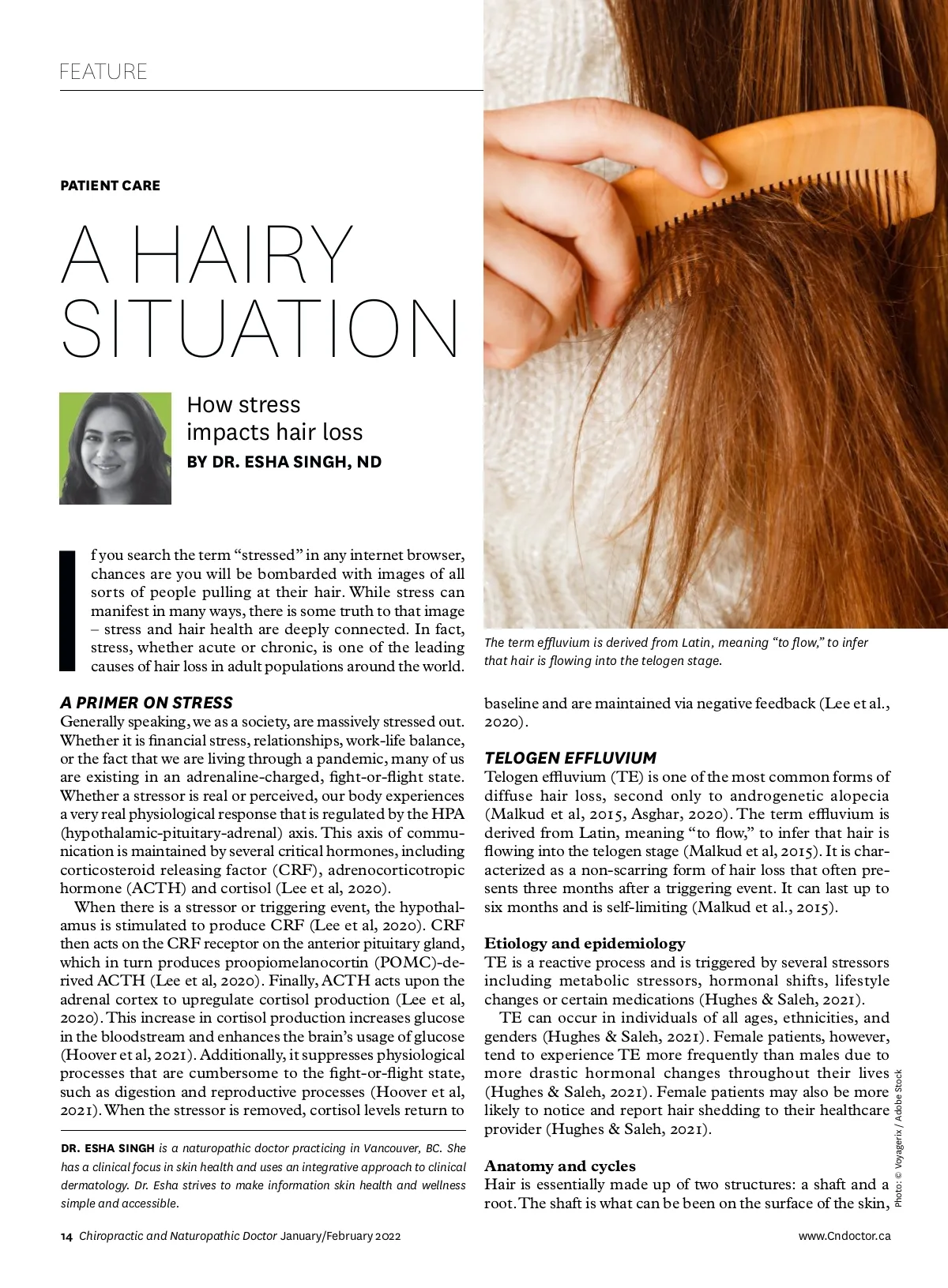
FEATURE PATIENT CARE A HAIRY SITUATION How stress impacts hair loss BY DR. ESHA SINGH, ND I f you search the term “stressed” in any internet browser, chances are you will be bombarded with images of all sorts of people pulling at their hair. While stress can manifest in many ways, there is some truth to that image – stress and hair health are deeply connected. In fact, stress, whether acute or chronic, is one of the leading causes of hair loss in adult populations around the world. The term effluvium is derived from Latin, meaning “to flow,” to infer that hair is flowing into the telogen stage. A PRIMER ON STRESS DR. ESHA SINGH is a naturopathic doctor practicing in Vancouver, BC. She has a clinical focus in skin health and uses an integrative approach to clinical dermatology. Dr. Esha strives to make information skin health and wellness simple and accessible. 14 Chiropractic and Naturopathic Doctor January/February 2022 Anatomy and cycles Hair is essentially made up of two structures: a shaft and a root. The shaft is what can be been on the surface of the skin, www.Cndoctor.ca Photo: © Voyagerix / Adobe Stock Generally speaking, we as a society, are massively stressed out. Whether it is financial stress, relationships, work-life balance, or the fact that we are living through a pandemic, many of us are existing in an adrenaline-charged, fight-or-flight state. Whether a stressor is real or perceived, our body experiences a very real physiological response that is regulated by the HPA (hypothalamic-pituitary-adrenal) axis. This axis of commu-nication is maintained by several critical hormones, including corticosteroid releasing factor (CRF), adrenocorticotropic hormone (ACTH) and cortisol (Lee et al, 2020). When there is a stressor or triggering event, the hypothal-amus is stimulated to produce CRF (Lee et al, 2020). CRF then acts on the CRF receptor on the anterior pituitary gland, which in turn produces proopiomelanocortin (POMC)-de-rived ACTH (Lee et al, 2020). Finally, ACTH acts upon the adrenal cortex to upregulate cortisol production (Lee et al, 2020). This increase in cortisol production increases glucose in the bloodstream and enhances the brain’s usage of glucose (Hoover et al, 2021). Additionally, it suppresses physiological processes that are cumbersome to the fight-or-flight state, such as digestion and reproductive processes (Hoover et al, 2021). When the stressor is removed, cortisol levels return to baseline and are maintained via negative feedback (Lee et al., 2020). TELOGEN EFFLUVIUM Telogen effluvium (TE) is one of the most common forms of diffuse hair loss, second only to androgenetic alopecia (Malkud et al, 2015, Asghar, 2020). The term effluvium is derived from Latin, meaning “to flow,” to infer that hair is flowing into the telogen stage (Malkud et al, 2015). It is char-acterized as a non-scarring form of hair loss that often pre-sents three months after a triggering event. It can last up to six months and is self-limiting (Malkud et al., 2015). Etiology and epidemiology TE is a reactive process and is triggered by several stressors including metabolic stressors, hormonal shifts, lifestyle changes or certain medications (Hughes & Saleh, 2021). TE can occur in individuals of all ages, ethnicities, and genders (Hughes & Saleh, 2021). Female patients, however, tend to experience TE more frequently than males due to more drastic hormonal changes throughout their lives (Hughes & Saleh, 2021). Female patients may also be more likely to notice and report hair shedding to their healthcare provider (Hughes & Saleh, 2021).
Chiropractic + Naturopathic Doctor January/February 2022: Page 14