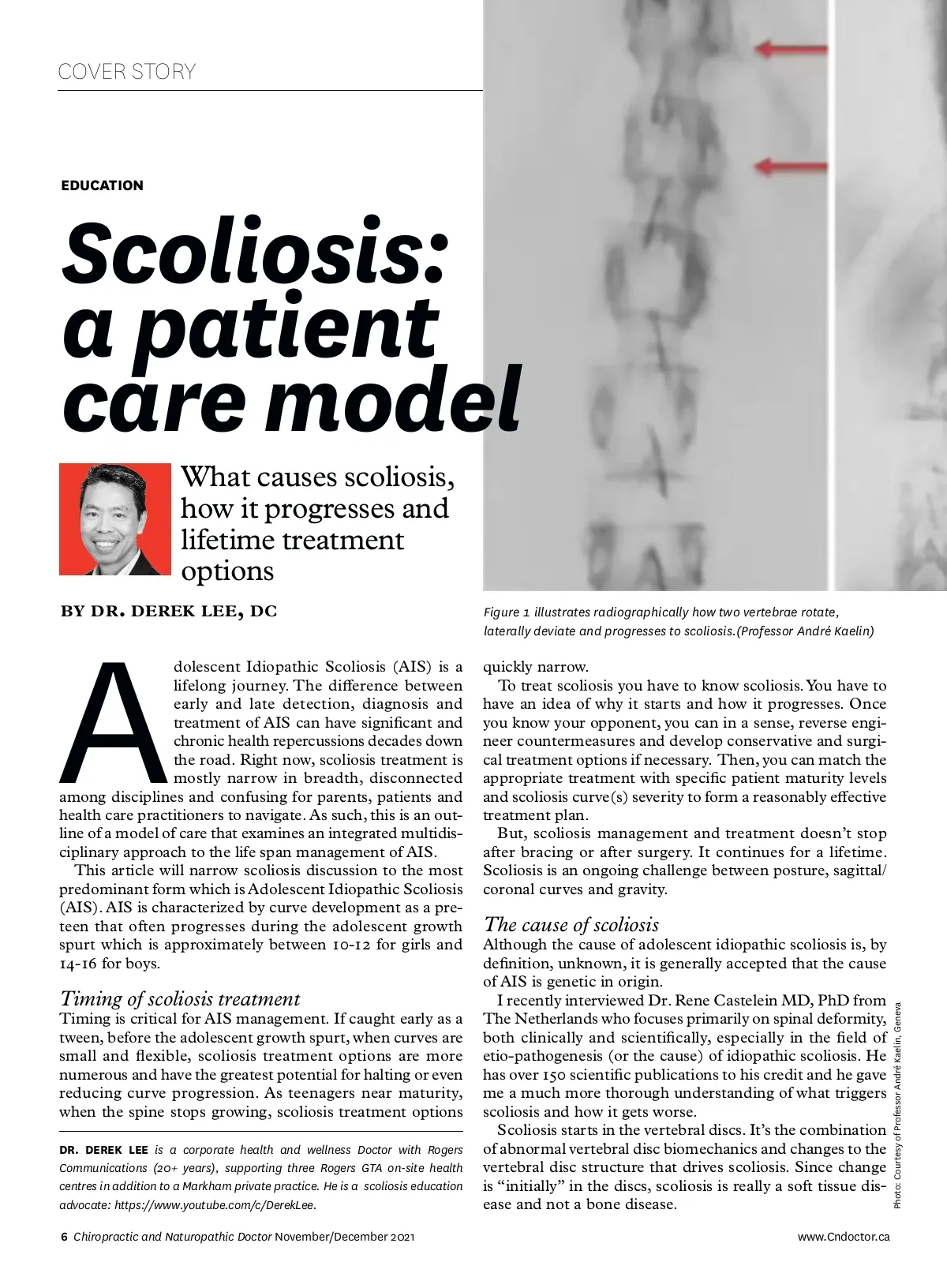
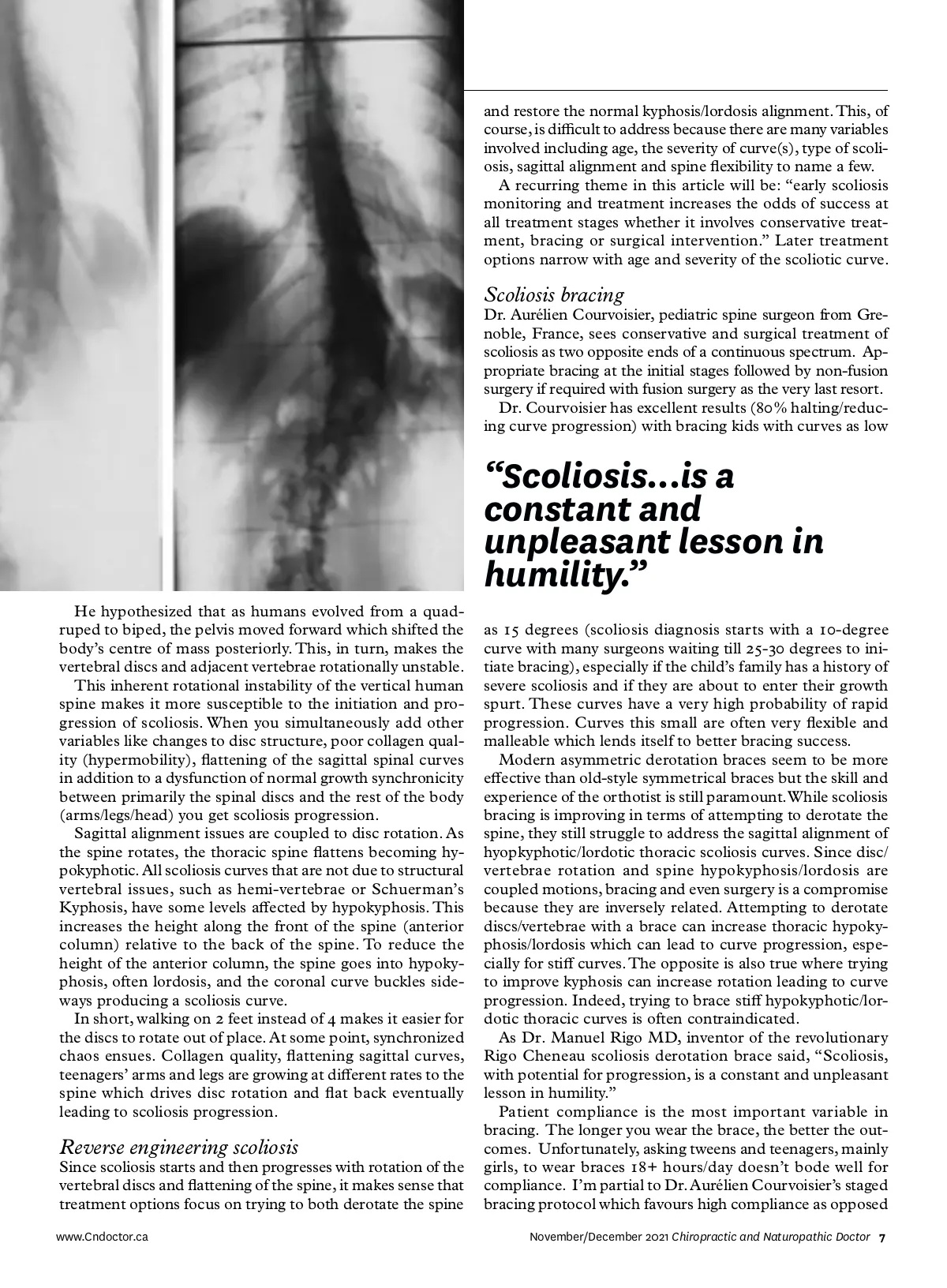
and restore the normal kyphosis/lordosis alignment. This, of course, is difficult to address because there are many variables involved including age, the severity of curve(s), type of scoli-osis, sagittal alignment and spine flexibility to name a few. A recurring theme in this article will be: “early scoliosis monitoring and treatment increases the odds of success at all treatment stages whether it involves conservative treat-ment, bracing or surgical intervention.” Later treatment options narrow with age and severity of the scoliotic curve. Scoliosis bracing Dr. Aurélien Courvoisier, pediatric spine surgeon from Gre-noble, France, sees conservative and surgical treatment of scoliosis as two opposite ends of a continuous spectrum. Ap-propriate bracing at the initial stages followed by non-fusion surgery if required with fusion surgery as the very last resort. Dr. Courvoisier has excellent results (80% halting/reduc-ing curve progression) with bracing kids with curves as low “Scoliosis...is a constant and unpleasant lesson in humility.” He hypothesized that as humans evolved from a quad-ruped to biped, the pelvis moved forward which shifted the body’s centre of mass posteriorly. This, in turn, makes the vertebral discs and adjacent vertebrae rotationally unstable. This inherent rotational instability of the vertical human spine makes it more susceptible to the initiation and pro-gression of scoliosis. When you simultaneously add other variables like changes to disc structure, poor collagen qual-ity (hypermobility), flattening of the sagittal spinal curves in addition to a dysfunction of normal growth synchronicity between primarily the spinal discs and the rest of the body (arms/legs/head) you get scoliosis progression. Sagittal alignment issues are coupled to disc rotation. As the spine rotates, the thoracic spine flattens becoming hy-pokyphotic. All scoliosis curves that are not due to structural vertebral issues, such as hemi-vertebrae or Schuerman’s Kyphosis, have some levels affected by hypokyphosis. This increases the height along the front of the spine (anterior column) relative to the back of the spine. To reduce the height of the anterior column, the spine goes into hypoky-phosis, often lordosis, and the coronal curve buckles side-ways producing a scoliosis curve. In short, walking on 2 feet instead of 4 makes it easier for the discs to rotate out of place. At some point, synchronized chaos ensues. Collagen quality, flattening sagittal curves, teenagers’ arms and legs are growing at different rates to the spine which drives disc rotation and flat back eventually leading to scoliosis progression. as 15 degrees (scoliosis diagnosis starts with a 10-degree curve with many surgeons waiting till 25-30 degrees to ini-tiate bracing), especially if the child’s family has a history of severe scoliosis and if they are about to enter their growth spurt. These curves have a very high probability of rapid progression. Curves this small are often very flexible and malleable which lends itself to better bracing success. Modern asymmetric derotation braces seem to be more effective than old-style symmetrical braces but the skill and experience of the orthotist is still paramount. While scoliosis bracing is improving in terms of attempting to derotate the spine, they still struggle to address the sagittal alignment of hyopkyphotic/lordotic thoracic scoliosis curves. Since disc/ vertebrae rotation and spine hypokyphosis/lordosis are coupled motions, bracing and even surgery is a compromise because they are inversely related. Attempting to derotate discs/vertebrae with a brace can increase thoracic hypoky-phosis/lordosis which can lead to curve progression, espe-cially for stiff curves. The opposite is also true where trying to improve kyphosis can increase rotation leading to curve progression. Indeed, trying to brace stiff hypokyphotic/lor-dotic thoracic curves is often contraindicated. As Dr. Manuel Rigo MD, inventor of the revolutionary Rigo Cheneau scoliosis derotation brace said, “Scoliosis, with potential for progression, is a constant and unpleasant lesson in humility.” Patient compliance is the most important variable in bracing. The longer you wear the brace, the better the out-comes. Unfortunately, asking tweens and teenagers, mainly girls, to wear braces 18+ hours/day doesn’t bode well for compliance. I’m partial to Dr. Aurélien Courvoisier’s staged bracing protocol which favours high compliance as opposed November/December 2021 Chiropractic and Naturopathic Doctor 7 Reverse engineering scoliosis Since scoliosis starts and then progresses with rotation of the vertebral discs and flattening of the spine, it makes sense that treatment options focus on trying to both derotate the spine www.Cndoctor.ca
Chiropractic + Naturopathic Doctor November/December 2021: Page 7