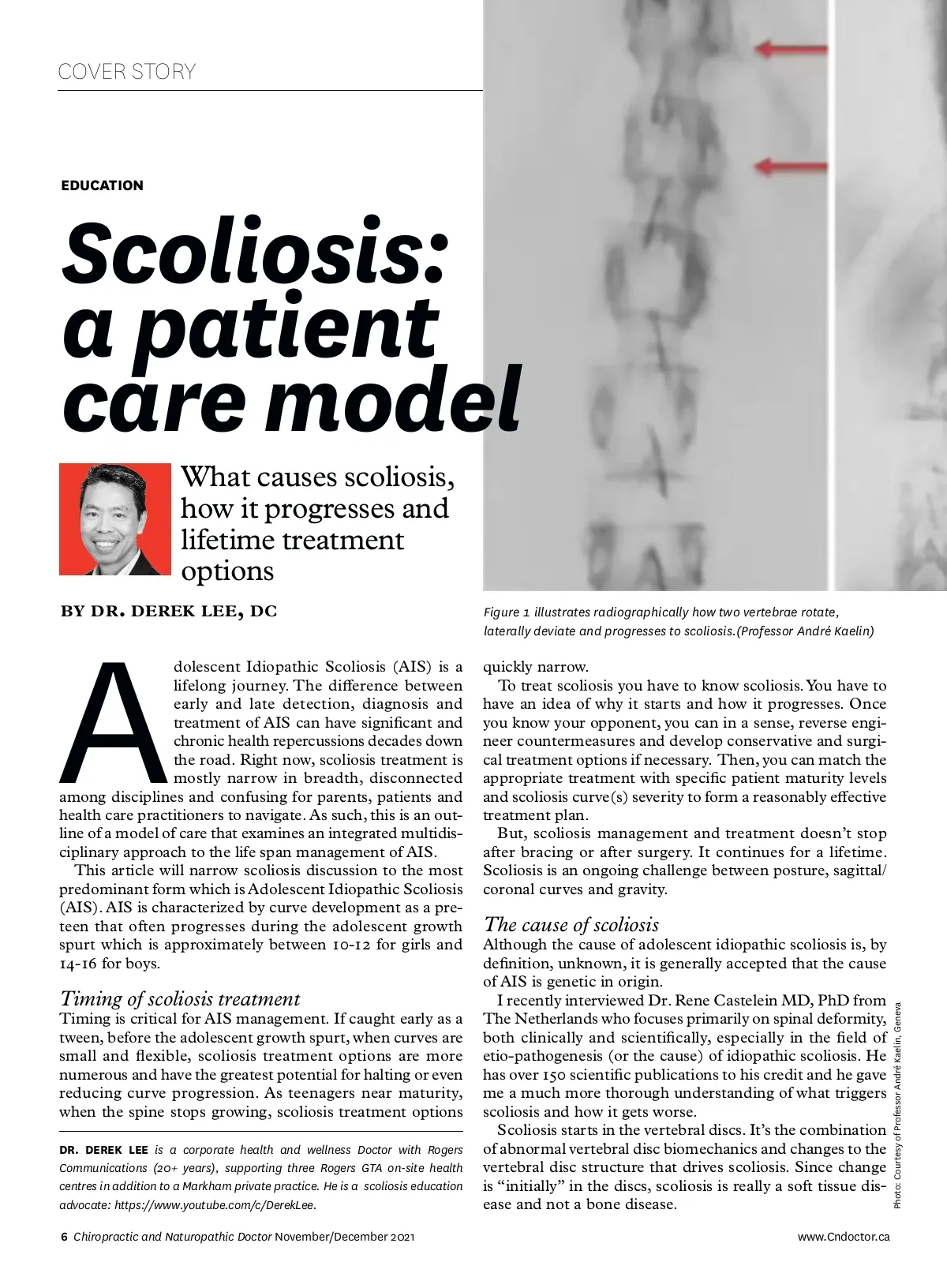
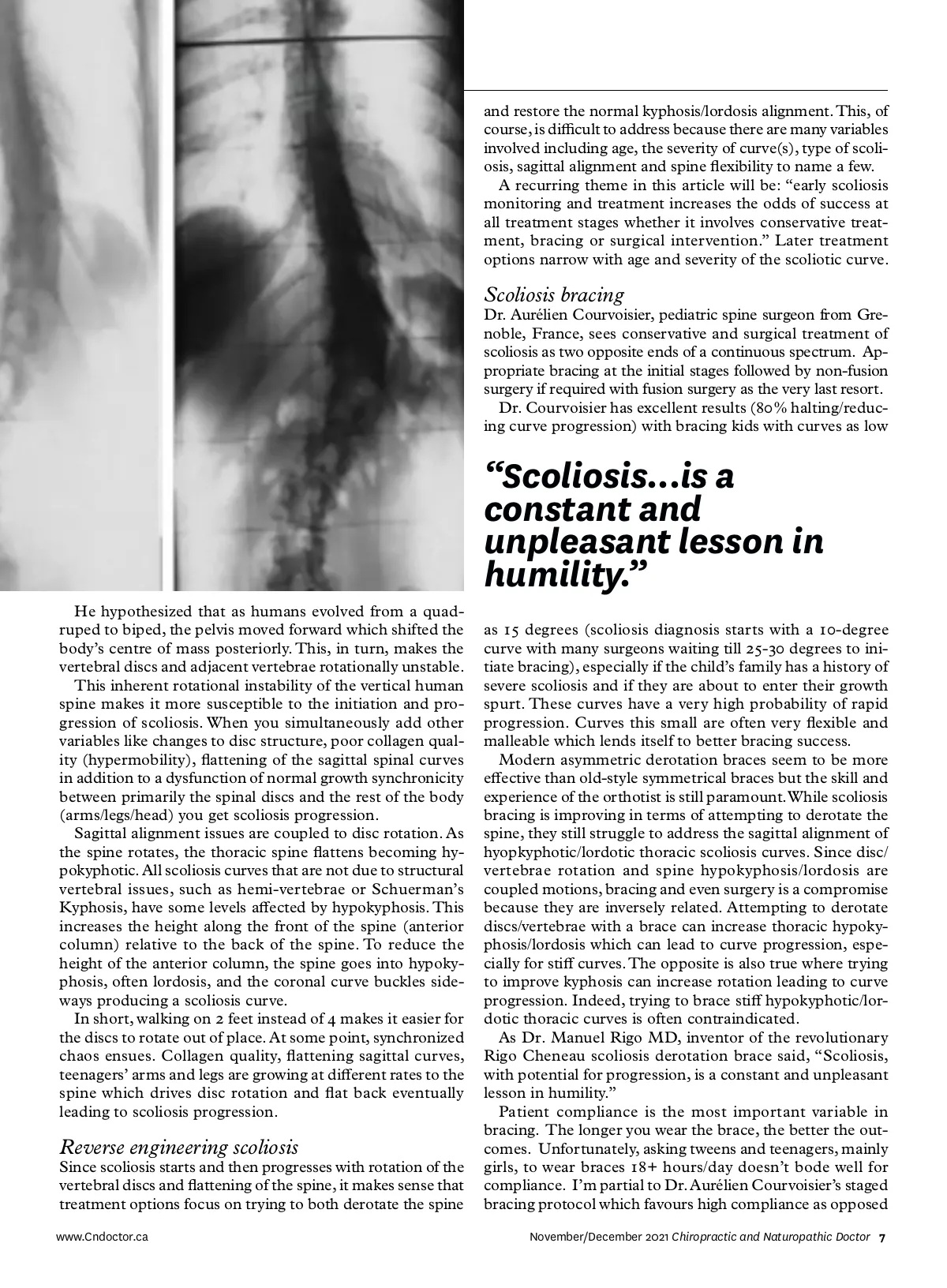
COVER STORY EDUCATION Scoliosis: a patient care model A What causes scoliosis, how it progresses and lifetime treatment options Figure 1 illustrates radiographically how two vertebrae rotate, laterally deviate and progresses to scoliosis.(Professor André Kaelin) by dr . derek lee , dc dolescent Idiopathic Scoliosis (AIS) is a lifelong journey. The difference between early and late detection, diagnosis and treatment of AIS can have significant and chronic health repercussions decades down the road. Right now, scoliosis treatment is mostly narrow in breadth, disconnected among disciplines and confusing for parents, patients and health care practitioners to navigate. As such, this is an out-line of a model of care that examines an integrated multidis-ciplinary approach to the life span management of AIS. This article will narrow scoliosis discussion to the most predominant form which is Adolescent Idiopathic Scoliosis (AIS). AIS is characterized by curve development as a pre-teen that often progresses during the adolescent growth spurt which is approximately between 10-12 for girls and 14-16 for boys. quickly narrow. To treat scoliosis you have to know scoliosis. You have to have an idea of why it starts and how it progresses. Once you know your opponent, you can in a sense, reverse engi-neer countermeasures and develop conservative and surgi-cal treatment options if necessary. Then, you can match the appropriate treatment with specific patient maturity levels and scoliosis curve(s) severity to form a reasonably effective treatment plan. But, scoliosis management and treatment doesn’t stop after bracing or after surgery. It continues for a lifetime. Scoliosis is an ongoing challenge between posture, sagittal/ coronal curves and gravity. The cause of scoliosis Timing is critical for AIS management. If caught early as a tween, before the adolescent growth spurt, when curves are small and flexible, scoliosis treatment options are more numerous and have the greatest potential for halting or even reducing curve progression. As teenagers near maturity, when the spine stops growing, scoliosis treatment options DR. DEREK LEE is a corporate health and wellness Doctor with Rogers Communications (20+ years), supporting three Rogers GTA on-site health centres in addition to a Markham private practice. He is a scoliosis education advocate: https://www.youtube.com/c/DerekLee. 6 Chiropractic and Naturopathic Doctor November/December 2021 www.Cndoctor.ca Photo: Courtesy of Professor André Kaelin, Geneva Timing of scoliosis treatment Although the cause of adolescent idiopathic scoliosis is, by definition, unknown, it is generally accepted that the cause of AIS is genetic in origin. I recently interviewed Dr. Rene Castelein MD, PhD from The Netherlands who focuses primarily on spinal deformity, both clinically and scientifically, especially in the field of etio-pathogenesis (or the cause) of idiopathic scoliosis. He has over 150 scientific publications to his credit and he gave me a much more thorough understanding of what triggers scoliosis and how it gets worse. Scoliosis starts in the vertebral discs. It’s the combination of abnormal vertebral disc biomechanics and changes to the vertebral disc structure that drives scoliosis. Since change is “initially” in the discs, scoliosis is really a soft tissue dis-ease and not a bone disease.
Chiropractic + Naturopathic Doctor November/December 2021: Page 6