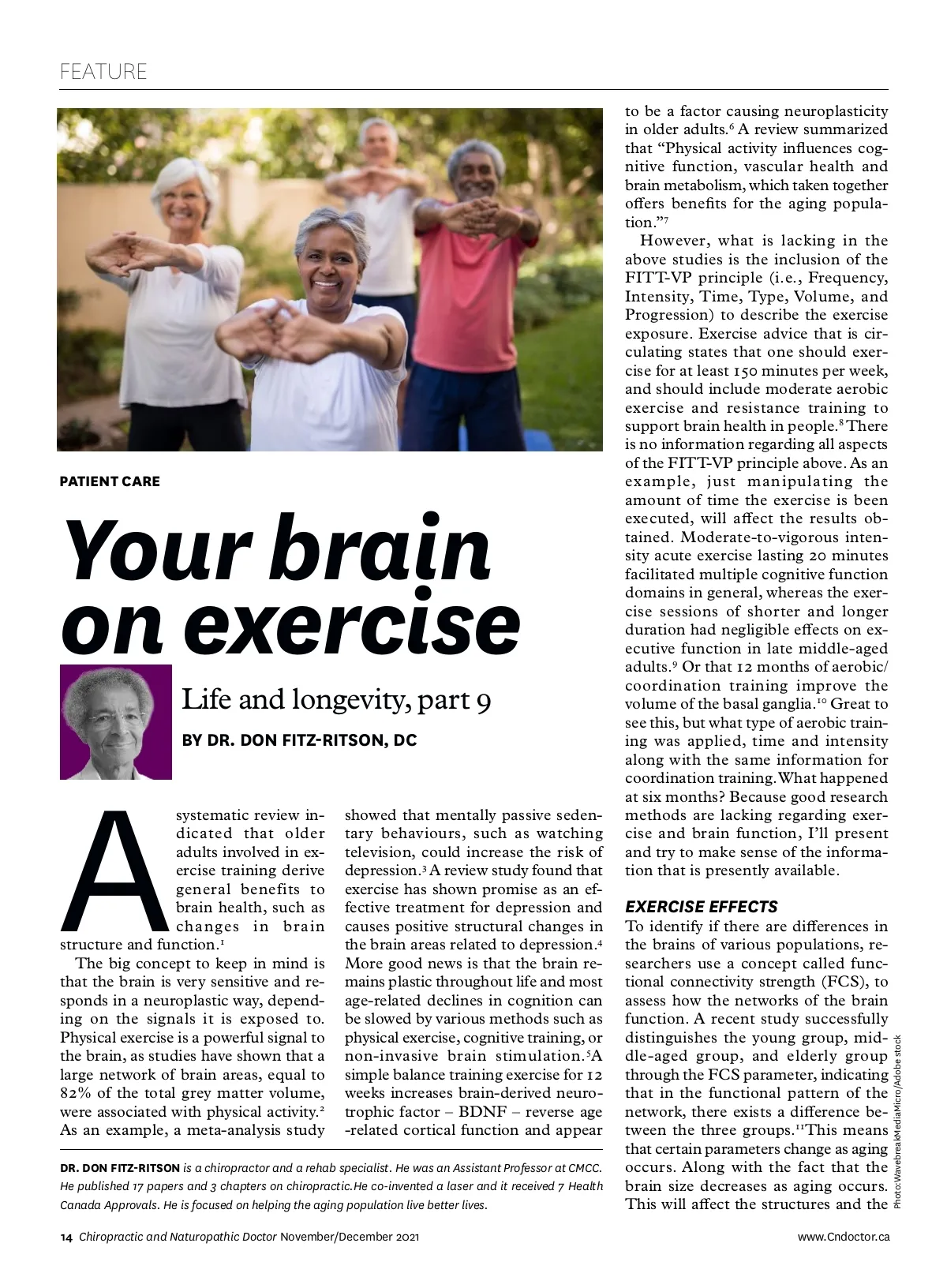
FEATURE to be a factor causing neuroplasticity in older adults. 6 A review summarized that “Physical activity influences cog-nitive function, vascular health and brain metabolism, which taken together offers benefits for the aging popula-tion.” 7 However, what is lacking in the above studies is the inclusion of the FITT-VP principle (i.e., Frequency, Intensity, Time, Type, Volume, and Progression) to describe the exercise exposure. Exercise advice that is cir-culating states that one should exer-cise for at least 150 minutes per week, and should include moderate aerobic exercise and resistance training to support brain health in people. 8 There is no information regarding all aspects of the FITT-VP principle above. As an example, just manipulating the amount of time the exercise is been executed, will affect the results ob-tained. Moderate-to-vigorous inten-sity acute exercise lasting 20 minutes facilitated multiple cognitive function domains in general, whereas the exer-cise sessions of shorter and longer duration had negligible effects on ex-ecutive function in late middle-aged adults. 9 Or that 12 months of aerobic/ coordination training improve the volume of the basal ganglia. 10 Great to see this, but what type of aerobic train-ing was applied, time and intensity along with the same information for coordination training. What happened at six months? Because good research methods are lacking regarding exer-cise and brain function, I’ll present and try to make sense of the informa-tion that is presently available. To identify if there are differences in the brains of various populations, re-searchers use a concept called func-tional connectivity strength (FCS), to assess how the networks of the brain function. A recent study successfully distinguishes the young group, mid-dle-aged group, and elderly group through the FCS parameter, indicating that in the functional pattern of the network, there exists a difference be-tween the three groups. 11 This means that certain parameters change as aging occurs. Along with the fact that the brain size decreases as aging occurs. This will affect the structures and the www.Cndoctor.ca PATIENT CARE Your brain on exercise Life and longevity, part 9 A BY DR. DON FITZ-RITSON, DC DR. DON FITZ-RITSON is a chiropractor and a rehab specialist. He was an Assistant Professor at CMCC. He published 17 papers and 3 chapters on chiropractic.He co-invented a laser and it received 7 Health Canada Approvals. He is focused on helping the aging population live better lives. 14 Chiropractic and Naturopathic Doctor November/December 2021 Photo:WavebreakMediaMicro/Adobe stock systematic review in-dicated that older adults involved in ex-ercise training derive general benefits to brain health, such as changes in brain structure and function. 1 The big concept to keep in mind is that the brain is very sensitive and re-sponds in a neuroplastic way, depend-ing on the signals it is exposed to. Physical exercise is a powerful signal to the brain, as studies have shown that a large network of brain areas, equal to 82% of the total grey matter volume, were associated with physical activity. 2 As an example, a meta-analysis study showed that mentally passive seden-tary behaviours, such as watching television, could increase the risk of depression. 3 A review study found that exercise has shown promise as an ef-fective treatment for depression and causes positive structural changes in the brain areas related to depression. 4 More good news is that the brain re-mains plastic throughout life and most age-related declines in cognition can be slowed by various methods such as physical exercise, cognitive training, or non-invasive brain stimulation. 5 A simple balance training exercise for 12 weeks increases brain-derived neuro-trophic factor – BDNF – reverse age -related cortical function and appear EXERCISE EFFECTS
Chiropractic + Naturopathic Doctor November/December 2021: Page 14