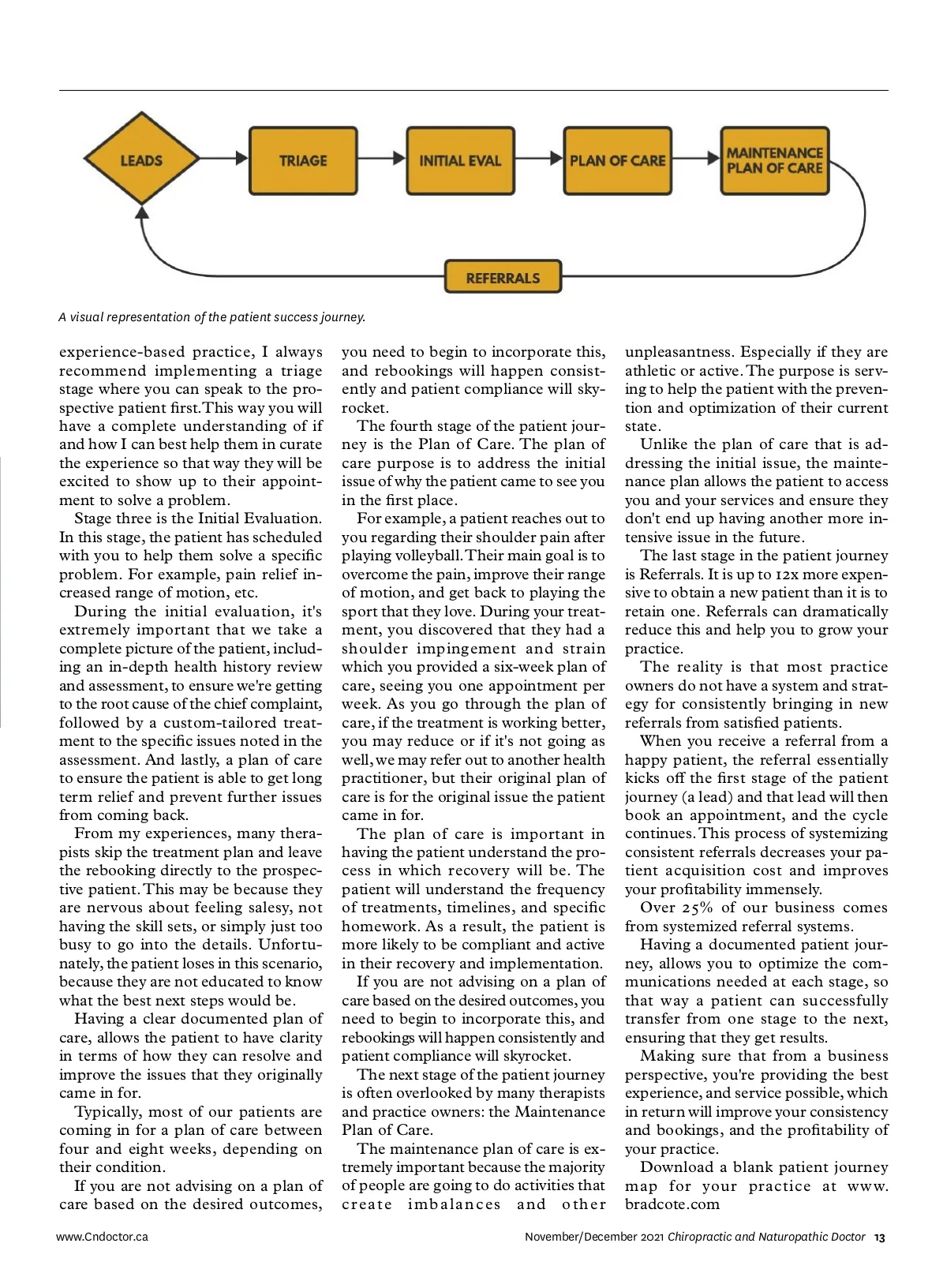
A visual representation of the patient success journey. experience-based practice, I always recommend implementing a triage stage where you can speak to the pro-spective patient first.This way you will have a complete understanding of if and how I can best help them in curate the experience so that way they will be excited to show up to their appoint-ment to solve a problem. Stage three is the Initial Evaluation. In this stage, the patient has scheduled with you to help them solve a specific problem. For example, pain relief in-creased range of motion, etc. During the initial evaluation, it's extremely important that we take a complete picture of the patient, includ-ing an in-depth health history review and assessment, to ensure we're getting to the root cause of the chief complaint, followed by a custom-tailored treat-ment to the specific issues noted in the assessment. And lastly, a plan of care to ensure the patient is able to get long term relief and prevent further issues from coming back. From my experiences, many thera-pists skip the treatment plan and leave the rebooking directly to the prospec-tive patient. This may be because they are nervous about feeling salesy, not having the skill sets, or simply just too busy to go into the details. Unfortu-nately, the patient loses in this scenario, because they are not educated to know what the best next steps would be. Having a clear documented plan of care, allows the patient to have clarity in terms of how they can resolve and improve the issues that they originally came in for. Typically, most of our patients are coming in for a plan of care between four and eight weeks, depending on their condition. If you are not advising on a plan of care based on the desired outcomes, www.Cndoctor.ca you need to begin to incorporate this, and rebookings will happen consist-ently and patient compliance will sky-rocket. The fourth stage of the patient jour-ney is the Plan of Care. The plan of care purpose is to address the initial issue of why the patient came to see you in the first place. For example, a patient reaches out to you regarding their shoulder pain after playing volleyball. Their main goal is to overcome the pain, improve their range of motion, and get back to playing the sport that they love. During your treat-ment, you discovered that they had a shoulder impingement and strain which you provided a six-week plan of care, seeing you one appointment per week. As you go through the plan of care, if the treatment is working better, you may reduce or if it's not going as well, we may refer out to another health practitioner, but their original plan of care is for the original issue the patient came in for. The plan of care is important in having the patient understand the pro-cess in which recovery will be. The patient will understand the frequency of treatments, timelines, and specific homework. As a result, the patient is more likely to be compliant and active in their recovery and implementation. If you are not advising on a plan of care based on the desired outcomes, you need to begin to incorporate this, and rebookings will happen consistently and patient compliance will skyrocket. The next stage of the patient journey is often overlooked by many therapists and practice owners: the Maintenance Plan of Care. The maintenance plan of care is ex-tremely important because the majority of people are going to do activities that create imbalances and other unpleasantness. Especially if they are athletic or active. The purpose is serv-ing to help the patient with the preven-tion and optimization of their current state. Unlike the plan of care that is ad-dressing the initial issue, the mainte-nance plan allows the patient to access you and your services and ensure they don't end up having another more in-tensive issue in the future. The last stage in the patient journey is Referrals. It is up to 12x more expen-sive to obtain a new patient than it is to retain one. Referrals can dramatically reduce this and help you to grow your practice. The reality is that most practice owners do not have a system and strat-egy for consistently bringing in new referrals from satisfied patients. When you receive a referral from a happy patient, the referral essentially kicks off the first stage of the patient journey (a lead) and that lead will then book an appointment, and the cycle continues. This process of systemizing consistent referrals decreases your pa-tient acquisition cost and improves your profitability immensely. Over 25% of our business comes from systemized referral systems. Having a documented patient jour-ney, allows you to optimize the com-munications needed at each stage, so that way a patient can successfully transfer from one stage to the next, ensuring that they get results. Making sure that from a business perspective, you're providing the best experience, and service possible, which in return will improve your consistency and bookings, and the profitability of your practice. Download a blank patient journey map for your practice at www. bradcote.com November/December 2021 Chiropractic and Naturopathic Doctor 13
Chiropractic + Naturopathic Doctor November/December 2021: Page 13