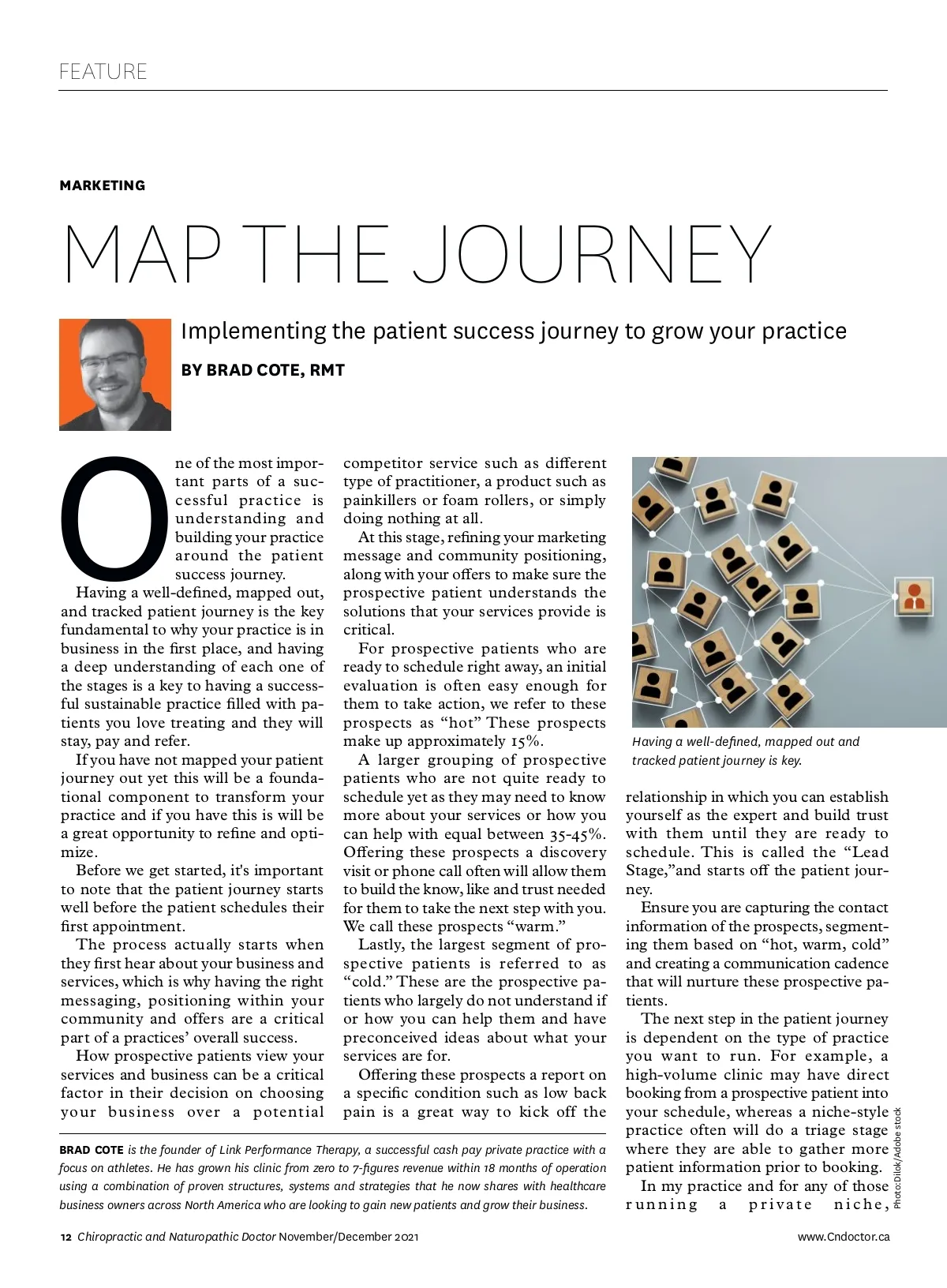
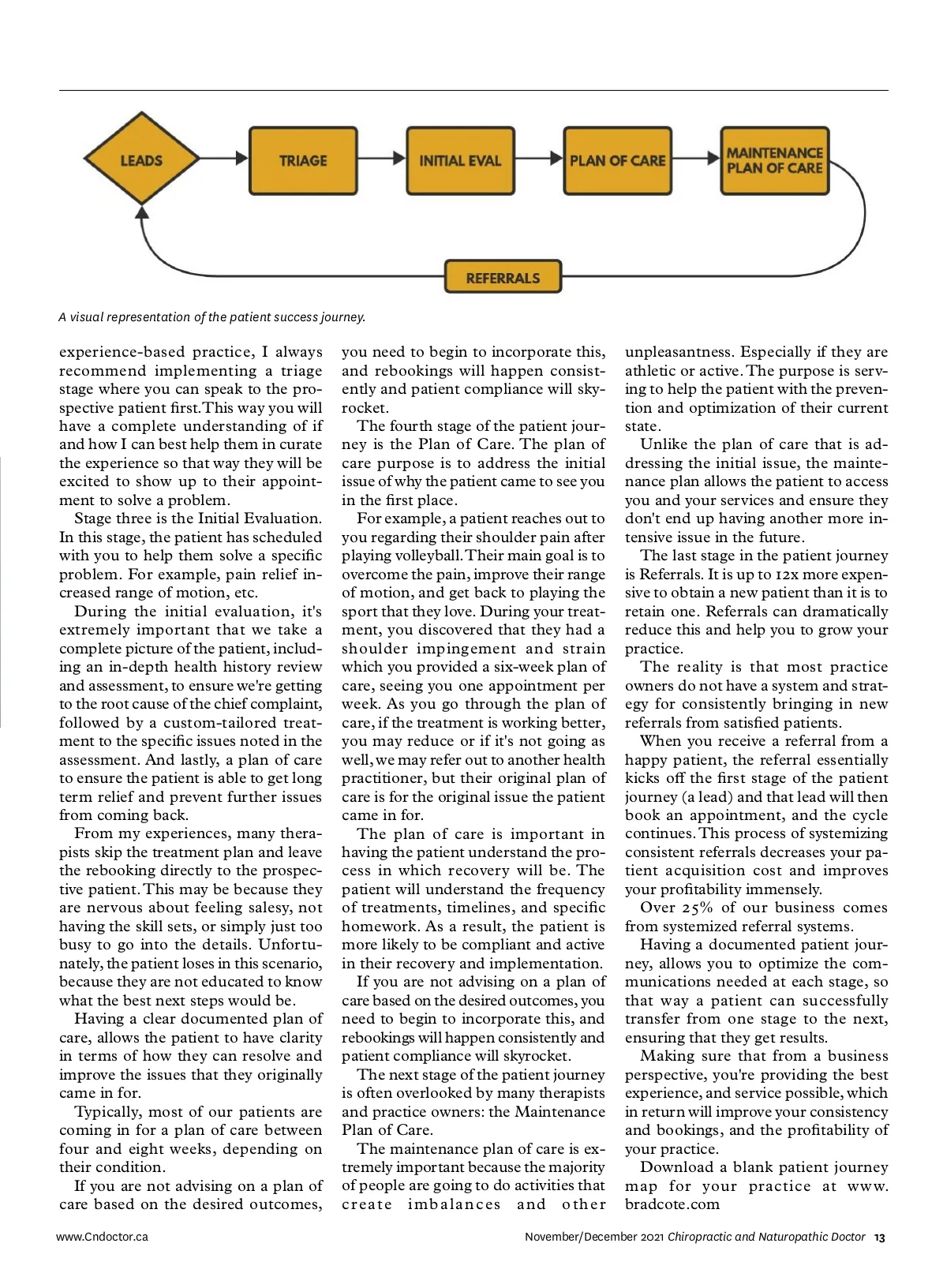
FEATURE MARKETING MAP THE JOURNEY Implementing the patient success journey to grow your practice BY BRAD COTE, RMT O BRAD COTE is the founder of Link Performance Therapy, a successful cash pay private practice with a focus on athletes. He has grown his clinic from zero to 7-figures revenue within 18 months of operation using a combination of proven structures, systems and strategies that he now shares with healthcare business owners across North America who are looking to gain new patients and grow their business. 12 Chiropractic and Naturopathic Doctor November/December 2021 www.Cndoctor.ca Photo:Dilok/Adobe stock ne of the most impor-tant parts of a suc-cessful practice is understanding and building your practice around the patient success journey. Having a well-defined, mapped out, and tracked patient journey is the key fundamental to why your practice is in business in the first place, and having a deep understanding of each one of the stages is a key to having a success-ful sustainable practice filled with pa-tients you love treating and they will stay, pay and refer. If you have not mapped your patient journey out yet this will be a founda-tional component to transform your practice and if you have this is will be a great opportunity to refine and opti-mize. Before we get started, it's important to note that the patient journey starts well before the patient schedules their first appointment. The process actually starts when they first hear about your business and services, which is why having the right messaging, positioning within your community and offers are a critical part of a practices’ overall success. How prospective patients view your services and business can be a critical factor in their decision on choosing your business over a potential competitor service such as different type of practitioner, a product such as painkillers or foam rollers, or simply doing nothing at all. At this stage, refining your marketing message and community positioning, along with your offers to make sure the prospective patient understands the solutions that your services provide is critical. For prospective patients who are ready to schedule right away, an initial evaluation is often easy enough for them to take action, we refer to these prospects as “hot” These prospects make up approximately 15%. A larger grouping of prospective patients who are not quite ready to schedule yet as they may need to know more about your services or how you can help with equal between 35-45%. Offering these prospects a discovery visit or phone call often will allow them to build the know, like and trust needed for them to take the next step with you. We call these prospects “warm.” Lastly, the largest segment of pro-spective patients is referred to as “cold.” These are the prospective pa-tients who largely do not understand if or how you can help them and have preconceived ideas about what your services are for. Offering these prospects a report on a specific condition such as low back pain is a great way to kick off the Having a well-defined, mapped out and tracked patient journey is key. relationship in which you can establish yourself as the expert and build trust with them until they are ready to schedule. This is called the “Lead Stage,”and starts off the patient jour-ney. Ensure you are capturing the contact information of the prospects, segment-ing them based on “hot, warm, cold” and creating a communication cadence that will nurture these prospective pa-tients. The next step in the patient journey is dependent on the type of practice you want to run. For example, a high-volume clinic may have direct booking from a prospective patient into your schedule, whereas a niche-style practice often will do a triage stage where they are able to gather more patient information prior to booking. In my practice and for any of those running a private niche,
Chiropractic + Naturopathic Doctor November/December 2021: Page 12