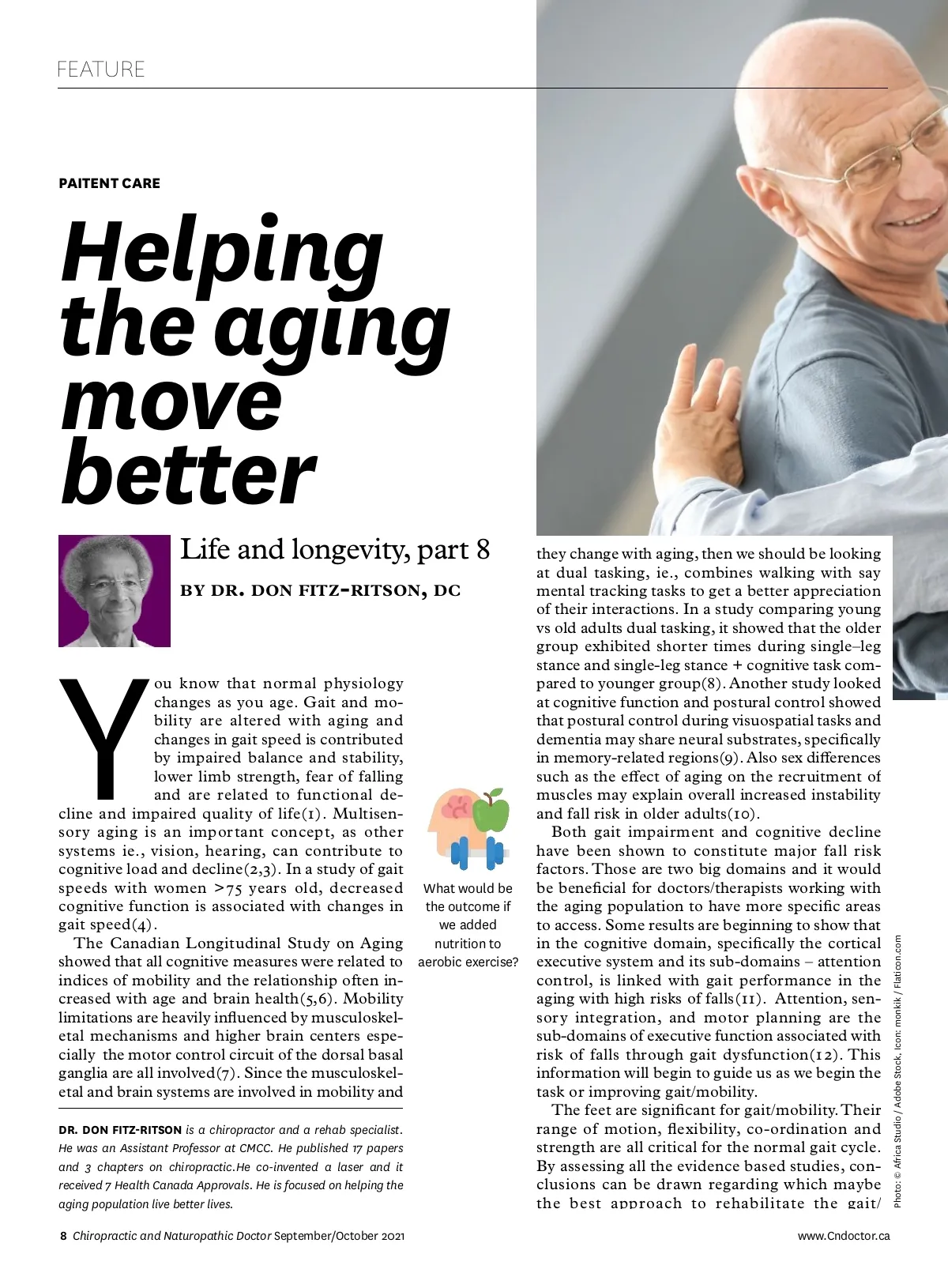
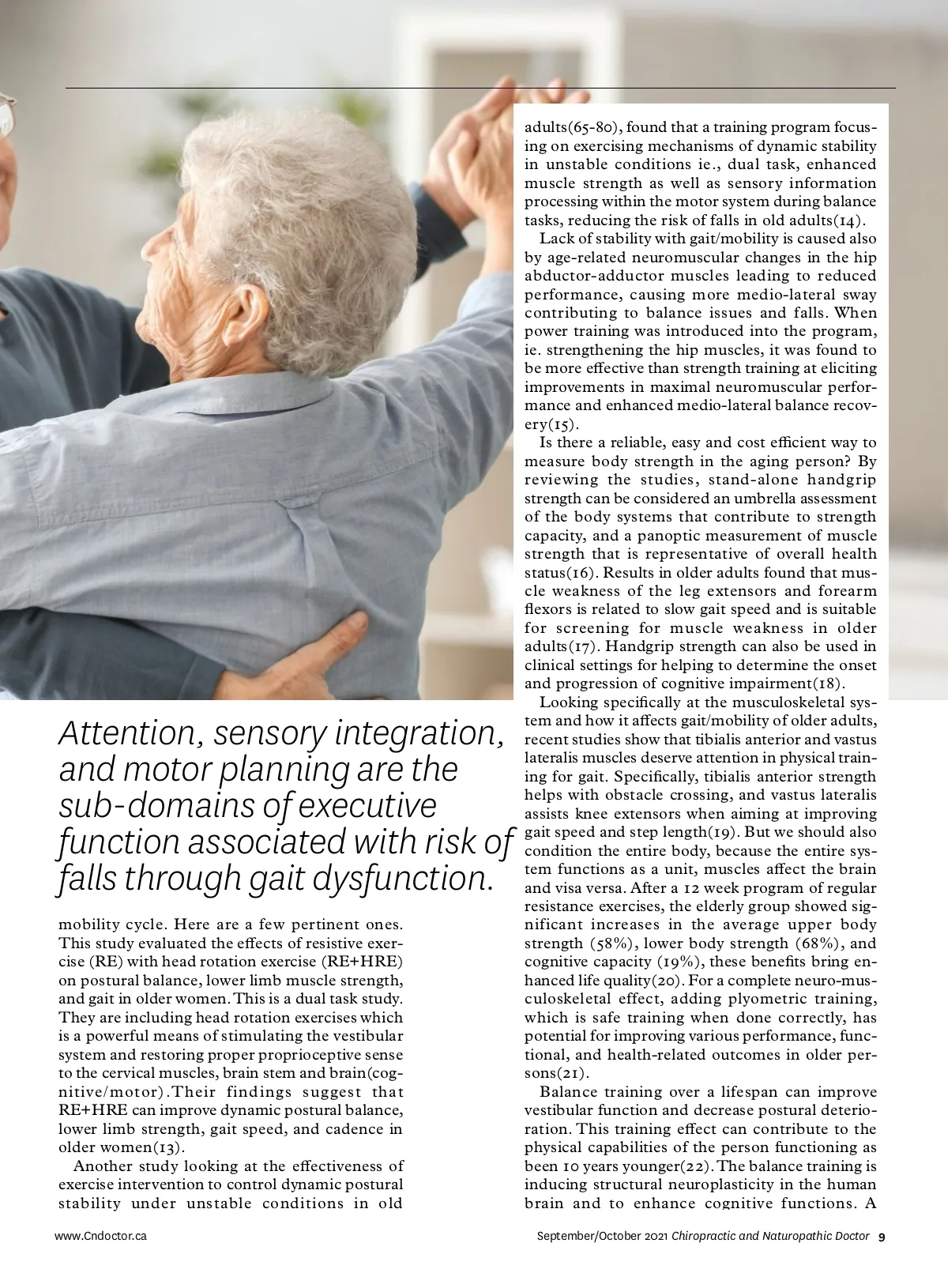
FEATURE PAITENT CARE Helping the aging move better Life and longevity, part 8 by dr . don fitz -ritson , dc Y DR. DON FITZ-RITSON is a chiropractor and a rehab specialist. He was an Assistant Professor at CMCC. He published 17 papers and 3 chapters on chiropractic.He co-invented a laser and it received 7 Health Canada Approvals. He is focused on helping the aging population live better lives. 8 Chiropractic and Naturopathic Doctor September/October 2021 www.Cndoctor.ca Photo: © Africa Studio / Adobe Stock, Icon: monkik / Flaticon.com ou know that normal physiology changes as you age. Gait and mo-bility are altered with aging and changes in gait speed is contributed by impaired balance and stability, lower limb strength, fear of falling and are related to functional de-cline and impaired quality of life(1). Multisen-sory aging is an important concept, as other systems ie., vision, hearing, can contribute to cognitive load and decline(2,3). In a study of gait speeds with women >75 years old, decreased What would be cognitive function is associated with changes in the outcome if we added gait speed(4). nutrition to The Canadian Longitudinal Study on Aging showed that all cognitive measures were related to aerobic exercise? indices of mobility and the relationship often in-creased with age and brain health(5,6). Mobility limitations are heavily influenced by musculoskel-etal mechanisms and higher brain centers espe-cially the motor control circuit of the dorsal basal ganglia are all involved(7). Since the musculoskel-etal and brain systems are involved in mobility and they change with aging, then we should be looking at dual tasking, ie., combines walking with say mental tracking tasks to get a better appreciation of their interactions. In a study comparing young vs old adults dual tasking, it showed that the older group exhibited shorter times during single–leg stance and single-leg stance + cognitive task com-pared to younger group(8). Another study looked at cognitive function and postural control showed that postural control during visuospatial tasks and dementia may share neural substrates, specifically in memory-related regions(9). Also sex differences such as the effect of aging on the recruitment of muscles may explain overall increased instability and fall risk in older adults(10). Both gait impairment and cognitive decline have been shown to constitute major fall risk factors. Those are two big domains and it would be beneficial for doctors/therapists working with the aging population to have more specific areas to access. Some results are beginning to show that in the cognitive domain, specifically the cortical executive system and its sub-domains – attention control, is linked with gait performance in the aging with high risks of falls(11). Attention, sen-sory integration, and motor planning are the sub-domains of executive function associated with risk of falls through gait dysfunction(12). This information will begin to guide us as we begin the task or improving gait/mobility. The feet are significant for gait/mobility. Their range of motion, flexibility, co-ordination and strength are all critical for the normal gait cycle. By assessing all the evidence based studies, con-clusions can be drawn regarding which maybe the best approach to rehabilitate the gait/
Chiropractic + Naturopathic Doctor September/October 2021: Page 8