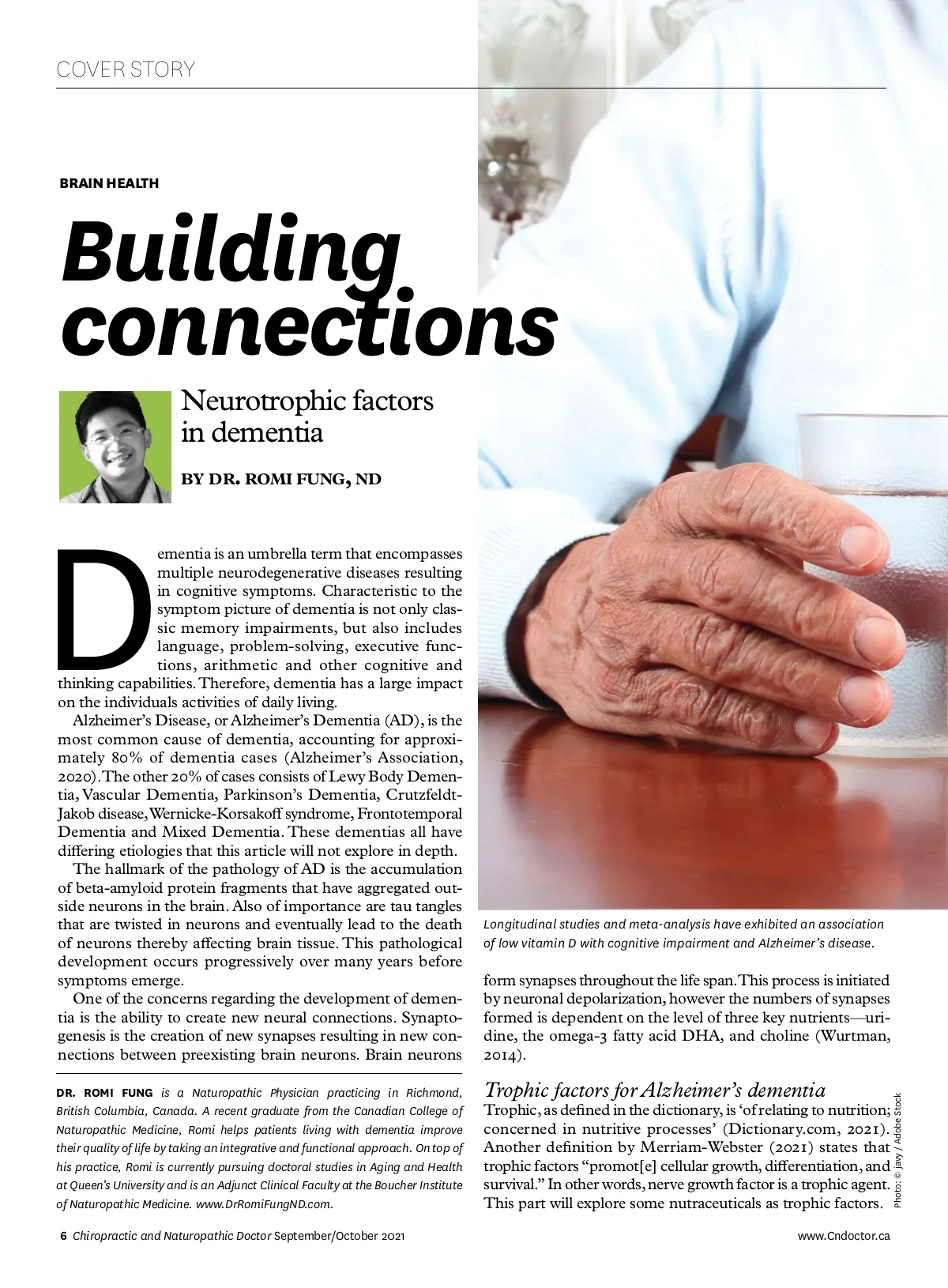
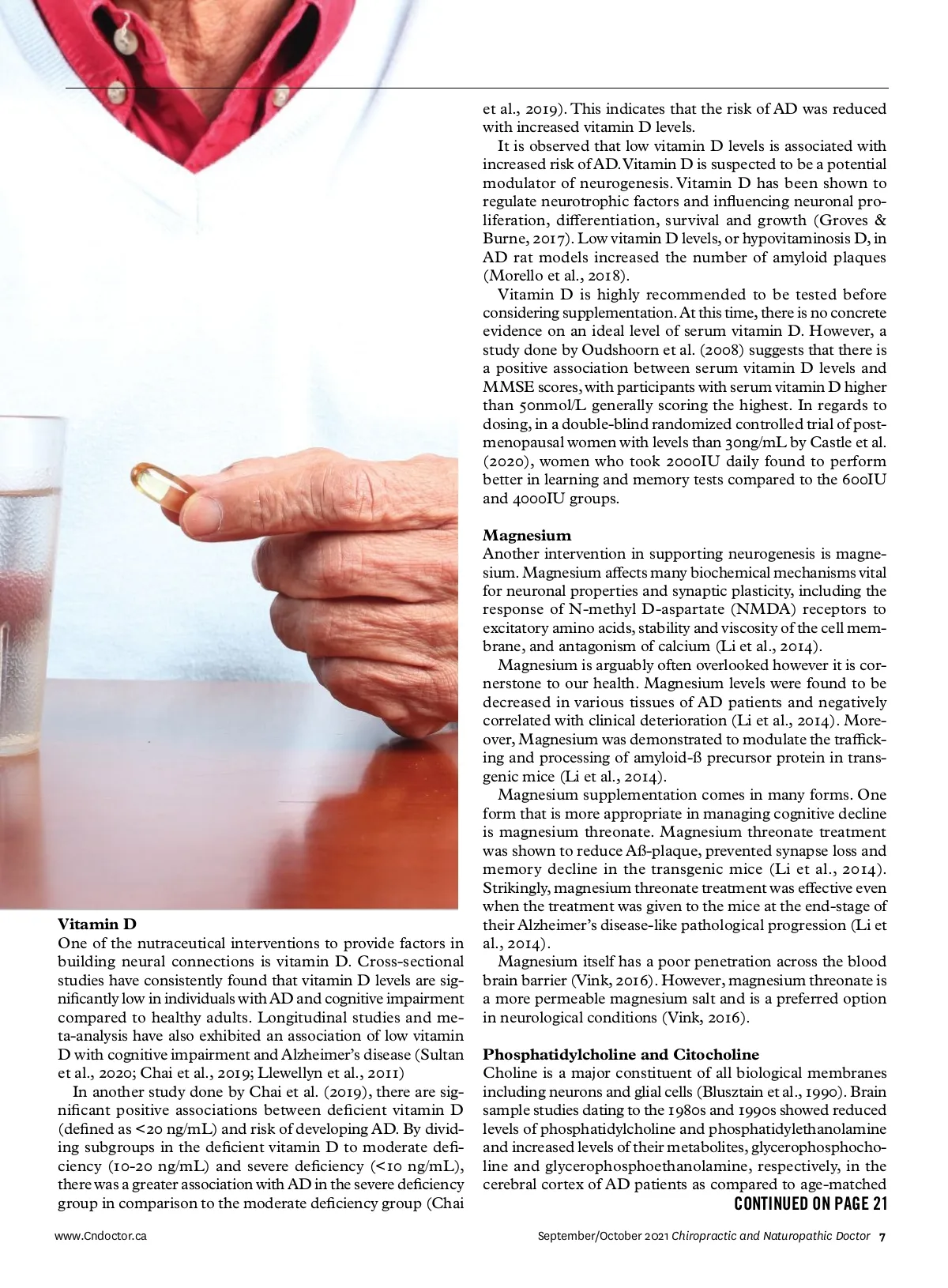
COVER STORY BRAIN HEALTH Building connections Neurotrophic factors in dementia D by dr . romi fung , nd ementia is an umbrella term that encompasses multiple neurodegenerative diseases resulting in cognitive symptoms. Characteristic to the symptom picture of dementia is not only clas-sic memory impairments, but also includes language, problem-solving, executive func-tions, arithmetic and other cognitive and thinking capabilities. Therefore, dementia has a large impact on the individuals activities of daily living. Alzheimer’s Disease, or Alzheimer’s Dementia (AD), is the most common cause of dementia, accounting for approxi-mately 80% of dementia cases (Alzheimer’s Association, 2020). The other 20% of cases consists of Lewy Body Demen-tia, Vascular Dementia, Parkinson’s Dementia, Crutzfeldt-Jakob disease, Wernicke-Korsakoff syndrome, Frontotemporal Dementia and Mixed Dementia. These dementias all have differing etiologies that this article will not explore in depth. The hallmark of the pathology of AD is the accumulation of beta-amyloid protein fragments that have aggregated out-side neurons in the brain. Also of importance are tau tangles that are twisted in neurons and eventually lead to the death of neurons thereby affecting brain tissue. This pathological development occurs progressively over many years before symptoms emerge. One of the concerns regarding the development of demen-tia is the ability to create new neural connections. Synapto-genesis is the creation of new synapses resulting in new con-nections between preexisting brain neurons. Brain neurons Longitudinal studies and meta-analysis have exhibited an association of low vitamin D with cognitive impairment and Alzheimer’s disease. form synapses throughout the life span. This process is initiated by neuronal depolarization, however the numbers of synapses formed is dependent on the level of three key nutrients—uri-dine, the omega-3 fatty acid DHA, and choline (Wurtman, 2014). Trophic, as defined in the dictionary, is ‘of relating to nutrition; concerned in nutritive processes’ (Dictionary.com, 2021). Another definition by Merriam-Webster (2021) states that trophic factors “promot[e] cellular growth, differentiation, and survival.” In other words, nerve growth factor is a trophic agent. This part will explore some nutraceuticals as trophic factors. www.Cndoctor.ca Photo: © javy / Adobe Stock DR. ROMI FUNG is a Naturopathic Physician practicing in Richmond, British Columbia, Canada. A recent graduate from the Canadian College of Naturopathic Medicine, Romi helps patients living with dementia improve their quality of life by taking an integrative and functional approach. On top of his practice, Romi is currently pursuing doctoral studies in Aging and Health at Queen’s University and is an Adjunct Clinical Faculty at the Boucher Institute of Naturopathic Medicine. www.DrRomiFungND.com. 6 Chiropractic and Naturopathic Doctor September/October 2021 Trophic factors for Alzheimer’s dementia
Chiropractic + Naturopathic Doctor September/October 2021: Page 6