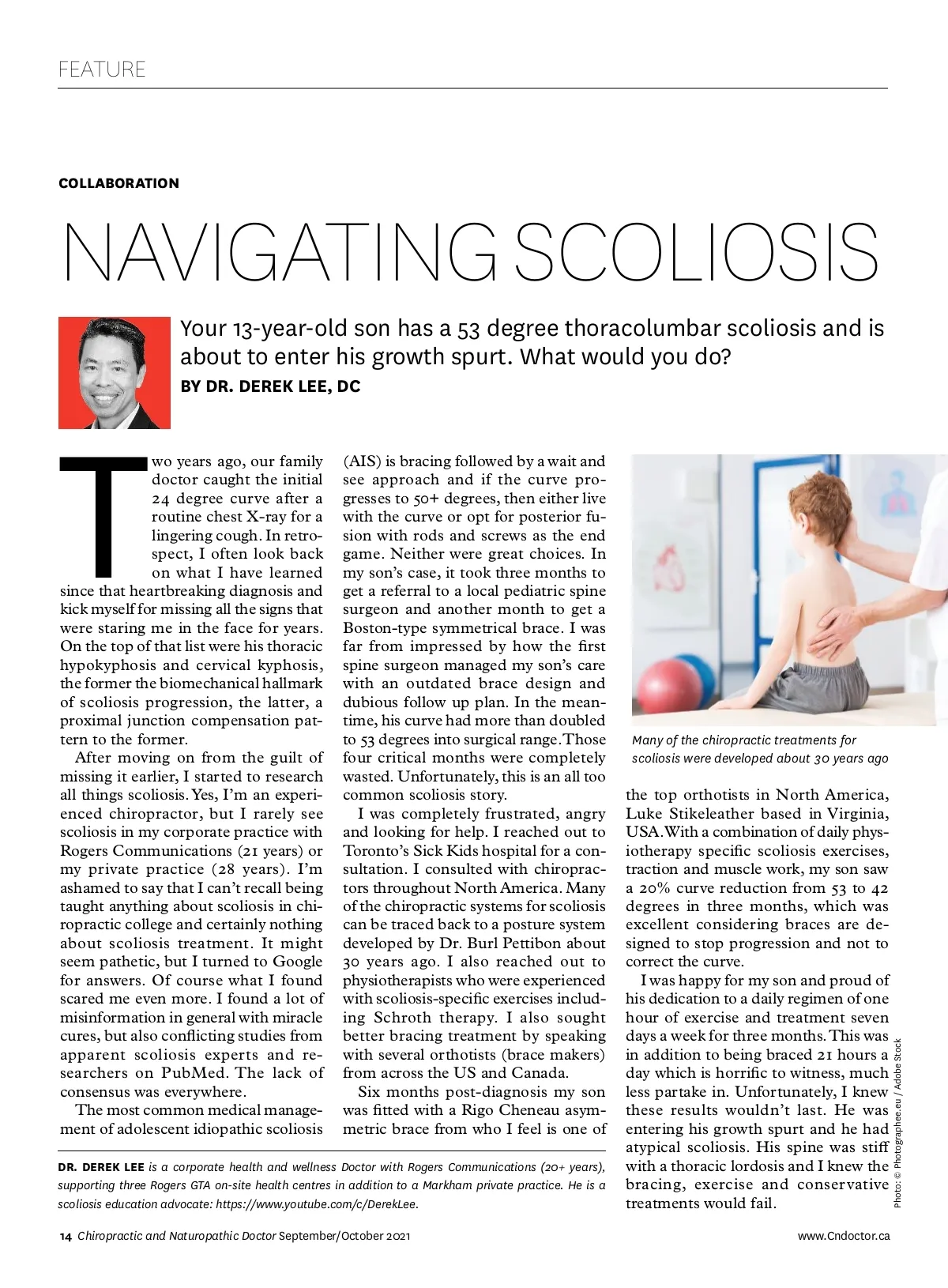
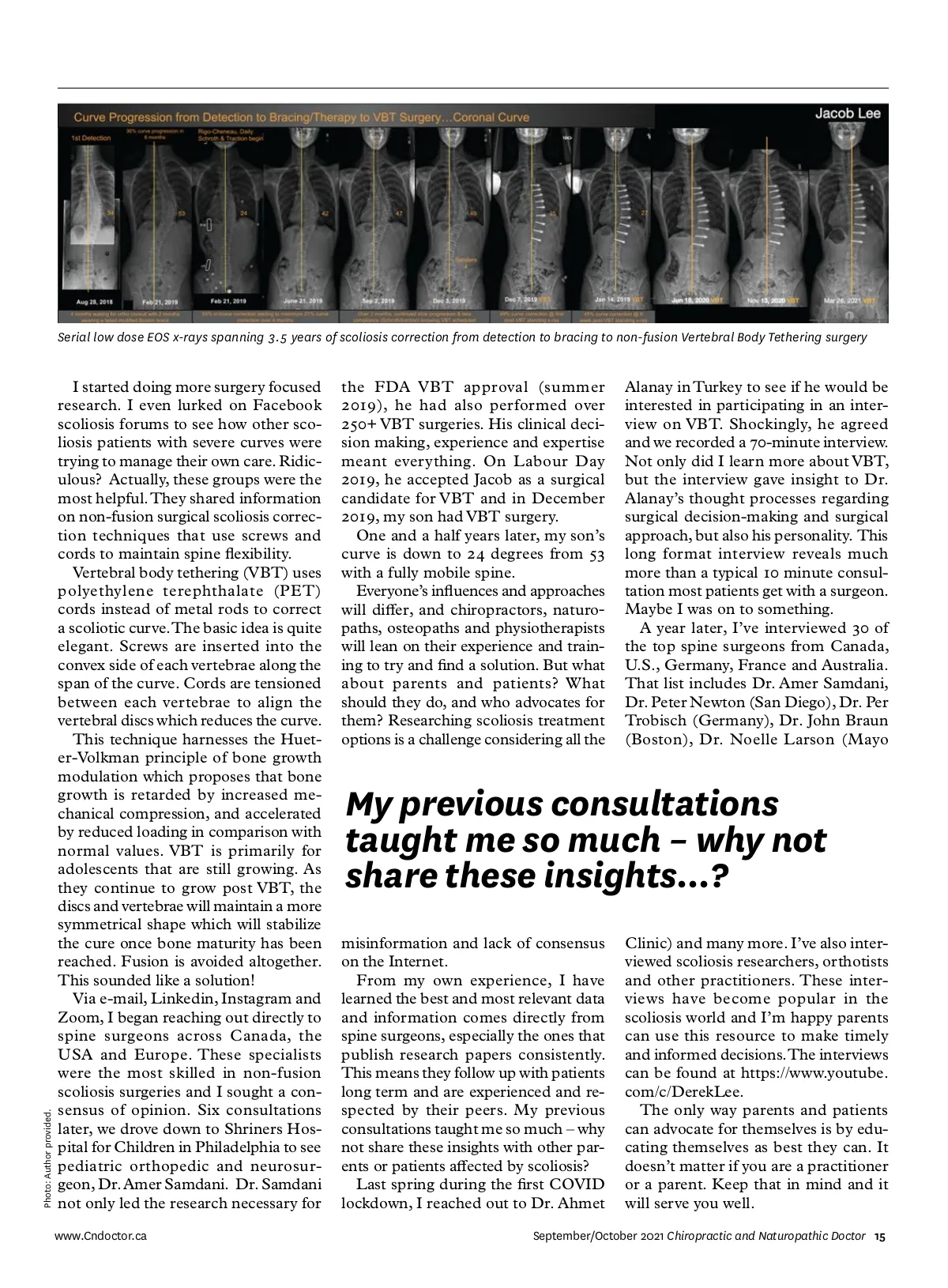
FEATURE COLLABORATION NAVIGATING SCOLIOSIS Your 13-year-old son has a 53 degree thoracolumbar scoliosis and is about to enter his growth spurt. What would you do? T BY DR. DEREK LEE, DC DR. DEREK LEE is a corporate health and wellness Doctor with Rogers Communications (20+ years), supporting three Rogers GTA on-site health centres in addition to a Markham private practice. He is a scoliosis education advocate: https://www.youtube.com/c/DerekLee. 14 Chiropractic and Naturopathic Doctor September/October 2021 www.Cndoctor.ca Photo: © Photographee.eu / Adobe Stock wo years ago, our family doctor caught the initial 24 degree curve after a routine chest X-ray for a lingering cough. In retro-spect, I often look back on what I have learned since that heartbreaking diagnosis and kick myself for missing all the signs that were staring me in the face for years. On the top of that list were his thoracic hypokyphosis and cervical kyphosis, the former the biomechanical hallmark of scoliosis progression, the latter, a proximal junction compensation pat-tern to the former. After moving on from the guilt of missing it earlier, I started to research all things scoliosis. Yes, I’m an experi-enced chiropractor, but I rarely see scoliosis in my corporate practice with Rogers Communications (21 years) or my private practice (28 years). I’m ashamed to say that I can’t recall being taught anything about scoliosis in chi-ropractic college and certainly nothing about scoliosis treatment. It might seem pathetic, but I turned to Google for answers. Of course what I found scared me even more. I found a lot of misinformation in general with miracle cures, but also conflicting studies from apparent scoliosis experts and re-searchers on PubMed. The lack of consensus was everywhere. The most common medical manage-ment of adolescent idiopathic scoliosis (AIS) is bracing followed by a wait and see approach and if the curve pro-gresses to 50+ degrees, then either live with the curve or opt for posterior fu-sion with rods and screws as the end game. Neither were great choices. In my son’s case, it took three months to get a referral to a local pediatric spine surgeon and another month to get a Boston-type symmetrical brace. I was far from impressed by how the first spine surgeon managed my son’s care with an outdated brace design and dubious follow up plan. In the mean-time, his curve had more than doubled to 53 degrees into surgical range. Those four critical months were completely wasted. Unfortunately, this is an all too common scoliosis story. I was completely frustrated, angry and looking for help. I reached out to Toronto’s Sick Kids hospital for a con-sultation. I consulted with chiroprac-tors throughout North America. Many of the chiropractic systems for scoliosis can be traced back to a posture system developed by Dr. Burl Pettibon about 30 years ago. I also reached out to physiotherapists who were experienced with scoliosis-specific exercises includ-ing Schroth therapy. I also sought better bracing treatment by speaking with several orthotists (brace makers) from across the US and Canada. Six months post-diagnosis my son was fitted with a Rigo Cheneau asym-metric brace from who I feel is one of Many of the chiropractic treatments for scoliosis were developed about 30 years ago the top orthotists in North America, Luke Stikeleather based in Virginia, USA. With a combination of daily phys-iotherapy specific scoliosis exercises, traction and muscle work, my son saw a 20% curve reduction from 53 to 42 degrees in three months, which was excellent considering braces are de-signed to stop progression and not to correct the curve. I was happy for my son and proud of his dedication to a daily regimen of one hour of exercise and treatment seven days a week for three months. This was in addition to being braced 21 hours a day which is horrific to witness, much less partake in. Unfortunately, I knew these results wouldn’t last. He was entering his growth spurt and he had atypical scoliosis. His spine was stiff with a thoracic lordosis and I knew the bracing, exercise and conservative treatments would fail.
Chiropractic + Naturopathic Doctor September/October 2021: Page 14