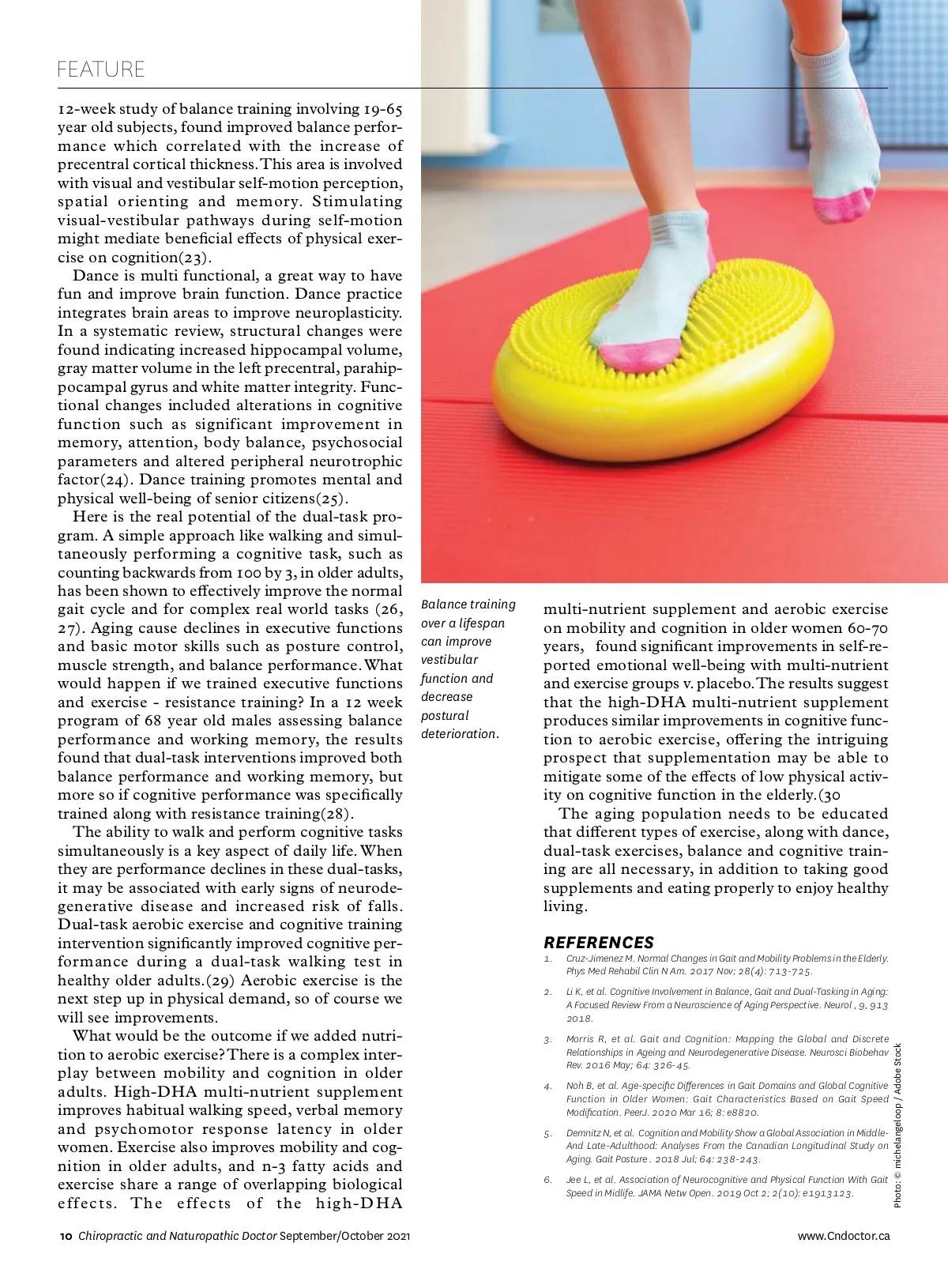
FEATURE 12-week study of balance training involving 19-65 year old subjects, found improved balance perfor-mance which correlated with the increase of precentral cortical thickness. This area is involved with visual and vestibular self-motion perception, spatial orienting and memory. Stimulating visual-vestibular pathways during self-motion might mediate beneficial effects of physical exer-cise on cognition(23). Dance is multi functional, a great way to have fun and improve brain function. Dance practice integrates brain areas to improve neuroplasticity. In a systematic review, structural changes were found indicating increased hippocampal volume, gray matter volume in the left precentral, parahip-pocampal gyrus and white matter integrity. Func-tional changes included alterations in cognitive function such as significant improvement in memory, attention, body balance, psychosocial parameters and altered peripheral neurotrophic factor(24). Dance training promotes mental and physical well-being of senior citizens(25). Here is the real potential of the dual-task pro-gram. A simple approach like walking and simul-taneously performing a cognitive task, such as counting backwards from 100 by 3, in older adults, has been shown to effectively improve the normal gait cycle and for complex real world tasks (26, 27). Aging cause declines in executive functions and basic motor skills such as posture control, muscle strength, and balance performance. What would happen if we trained executive functions and exercise -resistance training? In a 12 week program of 68 year old males assessing balance performance and working memory, the results found that dual-task interventions improved both balance performance and working memory, but more so if cognitive performance was specifically trained along with resistance training(28). The ability to walk and perform cognitive tasks simultaneously is a key aspect of daily life. When they are performance declines in these dual-tasks, it may be associated with early signs of neurode-generative disease and increased risk of falls. Dual-task aerobic exercise and cognitive training intervention significantly improved cognitive per-formance during a dual-task walking test in healthy older adults.(29) Aerobic exercise is the next step up in physical demand, so of course we will see improvements. What would be the outcome if we added nutri-tion to aerobic exercise? There is a complex inter-play between mobility and cognition in older adults. High-DHA multi-nutrient supplement improves habitual walking speed, verbal memory and psychomotor response latency in older women. Exercise also improves mobility and cog-nition in older adults, and n-3 fatty acids and exercise share a range of overlapping biological effects. The effects of the high-DHA 10 Chiropractic and Naturopathic Doctor September/October 2021 Balance training over a lifespan can improve vestibular function and decrease postural deterioration. multi-nutrient supplement and aerobic exercise on mobility and cognition in older women 60-70 years, found significant improvements in self-re-ported emotional well-being with multi-nutrient and exercise groups v. placebo. The results suggest that the high-DHA multi-nutrient supplement produces similar improvements in cognitive func-tion to aerobic exercise, offering the intriguing prospect that supplementation may be able to mitigate some of the effects of low physical activ-ity on cognitive function in the elderly.(30 The aging population needs to be educated that different types of exercise, along with dance, dual-task exercises, balance and cognitive train-ing are all necessary, in addition to taking good supplements and eating properly to enjoy healthy living. REFERENCES 1. 2. Cruz-Jimenez M. Normal Changes in Gait and Mobility Problems in the Elderly. Phys Med Rehabil Clin N Am. 2017 Nov; 28(4): 713-725. Li K, et al. Cognitive Involvement in Balance, Gait and Dual-Tasking in Aging: A Focused Review From a Neuroscience of Aging Perspective. Neurol , 9, 913 2018. Photo: © michelangeloop / Adobe Stock 3. Morris R, et al. Gait and Cognition: Mapping the Global and Discrete Relationships in Ageing and Neurodegenerative Disease. Neurosci Biobehav Rev. 2016 May; 64: 326-45. Noh B, et al. Age-specific Differences in Gait Domains and Global Cognitive Function in Older Women: Gait Characteristics Based on Gait Speed Modification. PeerJ. 2020 Mar 16; 8: e8820. Demnitz N, et al. Cognition and Mobility Show a Global Association in Middle-And Late-Adulthood: Analyses From the Canadian Longitudinal Study on Aging. Gait Posture . 2018 Jul; 64: 238-243. Jee L, et al. Association of Neurocognitive and Physical Function With Gait Speed in Midlife. JAMA Netw Open. 2019 Oct 2; 2(10): e1913123. 4. 5. 6. www.Cndoctor.ca
Chiropractic + Naturopathic Doctor September/October 2021: Page 10