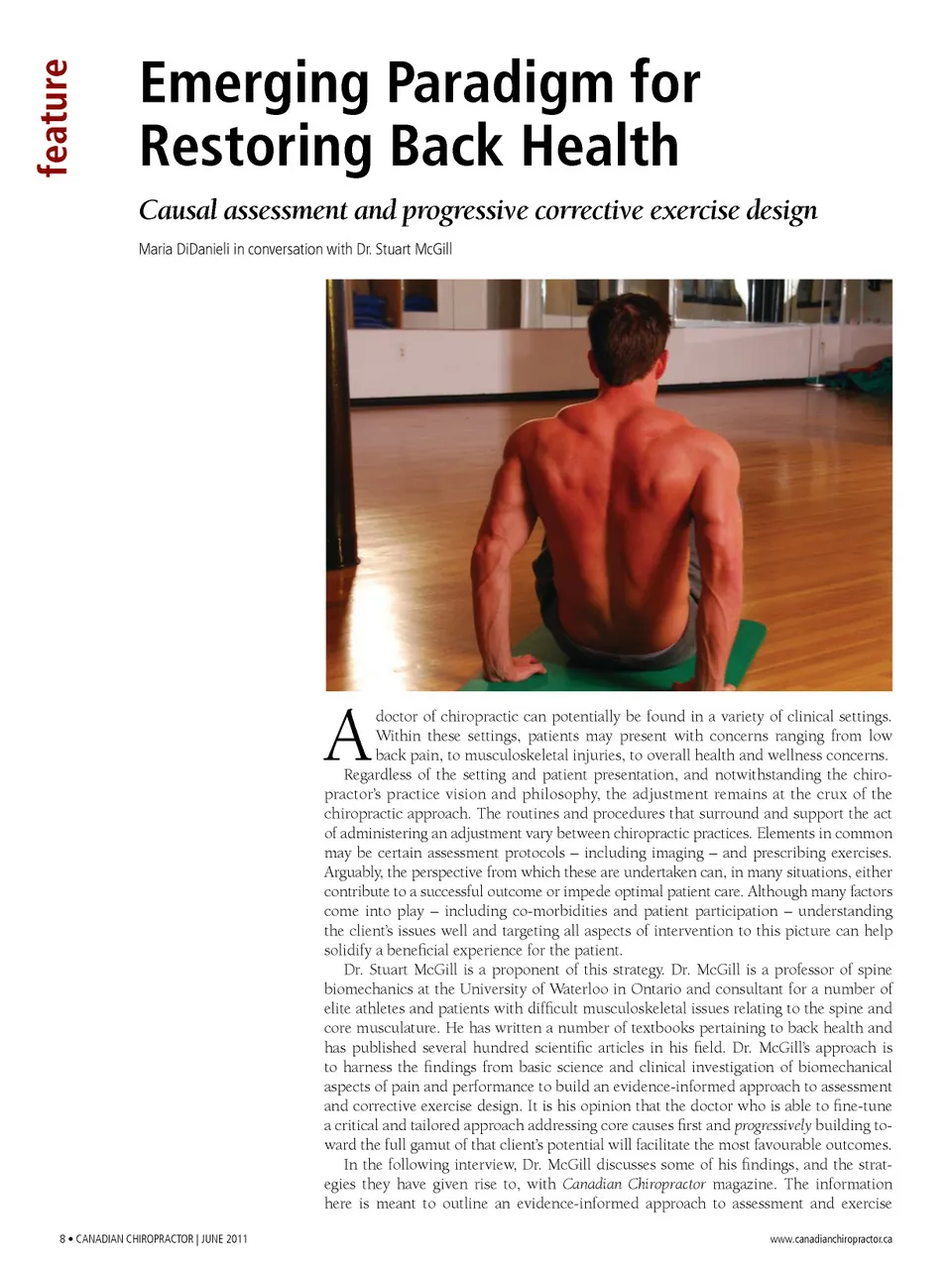
Emerging Paradigm for Restoring Back Health Causal assessment and progressive corrective exercise design Maria DiDanieli in conversation with Dr. Stuart McGill feature A doctor of chiropractic can potentially be found in a variety of clinical settings. Within these settings, patients may present with concerns ranging from low back pain, to musculoskeletal injuries, to overall health and wellness concerns. Regardless of the setting and patient presentation, and notwithstanding the chiro-practor’s practice vision and philosophy, the adjustment remains at the crux of the chiropractic approach. The routines and procedures that surround and support the act of administering an adjustment vary between chiropractic practices. Elements in common may be certain assessment protocols – including imaging – and prescribing exercises. Arguably, the perspective from which these are undertaken can, in many situations, either contribute to a successful outcome or impede optimal patient care. Although many factors come into play – including co-morbidities and patient participation – understanding the client’s issues well and targeting all aspects of intervention to this picture can help solidify a beneficial experience for the patient. Dr. Stuart McGill is a proponent of this strategy. Dr. McGill is a professor of spine biomechanics at the University of Waterloo in Ontario and consultant for a number of elite athletes and patients with difficult musculoskeletal issues relating to the spine and core musculature. He has written a number of textbooks pertaining to back health and has published several hundred scientific articles in his field. Dr. McGill’s approach is to harness the findings from basic science and clinical investigation of biomechanical aspects of pain and performance to build an evidence-informed approach to assessment and corrective exercise design. It is his opinion that the doctor who is able to fine-tune a critical and tailored approach addressing core causes first and progressively building to-ward the full gamut of that client’s potential will facilitate the most favourable outcomes. In the following interview, Dr. McGill discusses some of his findings, and the strat-egies they have given rise to, with Canadian Chiropractor magazine. The information here is meant to outline an evidence-informed approach to assessment and exercise 8 • CANADiAN CHiROPRACTOR | JUNE 2011 www.canadianchiropractor.ca
Chiropractic + Naturopathic Doctor June 2011: Page 8