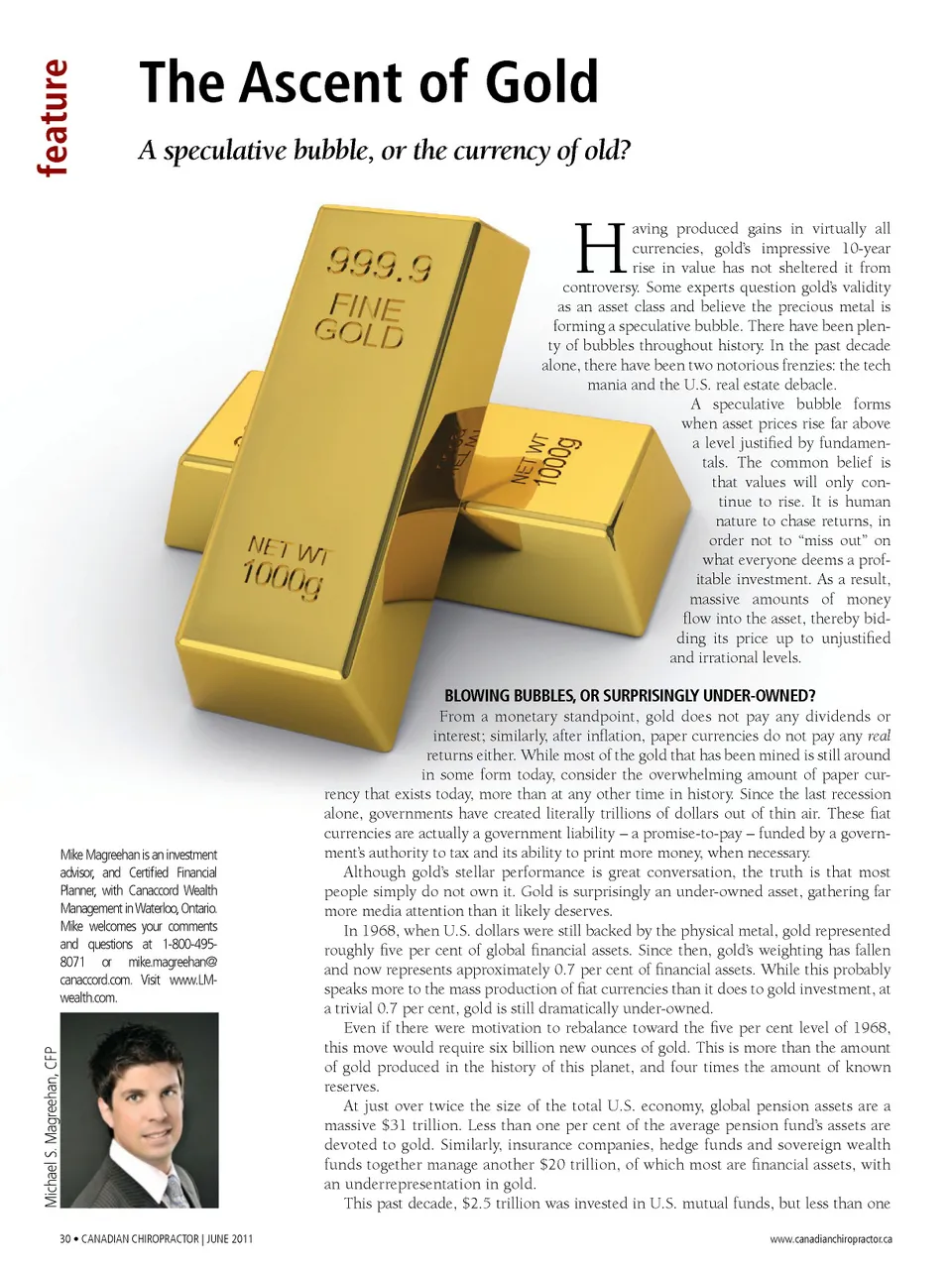
feature The Ascent of Gold A speculative bubble, or the currency of old? aving produced gains in virtually all currencies, gold’s impressive 10-year rise in value has not sheltered it from controversy. Some experts question gold’s validity as an asset class and believe the precious metal is forming a speculative bubble. There have been plen-ty of bubbles throughout history. In the past decade alone, there have been two notorious frenzies: the tech mania and the U.S. real estate debacle. A speculative bubble forms when asset prices rise far above a level justified by fundamen-tals. The common belief is that values will only con-tinue to rise. It is human nature to chase returns, in order not to “miss out” on what everyone deems a prof-itable investment. As a result, massive amounts of money flow into the asset, thereby bid-ding its price up to unjustified and irrational levels. H Mike Magreehan is an investment advisor, and Certified Financial Planner, with Canaccord Wealth Management in Waterloo, Ontario. Mike welcomes your comments and questions at 1-800-495-8071 or mike.magreehan@ canaccord.com. Visit www.LM-wealth.com. BLOWING BUBBLES, OR SURPRISINGLY UNDER-OWNED? From a monetary standpoint, gold does not pay any dividends or interest; similarly, after inflation, paper currencies do not pay any real returns either. While most of the gold that has been mined is still around in some form today, consider the overwhelming amount of paper cur-rency that exists today, more than at any other time in history. Since the last recession alone, governments have created literally trillions of dollars out of thin air. These fiat currencies are actually a government liability – a promise-to-pay – funded by a govern-ment’s authority to tax and its ability to print more money, when necessary. Although gold’s stellar performance is great conversation, the truth is that most people simply do not own it. Gold is surprisingly an under-owned asset, gathering far more media attention than it likely deserves. In 1968, when U.S. dollars were still backed by the physical metal, gold represented roughly five per cent of global financial assets. Since then, gold’s weighting has fallen and now represents approximately 0.7 per cent of financial assets. While this probably speaks more to the mass production of fiat currencies than it does to gold investment, at a trivial 0.7 per cent, gold is still dramatically under-owned. Even if there were motivation to rebalance toward the five per cent level of 1968, this move would require six billion new ounces of gold. This is more than the amount of gold produced in the history of this planet, and four times the amount of known reserves. At just over twice the size of the total U.S. economy, global pension assets are a massive $31 trillion. Less than one per cent of the average pension fund’s assets are devoted to gold. Similarly, insurance companies, hedge funds and sovereign wealth funds together manage another $20 trillion, of which most are financial assets, with an underrepresentation in gold. This past decade, $2.5 trillion was invested in U.S. mutual funds, but less than one www.canadianchiropractor.ca Michael S. Magreehan, CFP 30 • CANADiAN CHiROPRACTOR | JUNE 2011
Chiropractic + Naturopathic Doctor June 2011: Page 30