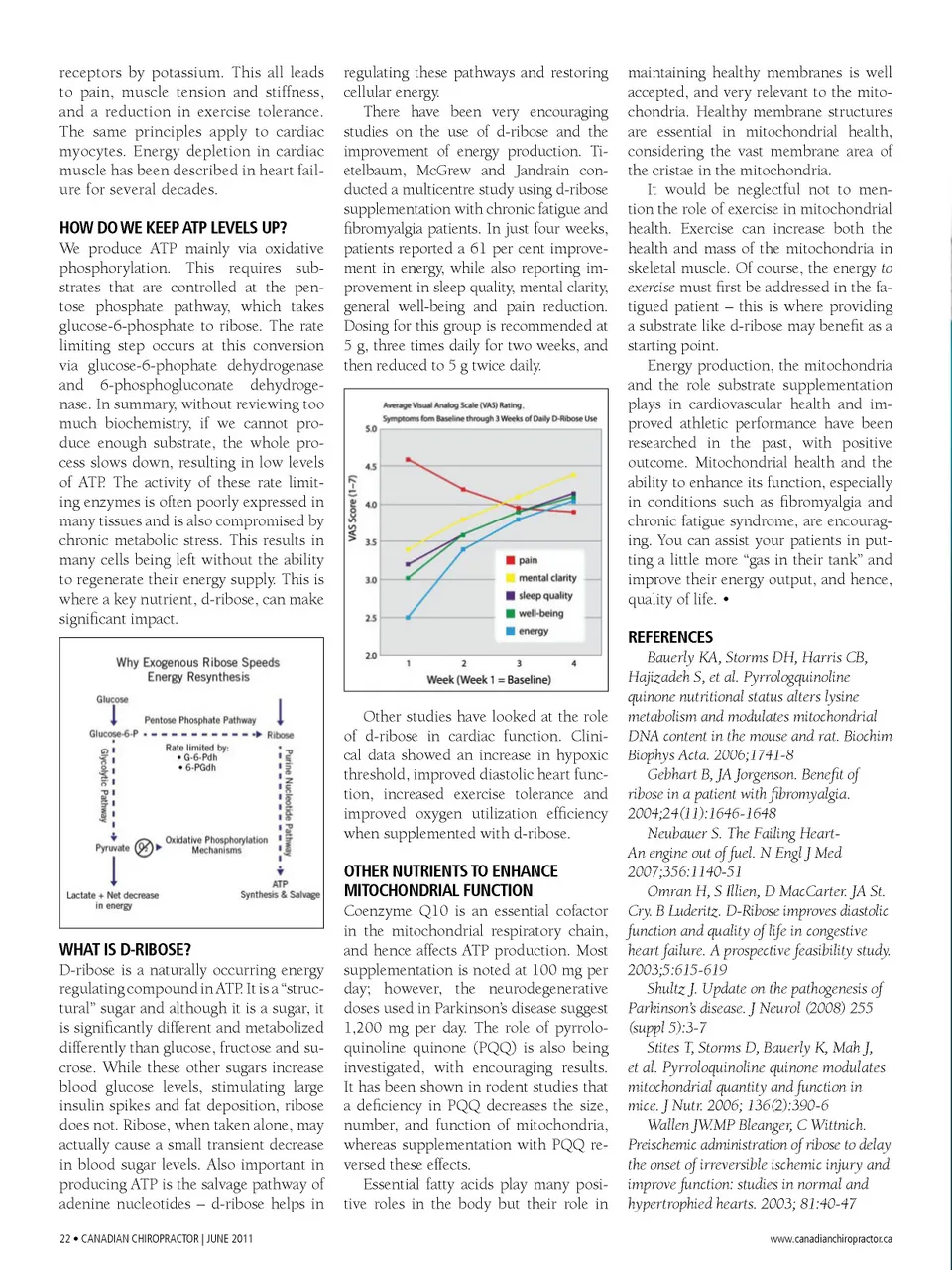
receptors by potassium. This all leads to pain, muscle tension and stiffness, and a reduction in exercise tolerance. The same principles apply to cardiac myocytes. Energy depletion in cardiac muscle has been described in heart fail-ure for several decades. HOW DO WE kEEP ATP LEVELS UP? We produce ATP mainly via oxidative phosphorylation. This requires sub-strates that are controlled at the pen-tose phosphate pathway, which takes glucose-6-phosphate to ribose. The rate limiting step occurs at this conversion via glucose-6-phophate dehydrogenase and 6-phosphogluconate dehydroge-nase. In summary, without reviewing too much biochemistry, if we cannot pro-duce enough substrate, the whole pro-cess slows down, resulting in low levels of ATP. The activity of these rate limit-ing enzymes is often poorly expressed in many tissues and is also compromised by chronic metabolic stress. This results in many cells being left without the ability to regenerate their energy supply. This is where a key nutrient, d-ribose, can make significant impact. regulating these pathways and restoring cellular energy. There have been very encouraging studies on the use of d-ribose and the improvement of energy production. Ti-etelbaum, McGrew and Jandrain con-ducted a multicentre study using d-ribose supplementation with chronic fatigue and fibromyalgia patients. In just four weeks, patients reported a 61 per cent improve-ment in energy, while also reporting im-provement in sleep quality, mental clarity, general well-being and pain reduction. Dosing for this group is recommended at 5 g, three times daily for two weeks, and then reduced to 5 g twice daily. maintaining healthy membranes is well accepted, and very relevant to the mito-chondria. Healthy membrane structures are essential in mitochondrial health, considering the vast membrane area of the cristae in the mitochondria. It would be neglectful not to men-tion the role of exercise in mitochondrial health. Exercise can increase both the health and mass of the mitochondria in skeletal muscle. Of course, the energy to exercise must first be addressed in the fa-tigued patient – this is where providing a substrate like d-ribose may benefit as a starting point. Energy production, the mitochondria and the role substrate supplementation plays in cardiovascular health and im-proved athletic performance have been researched in the past, with positive outcome. Mitochondrial health and the ability to enhance its function, especially in conditions such as fibromyalgia and chronic fatigue syndrome, are encourag-ing. You can assist your patients in put-ting a little more “gas in their tank” and improve their energy output, and hence, quality of life. • Other studies have looked at the role of d-ribose in cardiac function. Clini-cal data showed an increase in hypoxic threshold, improved diastolic heart func-tion, increased exercise tolerance and improved oxygen utilization efficiency when supplemented with d-ribose. WHAT IS D-RIBOSE? D-ribose is a naturally occurring energy regulating compound in ATP. It is a “struc-tural” sugar and although it is a sugar, it is significantly different and metabolized differently than glucose, fructose and su-crose. While these other sugars increase blood glucose levels, stimulating large insulin spikes and fat deposition, ribose does not. Ribose, when taken alone, may actually cause a small transient decrease in blood sugar levels. Also important in producing ATP is the salvage pathway of adenine nucleotides – d-ribose helps in 22 • CANADiAN CHiROPRACTOR | JUNE 2011 OTHER NUTRIENTS TO ENHANCE MITOCHONDRIAL FUNCTION Coenzyme Q10 is an essential cofactor in the mitochondrial respiratory chain, and hence affects ATP production. Most supplementation is noted at 100 mg per day; however, the neurodegenerative doses used in Parkinson’s disease suggest 1,200 mg per day. The role of pyrrolo-quinoline quinone (PQQ) is also being investigated, with encouraging results. It has been shown in rodent studies that a deficiency in PQQ decreases the size, number, and function of mitochondria, whereas supplementation with PQQ re-versed these effects. Essential fatty acids play many posi-tive roles in the body but their role in REFERENCES Bauerly KA, Storms DH, Harris CB, Hajizadeh S, et al. Pyrrologquinoline quinone nutritional status alters lysine metabolism and modulates mitochondrial DNA content in the mouse and rat. Biochim Biophys Acta. 2006;1741-8 Gebhart B, JA Jorgenson. Benefit of ribose in a patient with fibromyalgia. 2004;24(11):1646-1648 Neubauer S. The Failing Heart-An engine out of fuel. N Engl J Med 2007;356:1140-51 Omran H, S Illien, D MacCarter. JA St. Cry. B Luderitz. D-Ribose improves diastolic function and quality of life in congestive heart failure. A prospective feasibility study. 2003;5:615-619 Shultz J. Update on the pathogenesis of Parkinson’s disease. J Neurol (2008) 255 (suppl 5):3-7 Stites T, Storms D, Bauerly K, Mah J, et al. Pyrroloquinoline quinone modulates mitochondrial quantity and function in mice. J Nutr. 2006; 136(2):390-6 Wallen JW.MP Bleanger, C Wittnich. Preischemic administration of ribose to delay the onset of irreversible ischemic injury and improve function: studies in normal and hypertrophied hearts. 2003; 81:40-47 www.canadianchiropractor.ca
Chiropractic + Naturopathic Doctor June 2011: Page 22