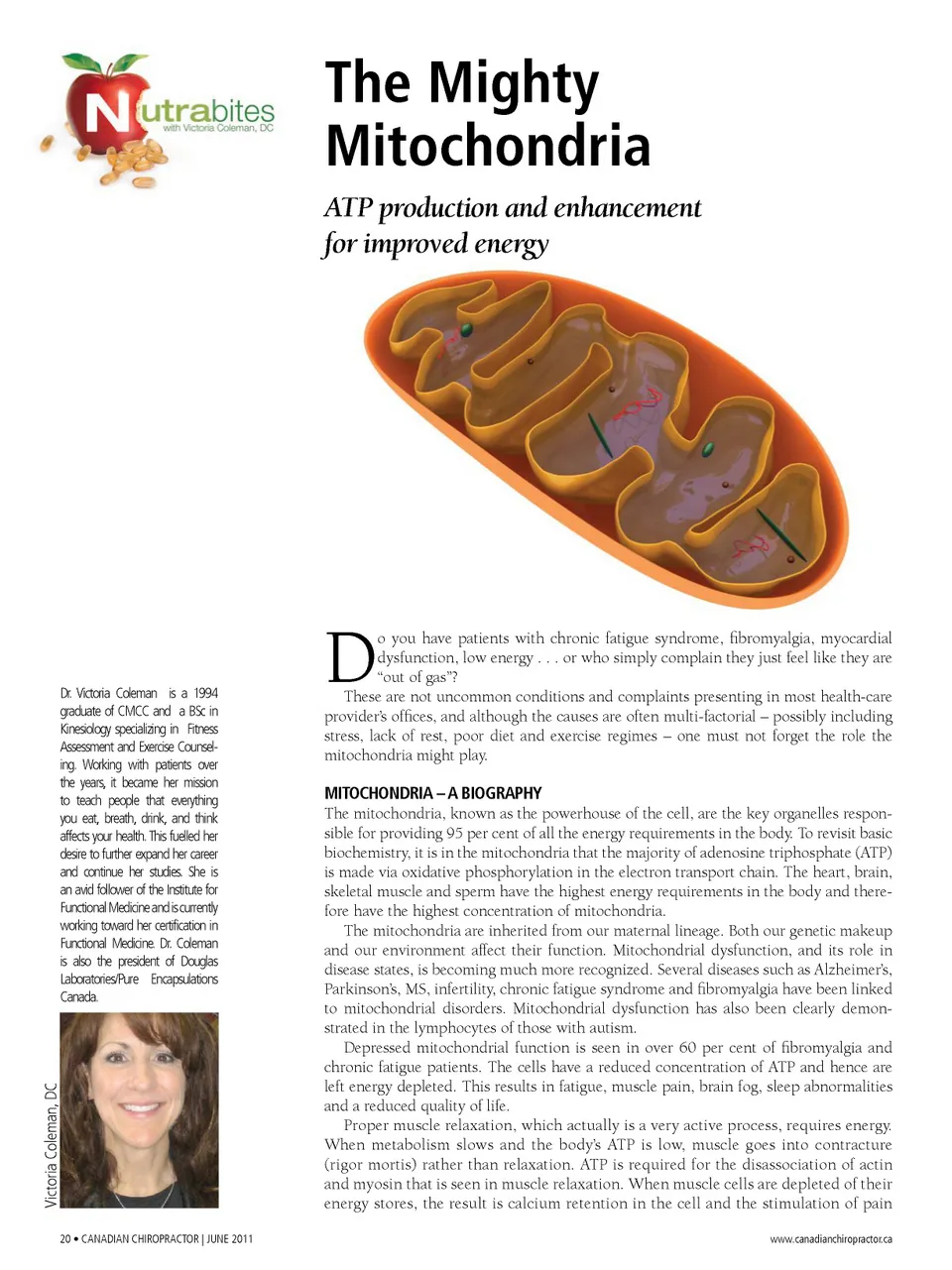
The Mighty Mitochondria ATP production and enhancement for improved energy Dr. Victoria Coleman is a 1994 graduate of CMCC and a BSc in Kinesiology specializing in Fitness Assessment and Exercise Counsel-ing. Working with patients over the years, it became her mission to teach people that everything you eat, breath, drink, and think affects your health. This fuelled her desire to further expand her career and continue her studies. She is an avid follower of the institute for Functional Medicine and is currently working toward her certification in Functional Medicine. Dr. Coleman is also the president of Douglas Laboratories/Pure Encapsulations Canada. D o you have patients with chronic fatigue syndrome, fibromyalgia, myocardial dysfunction, low energy . . . or who simply complain they just feel like they are “out of gas”? These are not uncommon conditions and complaints presenting in most health-care provider’s offices, and although the causes are often multi-factorial – possibly including stress, lack of rest, poor diet and exercise regimes – one must not forget the role the mitochondria might play. MITOCHONDRIA – A BIOGRAPHY The mitochondria, known as the powerhouse of the cell, are the key organelles respon-sible for providing 95 per cent of all the energy requirements in the body. To revisit basic biochemistry, it is in the mitochondria that the majority of adenosine triphosphate (ATP) is made via oxidative phosphorylation in the electron transport chain. The heart, brain, skeletal muscle and sperm have the highest energy requirements in the body and there-fore have the highest concentration of mitochondria. The mitochondria are inherited from our maternal lineage. Both our genetic makeup and our environment affect their function. Mitochondrial dysfunction, and its role in disease states, is becoming much more recognized. Several diseases such as Alzheimer’s, Parkinson’s, MS, infertility, chronic fatigue syndrome and fibromyalgia have been linked to mitochondrial disorders. Mitochondrial dysfunction has also been clearly demon-strated in the lymphocytes of those with autism. Depressed mitochondrial function is seen in over 60 per cent of fibromyalgia and chronic fatigue patients. The cells have a reduced concentration of ATP and hence are left energy depleted. This results in fatigue, muscle pain, brain fog, sleep abnormalities and a reduced quality of life. Proper muscle relaxation, which actually is a very active process, requires energy. When metabolism slows and the body’s ATP is low, muscle goes into contracture (rigor mortis) rather than relaxation. ATP is required for the disassociation of actin and myosin that is seen in muscle relaxation. When muscle cells are depleted of their energy stores, the result is calcium retention in the cell and the stimulation of pain www.canadianchiropractor.ca Victoria Coleman, DC 20 • CANADiAN CHiROPRACTOR | JUNE 2011
Chiropractic + Naturopathic Doctor June 2011: Page 20