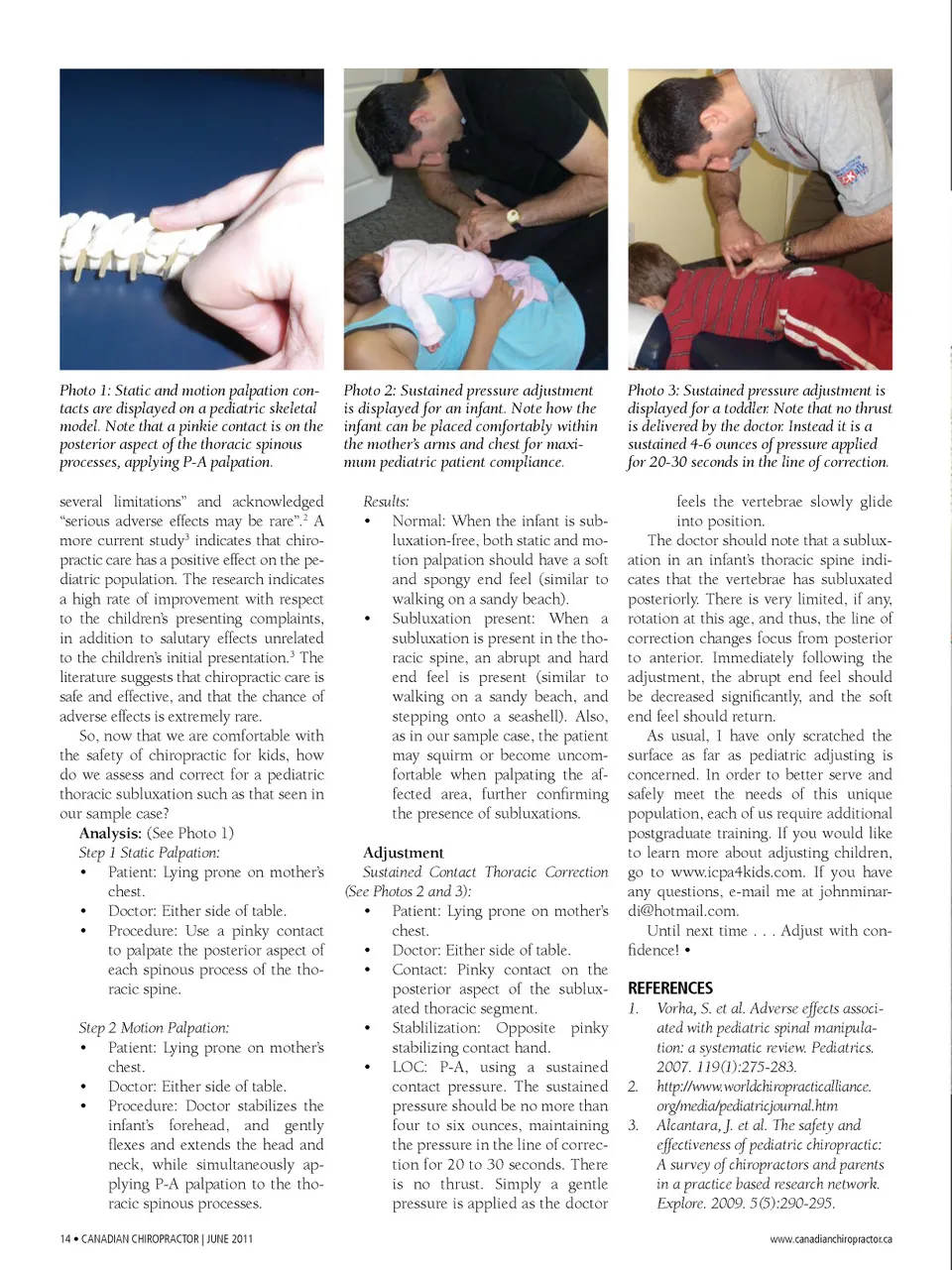
Photo 1: Static and motion palpation con-tacts are displayed on a pediatric skeletal model. Note that a pinkie contact is on the posterior aspect of the thoracic spinous processes, applying P-A palpation. several limitations” and acknowledged “serious adverse effects may be rare”. 2 A more current study 3 indicates that chiro-practic care has a positive effect on the pe-diatric population. The research indicates a high rate of improvement with respect to the children’s presenting complaints, in addition to salutary effects unrelated to the children’s initial presentation. 3 The literature suggests that chiropractic care is safe and effective, and that the chance of adverse effects is extremely rare. So, now that we are comfortable with the safety of chiropractic for kids, how do we assess and correct for a pediatric thoracic subluxation such as that seen in our sample case? Analysis: (See Photo 1) Step 1 Static Palpation: • Patient: Lying prone on mother’s chest. • Doctor: Either side of table. • Procedure: Use a pinky contact to palpate the posterior aspect of each spinous process of the tho-racic spine. Step 2 Motion Palpation: • Patient: Lying prone on mother’s chest. • Doctor: Either side of table. • Procedure: Doctor stabilizes the infant’s forehead, and gently flexes and extends the head and neck, while simultaneously ap-plying P-A palpation to the tho-racic spinous processes. 14 • CANADiAN CHiROPRACTOR | JUNE 2011 Photo 2: Sustained pressure adjustment is displayed for an infant. Note how the infant can be placed comfortably within the mother’s arms and chest for maxi-mum pediatric patient compliance. Results: • Normal: When the infant is sub-luxation-free, both static and mo-tion palpation should have a soft and spongy end feel (similar to walking on a sandy beach). • Subluxation present: When a subluxation is present in the tho-racic spine, an abrupt and hard end feel is present (similar to walking on a sandy beach, and stepping onto a seashell). Also, as in our sample case, the patient may squirm or become uncom-fortable when palpating the af-fected area, further confirming the presence of subluxations. Adjustment Sustained Contact Thoracic Correction (See Photos 2 and 3): • Patient: Lying prone on mother’s chest. • Doctor: Either side of table. • Contact: Pinky contact on the posterior aspect of the sublux-ated thoracic segment. • Stablilization: Opposite pinky stabilizing contact hand. • LOC: P-A, using a sustained contact pressure. The sustained pressure should be no more than four to six ounces, maintaining the pressure in the line of correc-tion for 20 to 30 seconds. There is no thrust. Simply a gentle pressure is applied as the doctor Photo 3: Sustained pressure adjustment is displayed for a toddler. Note that no thrust is delivered by the doctor. Instead it is a sustained 4-6 ounces of pressure applied for 20-30 seconds in the line of correction. feels the vertebrae slowly glide into position. The doctor should note that a sublux-ation in an infant’s thoracic spine indi-cates that the vertebrae has subluxated posteriorly. There is very limited, if any, rotation at this age, and thus, the line of correction changes focus from posterior to anterior. Immediately following the adjustment, the abrupt end feel should be decreased significantly, and the soft end feel should return. As usual, I have only scratched the surface as far as pediatric adjusting is concerned. In order to better serve and safely meet the needs of this unique population, each of us require additional postgraduate training. If you would like to learn more about adjusting children, go to www.icpa4kids.com. If you have any questions, e-mail me at [email protected]. Until next time . . . Adjust with con-fidence! • REFERENCES 1. Vorha, S. et al. Adverse effects associ-ated with pediatric spinal manipula-tion: a systematic review. Pediatrics. 2007. 119(1):275-283. 2. http://www.worldchiropracticalliance. org/media/pediatricjournal.htm 3. Alcantara, J. et al. The safety and effectiveness of pediatric chiropractic: A survey of chiropractors and parents in a practice based research network. Explore. 2009. 5(5):290-295. www.canadianchiropractor.ca
Chiropractic + Naturopathic Doctor June 2011: Page 14