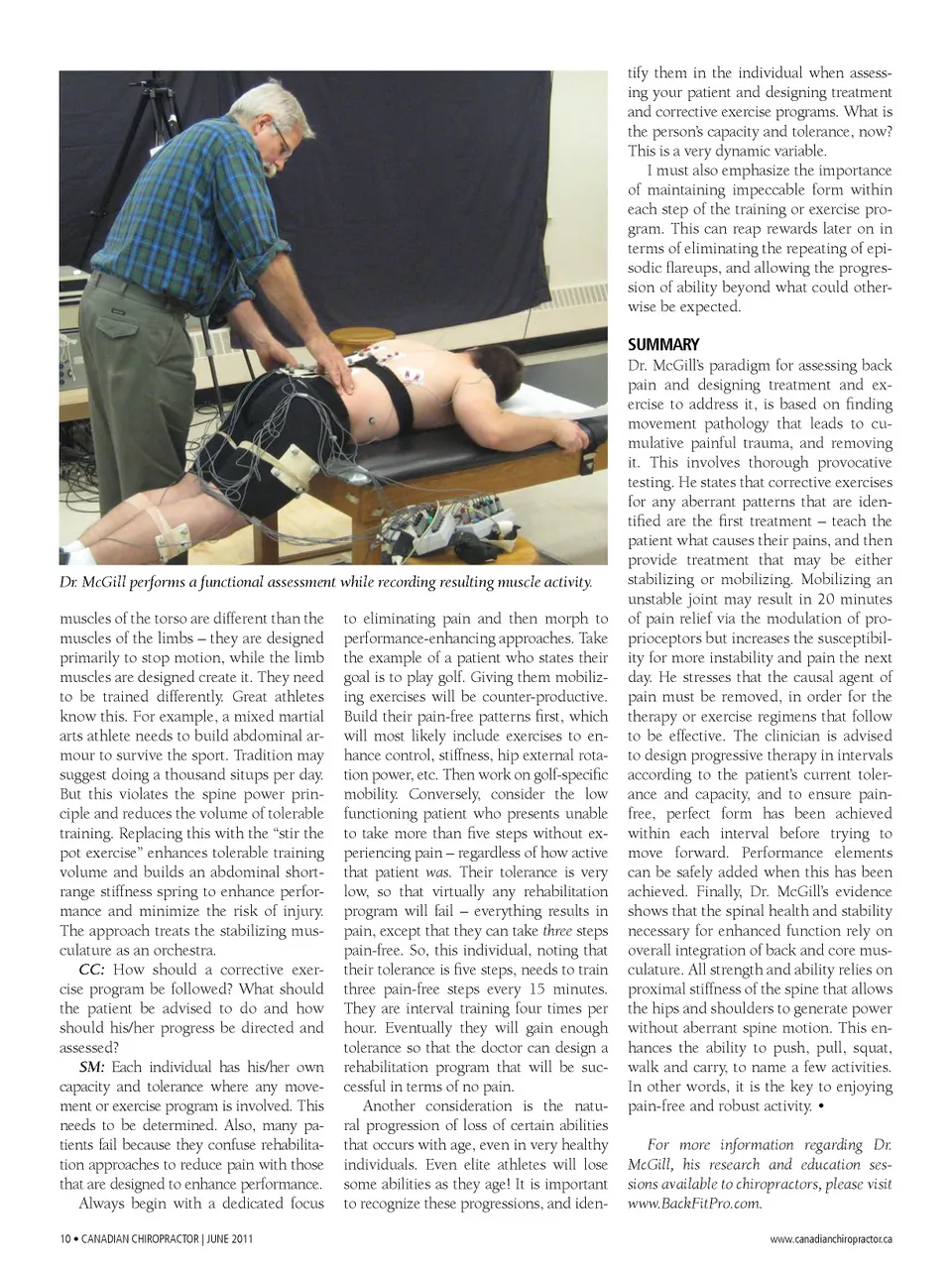
tify them in the individual when assess-ing your patient and designing treatment and corrective exercise programs. What is the person’s capacity and tolerance, now? This is a very dynamic variable. I must also emphasize the importance of maintaining impeccable form within each step of the training or exercise pro-gram. This can reap rewards later on in terms of eliminating the repeating of epi-sodic flareups, and allowing the progres-sion of ability beyond what could other-wise be expected. Dr. McGill performs a functional assessment while recording resulting muscle activity. muscles of the torso are different than the muscles of the limbs – they are designed primarily to stop motion, while the limb muscles are designed create it. They need to be trained differently. Great athletes know this. For example, a mixed martial arts athlete needs to build abdominal ar-mour to survive the sport. Tradition may suggest doing a thousand situps per day. But this violates the spine power prin-ciple and reduces the volume of tolerable training. Replacing this with the “stir the pot exercise” enhances tolerable training volume and builds an abdominal short-range stiffness spring to enhance perfor-mance and minimize the risk of injury. The approach treats the stabilizing mus-culature as an orchestra. CC: How should a corrective exer-cise program be followed? What should the patient be advised to do and how should his/her progress be directed and assessed? SM: Each individual has his/her own capacity and tolerance where any move-ment or exercise program is involved. This needs to be determined. Also, many pa-tients fail because they confuse rehabilita-tion approaches to reduce pain with those that are designed to enhance performance. Always begin with a dedicated focus 10 • CANADiAN CHiROPRACTOR | JUNE 2011 to eliminating pain and then morph to performance-enhancing approaches. Take the example of a patient who states their goal is to play golf. Giving them mobiliz-ing exercises will be counter-productive. Build their pain-free patterns first, which will most likely include exercises to en-hance control, stiffness, hip external rota-tion power, etc. Then work on golf-specific mobility. Conversely, consider the low functioning patient who presents unable to take more than five steps without ex-periencing pain – regardless of how active that patient was . Their tolerance is very low, so that virtually any rehabilitation program will fail – everything results in pain, except that they can take three steps pain-free. So, this individual, noting that their tolerance is five steps, needs to train three pain-free steps every 15 minutes. They are interval training four times per hour. Eventually they will gain enough tolerance so that the doctor can design a rehabilitation program that will be suc-cessful in terms of no pain. Another consideration is the natu-ral progression of loss of certain abilities that occurs with age, even in very healthy individuals. Even elite athletes will lose some abilities as they age! It is important to recognize these progressions, and iden-SUMMARY Dr. McGill’s paradigm for assessing back pain and designing treatment and ex-ercise to address it, is based on finding movement pathology that leads to cu-mulative painful trauma, and removing it. This involves thorough provocative testing. He states that corrective exercises for any aberrant patterns that are iden-tified are the first treatment – teach the patient what causes their pains, and then provide treatment that may be either stabilizing or mobilizing. Mobilizing an unstable joint may result in 20 minutes of pain relief via the modulation of pro-prioceptors but increases the susceptibil-ity for more instability and pain the next day. He stresses that the causal agent of pain must be removed, in order for the therapy or exercise regimens that follow to be effective. The clinician is advised to design progressive therapy in intervals according to the patient’s current toler-ance and capacity, and to ensure pain-free, perfect form has been achieved within each interval before trying to move forward. Performance elements can be safely added when this has been achieved. Finally, Dr. McGill’s evidence shows that the spinal health and stability necessary for enhanced function rely on overall integration of back and core mus-culature. All strength and ability relies on proximal stiffness of the spine that allows the hips and shoulders to generate power without aberrant spine motion. This en-hances the ability to push, pull, squat, walk and carry, to name a few activities. In other words, it is the key to enjoying pain-free and robust activity. • For more information regarding Dr. McGill, his research and education ses-sions available to chiropractors, please visit www.BackFitPro.com. www.canadianchiropractor.ca
Chiropractic + Naturopathic Doctor June 2011: Page 10