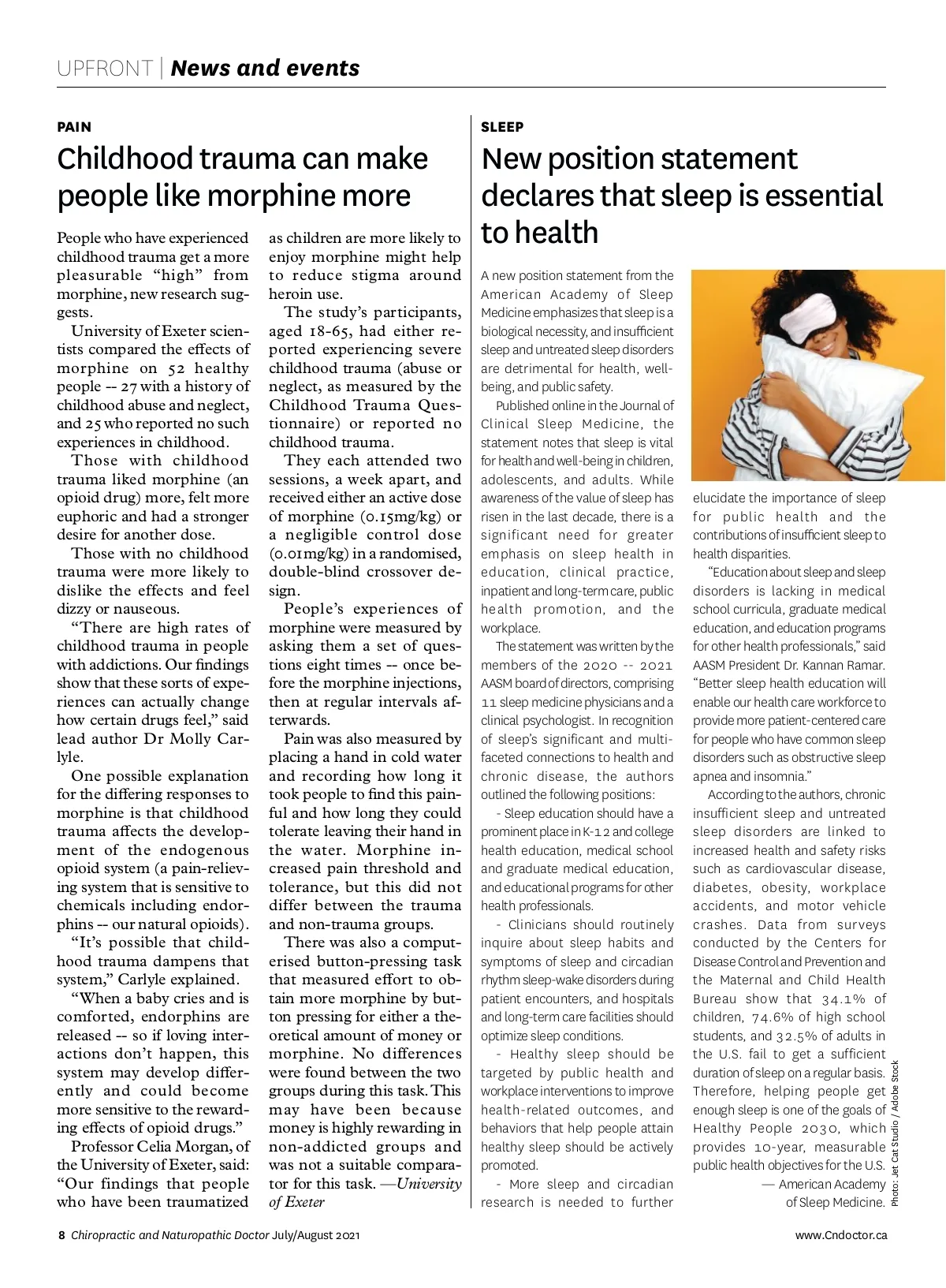
UPFRONT | News and events PAIN Childhood trauma can make people like morphine more People who have experienced childhood trauma get a more pleasurable “high” from morphine, new research sug-gests. University of Exeter scien-tists compared the effects of morphine on 52 healthy people --27 with a history of childhood abuse and neglect, and 25 who reported no such experiences in childhood. Those with childhood trauma liked morphine (an opioid drug) more, felt more euphoric and had a stronger desire for another dose. Those with no childhood trauma were more likely to dislike the effects and feel dizzy or nauseous. “There are high rates of childhood trauma in people with addictions. Our findings show that these sorts of expe-riences can actually change how certain drugs feel,” said lead author Dr Molly Car-lyle. One possible explanation for the differing responses to morphine is that childhood trauma affects the develop-ment of the endogenous opioid system (a pain-reliev-ing system that is sensitive to chemicals including endor-phins --our natural opioids). “It’s possible that child-hood trauma dampens that system,” Carlyle explained. “When a baby cries and is comforted, endorphins are released --so if loving inter-actions don’t happen, this system may develop differ-ently and could become more sensitive to the reward-ing effects of opioid drugs.” Professor Celia Morgan, of the University of Exeter, said: “Our findings that people who have been traumatized as children are more likely to enjoy morphine might help to reduce stigma around heroin use. The study’s participants, aged 18-65, had either re-ported experiencing severe childhood trauma (abuse or neglect, as measured by the Childhood Trauma Ques-tionnaire) or reported no childhood trauma. They each attended two sessions, a week apart, and received either an active dose of morphine (0.15mg/kg) or a negligible control dose (0.01mg/kg) in a randomised, double-blind crossover de-sign. People’s experiences of morphine were measured by asking them a set of ques-tions eight times --once be-fore the morphine injections, then at regular intervals af-terwards. Pain was also measured by placing a hand in cold water and recording how long it took people to find this pain-ful and how long they could tolerate leaving their hand in the water. Morphine in-creased pain threshold and tolerance, but this did not differ between the trauma and non-trauma groups. There was also a comput-erised button-pressing task that measured effort to ob-tain more morphine by but-ton pressing for either a the-oretical amount of money or morphine. No differences were found between the two groups during this task. This may have been because money is highly rewarding in non-addicted groups and was not a suitable compara-tor for this task. —University of Exeter SLEEP New position statement declares that sleep is essential to health A new position statement from the American Academy of Sleep Medicine emphasizes that sleep is a biological necessity, and insufficient sleep and untreated sleep disorders are detrimental for health, well-being, and public safety. Published online in the Journal of Clinical Sleep Medicine, the statement notes that sleep is vital for health and well-being in children, adolescents, and adults. While awareness of the value of sleep has risen in the last decade, there is a significant need for greater emphasis on sleep health in education, clinical practice, inpatient and long-term care, public health promotion, and the workplace. The statement was written by the members of the 2020 --2021 AASM board of directors, comprising 11 sleep medicine physicians and a clinical psychologist. In recognition of sleep’s significant and multi-faceted connections to health and chronic disease, the authors outlined the following positions: -Sleep education should have a prominent place in K-12 and college health education, medical school and graduate medical education, and educational programs for other health professionals. -Clinicians should routinely inquire about sleep habits and symptoms of sleep and circadian rhythm sleep-wake disorders during patient encounters, and hospitals and long-term care facilities should optimize sleep conditions. -Healthy sleep should be targeted by public health and workplace interventions to improve health-related outcomes, and behaviors that help people attain healthy sleep should be actively promoted. -More sleep and circadian research is needed to further elucidate the importance of sleep for public health and the contributions of insufficient sleep to health disparities. “Education about sleep and sleep disorders is lacking in medical school curricula, graduate medical education, and education programs for other health professionals,” said AASM President Dr. Kannan Ramar. “Better sleep health education will enable our health care workforce to provide more patient-centered care for people who have common sleep disorders such as obstructive sleep apnea and insomnia.” According to the authors, chronic insufficient sleep and untreated sleep disorders are linked to increased health and safety risks such as cardiovascular disease, diabetes, obesity, workplace accidents, and motor vehicle crashes. Data from surveys conducted by the Centers for Disease Control and Prevention and the Maternal and Child Health Bureau show that 34.1% of children, 74.6% of high school students, and 32.5% of adults in the U.S. fail to get a sufficient duration of sleep on a regular basis. Therefore, helping people get enough sleep is one of the goals of Healthy People 2030, which provides 10-year, measurable public health objectives for the U.S. — American Academy of Sleep Medicine. www.Cndoctor.ca 8 Chiropractic and Naturopathic Doctor July/August 2021 Photo: Jet Cat Studio / Adobe Stock
Chiropractic + Naturopathic Doctor July/August 2021: Page 8