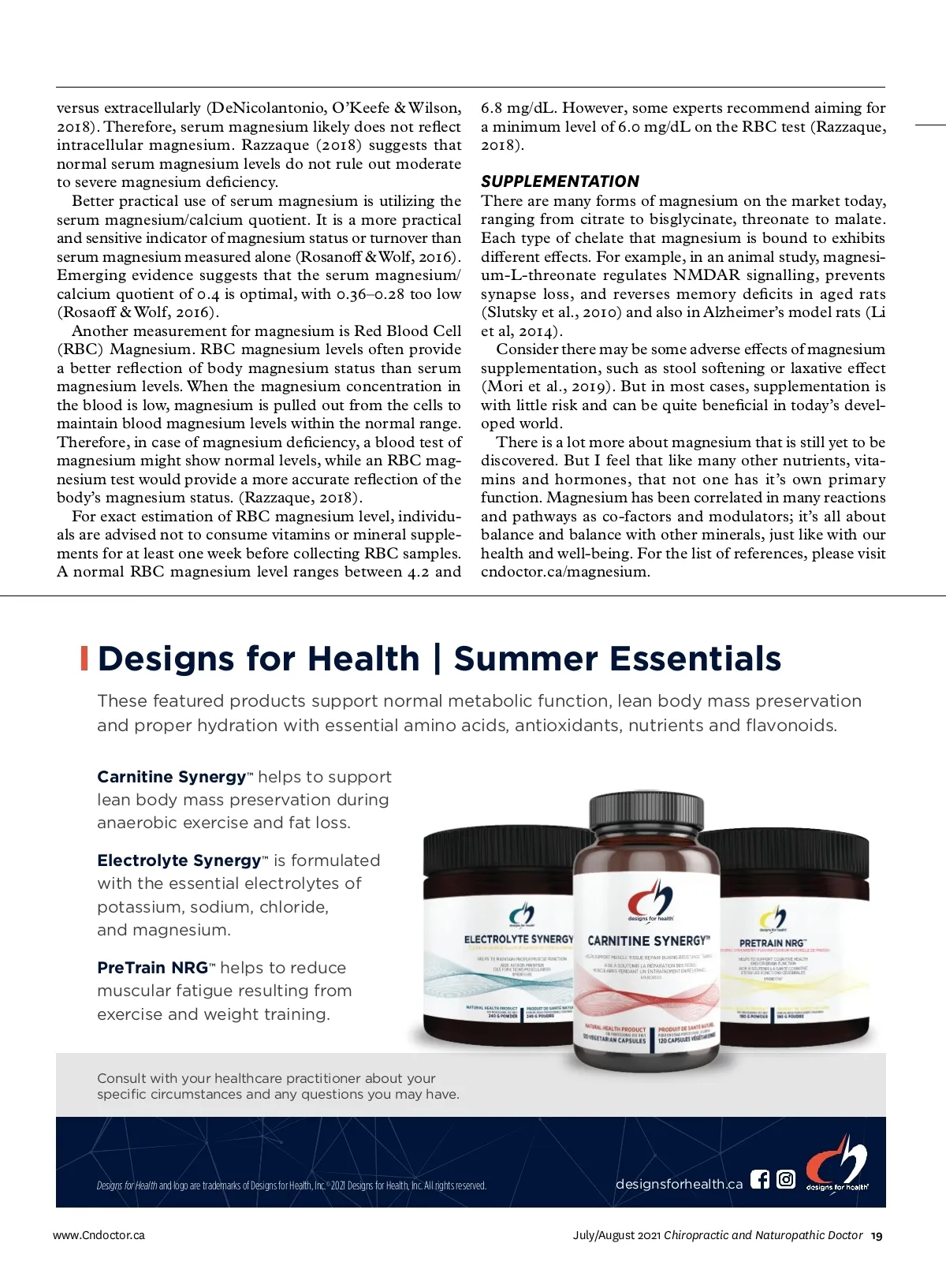
versus extracellularly (DeNicolantonio, O’Keefe & Wilson, 2018). Therefore, serum magnesium likely does not reflect intracellular magnesium. Razzaque (2018) suggests that normal serum magnesium levels do not rule out moderate to severe magnesium deficiency. Better practical use of serum magnesium is utilizing the serum magnesium/calcium quotient. It is a more practical and sensitive indicator of magnesium status or turnover than serum magnesium measured alone (Rosanoff & Wolf, 2016). Emerging evidence suggests that the serum magnesium/ calcium quotient of 0.4 is optimal, with 0.36–0.28 too low (Rosaoff & Wolf, 2016). Another measurement for magnesium is Red Blood Cell (RBC) Magnesium. RBC magnesium levels often provide a better reflection of body magnesium status than serum magnesium levels. When the magnesium concentration in the blood is low, magnesium is pulled out from the cells to maintain blood magnesium levels within the normal range. Therefore, in case of magnesium deficiency, a blood test of magnesium might show normal levels, while an RBC mag-nesium test would provide a more accurate reflection of the body’s magnesium status. (Razzaque, 2018). For exact estimation of RBC magnesium level, individu-als are advised not to consume vitamins or mineral supple-ments for at least one week before collecting RBC samples. A normal RBC magnesium level ranges between 4.2 and 6.8 mg/dL. However, some experts recommend aiming for a minimum level of 6.0 mg/dL on the RBC test (Razzaque, 2018). SUPPLEMENTATION There are many forms of magnesium on the market today, ranging from citrate to bisglycinate, threonate to malate. Each type of chelate that magnesium is bound to exhibits different effects. For example, in an animal study, magnesi-um-L-threonate regulates NMDAR signalling, prevents synapse loss, and reverses memory deficits in aged rats (Slutsky et al., 2010) and also in Alzheimer’s model rats (Li et al, 2014). Consider there may be some adverse effects of magnesium supplementation, such as stool softening or laxative effect (Mori et al., 2019). But in most cases, supplementation is with little risk and can be quite beneficial in today’s devel-oped world. There is a lot more about magnesium that is still yet to be discovered. But I feel that like many other nutrients, vita-mins and hormones, that not one has it’s own primary function. Magnesium has been correlated in many reactions and pathways as co-factors and modulators; it’s all about balance and balance with other minerals, just like with our health and well-being. For the list of references, please visit cndoctor.ca/magnesium. Designs for Health | Summer Essentials These featured products support normal metabolic function, lean body mass preservation and proper hydration with essential amino acids, antioxidants, nutrients and flavonoids. Carnitine Synergy ™ helps to support lean body mass preservation during anaerobic exercise and fat loss. Electrolyte Synergy ™ is formulated with the essential electrolytes of potassium, sodium, chloride, and magnesium. PreTrain NRG ™ helps to reduce muscular fatigue resulting from exercise and weight training. Consult with your healthcare practitioner about your specific circumstances and any questions you may have. Designs for Health and logo are trademarks of Designs for Health, Inc. © 2021 Designs for Health, Inc. All rights reserved. designsforhealth.ca www.Cndoctor.ca CND_Designs for Health_JulyAug21_CSA.indd 1 July/August 2021 Chiropractic and Naturopathic Doctor 19 2021-07-05 11:03 AM
Chiropractic + Naturopathic Doctor July/August 2021: Page 19