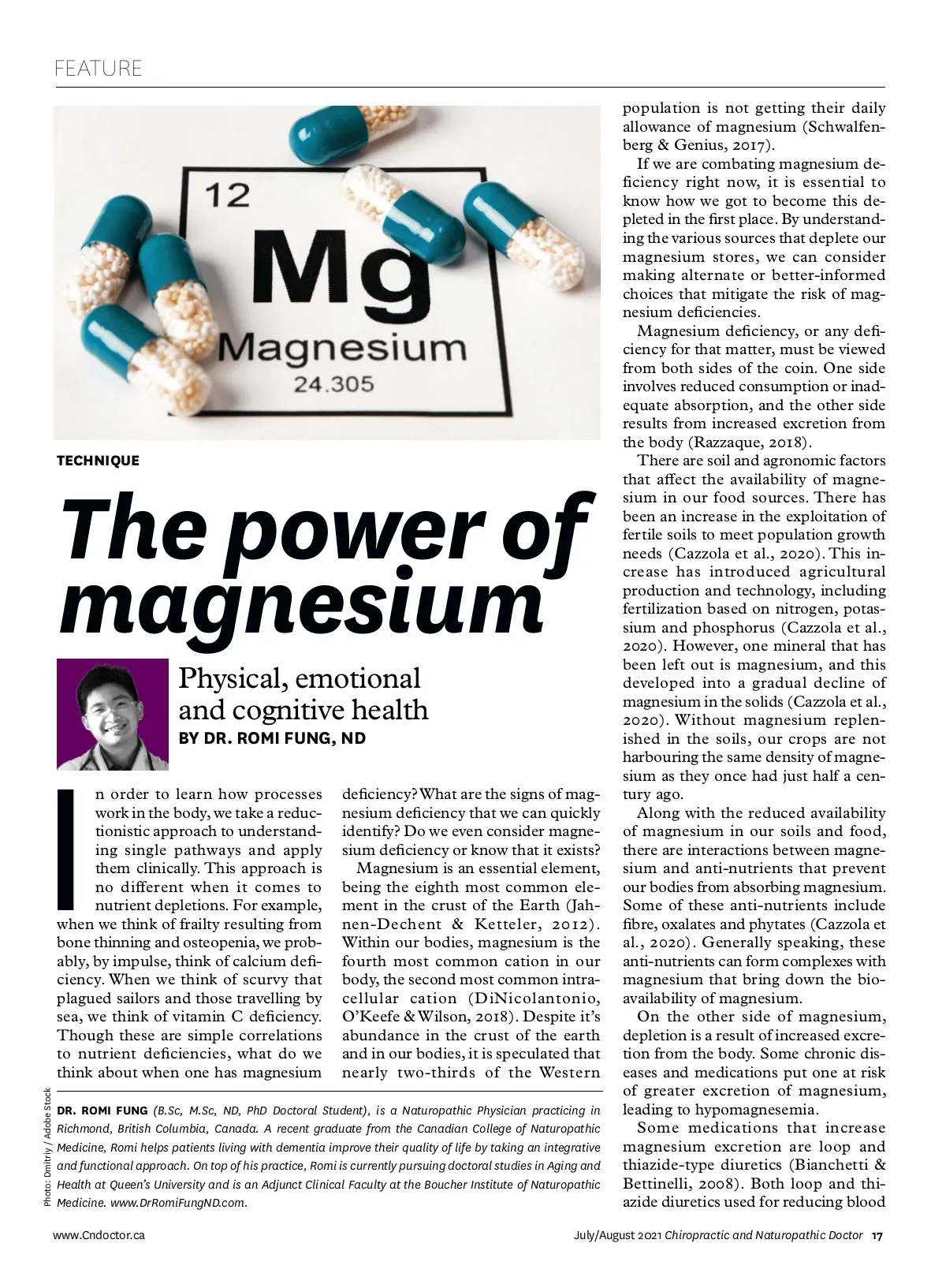
FEATURE population is not getting their daily allowance of magnesium (Schwalfen-berg & Genius, 2017). If we are combating magnesium de-ficiency right now, it is essential to know how we got to become this de-pleted in the first place. By understand-ing the various sources that deplete our magnesium stores, we can consider making alternate or better-informed choices that mitigate the risk of mag-nesium deficiencies. Magnesium deficiency, or any defi-ciency for that matter, must be viewed from both sides of the coin. One side involves reduced consumption or inad-equate absorption, and the other side results from increased excretion from the body (Razzaque, 2018). There are soil and agronomic factors that affect the availability of magne-sium in our food sources. There has been an increase in the exploitation of fertile soils to meet population growth needs (Cazzola et al., 2020). This in-crease has introduced agricultural production and technology, including fertilization based on nitrogen, potas-sium and phosphorus (Cazzola et al., 2020). However, one mineral that has been left out is magnesium, and this developed into a gradual decline of magnesium in the solids (Cazzola et al., 2020). Without magnesium replen-ished in the soils, our crops are not harbouring the same density of magne-sium as they once had just half a cen-tury ago. Along with the reduced availability of magnesium in our soils and food, there are interactions between magne-sium and anti-nutrients that prevent our bodies from absorbing magnesium. Some of these anti-nutrients include fibre, oxalates and phytates (Cazzola et al., 2020). Generally speaking, these anti-nutrients can form complexes with magnesium that bring down the bio-availability of magnesium. On the other side of magnesium, depletion is a result of increased excre-tion from the body. Some chronic dis-eases and medications put one at risk of greater excretion of magnesium, leading to hypomagnesemia. Some medications that increase magnesium excretion are loop and thiazide-type diuretics (Bianchetti & Bettinelli, 2008). Both loop and thi-azide diuretics used for reducing blood TECHNIQUE The power of magnesium I Photo: Dmitriy / Adobe Stock Physical, emotional and cognitive health BY DR. ROMI FUNG, ND deficiency? What are the signs of mag-nesium deficiency that we can quickly identify? Do we even consider magne-sium deficiency or know that it exists? Magnesium is an essential element, being the eighth most common ele-ment in the crust of the Earth (Jah-nen-Dechent & Ketteler, 2012). Within our bodies, magnesium is the fourth most common cation in our body, the second most common intra-cellular cation (DiNicolantonio, O’Keefe & Wilson, 2018). Despite it’s abundance in the crust of the earth and in our bodies, it is speculated that nearly two-thirds of the Western n order to learn how processes work in the body, we take a reduc-tionistic approach to understand-ing single pathways and apply them clinically. This approach is no different when it comes to nutrient depletions. For example, when we think of frailty resulting from bone thinning and osteopenia, we prob-ably, by impulse, think of calcium defi-ciency. When we think of scurvy that plagued sailors and those travelling by sea, we think of vitamin C deficiency. Though these are simple correlations to nutrient deficiencies, what do we think about when one has magnesium DR. ROMI FUNG (B.Sc, M.Sc, ND, PhD Doctoral Student), is a Naturopathic Physician practicing in Richmond, British Columbia, Canada. A recent graduate from the Canadian College of Naturopathic Medicine, Romi helps patients living with dementia improve their quality of life by taking an integrative and functional approach. On top of his practice, Romi is currently pursuing doctoral studies in Aging and Health at Queen’s University and is an Adjunct Clinical Faculty at the Boucher Institute of Naturopathic Medicine. www.DrRomiFungND.com. www.Cndoctor.ca July/August 2021 Chiropractic and Naturopathic Doctor 17
Chiropractic + Naturopathic Doctor July/August 2021: Page 17