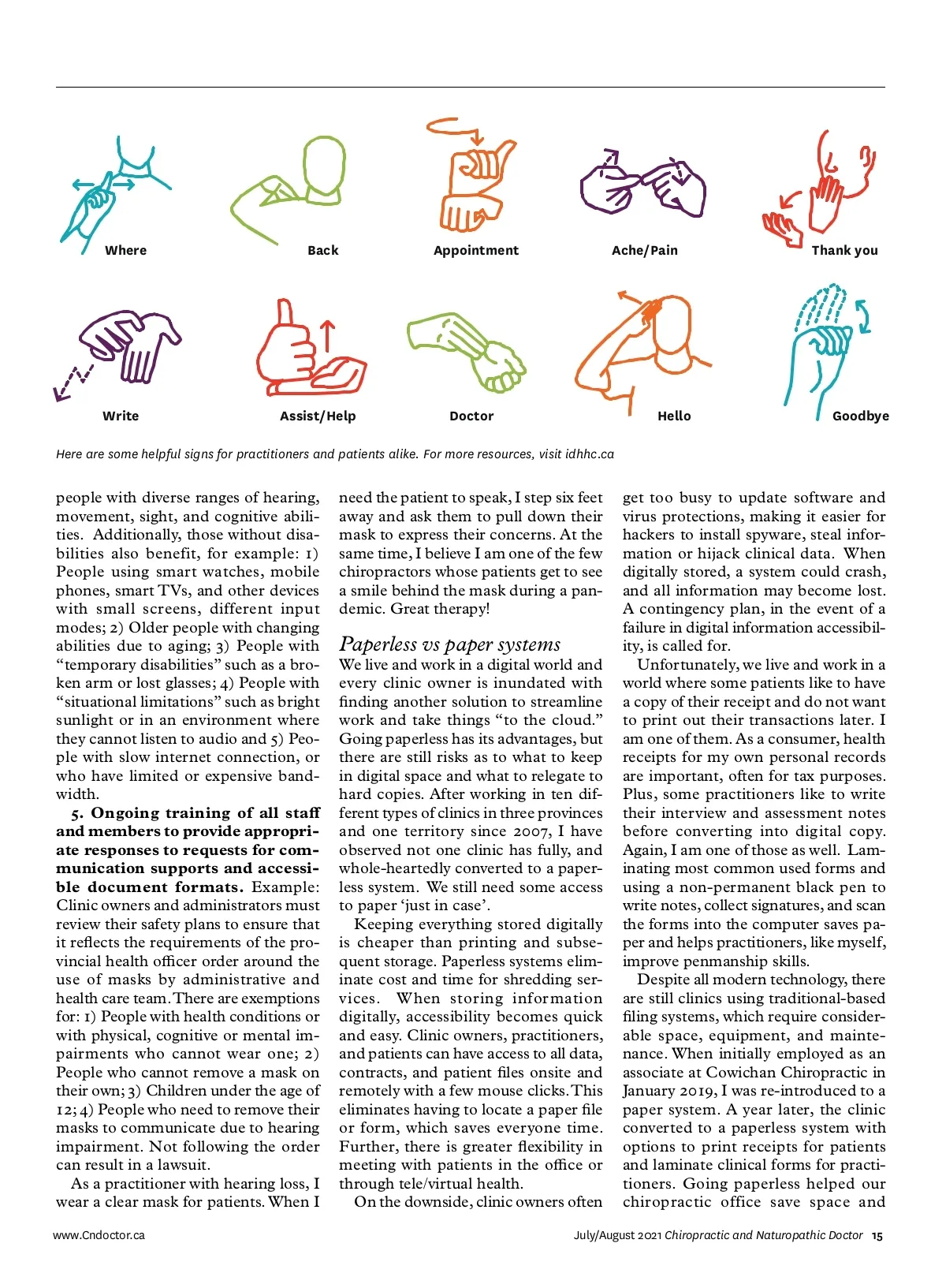
Where Where Back Back Appointment Appointment Ache/Pain Ache/Pain Thank you Thank you Write Write Assist/Help Assist/Help Doctor Doctor Hello Hello Goodbye Goodbye Here are some helpful signs for practitioners and patients alike. For more resources, visit idhhc.ca people with diverse ranges of hearing, movement, sight, and cognitive abili-ties. Additionally, those without disa-bilities also benefit, for example: 1) People using smart watches, mobile phones, smart TVs, and other devices with small screens, different input modes; 2) Older people with changing abilities due to aging; 3) People with “temporary disabilities” such as a bro-ken arm or lost glasses; 4) People with “situational limitations” such as bright sunlight or in an environment where they cannot listen to audio and 5) Peo-ple with slow internet connection, or who have limited or expensive band-width. 5. Ongoing training of all staff and members to provide appropri-ate responses to requests for com-munication supports and accessi-ble document formats. Example: Clinic owners and administrators must review their safety plans to ensure that it reflects the requirements of the pro-vincial health officer order around the use of masks by administrative and health care team. There are exemptions for: 1) People with health conditions or with physical, cognitive or mental im-pairments who cannot wear one; 2) People who cannot remove a mask on their own; 3) Children under the age of 12; 4) People who need to remove their masks to communicate due to hearing impairment. Not following the order can result in a lawsuit. As a practitioner with hearing loss, I wear a clear mask for patients. When I www.Cndoctor.ca need the patient to speak, I step six feet away and ask them to pull down their mask to express their concerns. At the same time, I believe I am one of the few chiropractors whose patients get to see a smile behind the mask during a pan-demic. Great therapy! Paperless vs paper systems We live and work in a digital world and every clinic owner is inundated with finding another solution to streamline work and take things “to the cloud.” Going paperless has its advantages, but there are still risks as to what to keep in digital space and what to relegate to hard copies. After working in ten dif-ferent types of clinics in three provinces and one territory since 2007, I have observed not one clinic has fully, and whole-heartedly converted to a paper-less system. We still need some access to paper ‘just in case’. Keeping everything stored digitally is cheaper than printing and subse-quent storage. Paperless systems elim-inate cost and time for shredding ser-vices. When storing information digitally, accessibility becomes quick and easy. Clinic owners, practitioners, and patients can have access to all data, contracts, and patient files onsite and remotely with a few mouse clicks. This eliminates having to locate a paper file or form, which saves everyone time. Further, there is greater flexibility in meeting with patients in the office or through tele/virtual health. On the downside, clinic owners often get too busy to update software and virus protections, making it easier for hackers to install spyware, steal infor-mation or hijack clinical data. When digitally stored, a system could crash, and all information may become lost. A contingency plan, in the event of a failure in digital information accessibil-ity, is called for. Unfortunately, we live and work in a world where some patients like to have a copy of their receipt and do not want to print out their transactions later. I am one of them. As a consumer, health receipts for my own personal records are important, often for tax purposes. Plus, some practitioners like to write their interview and assessment notes before converting into digital copy. Again, I am one of those as well. Lam-inating most common used forms and using a non-permanent black pen to write notes, collect signatures, and scan the forms into the computer saves pa-per and helps practitioners, like myself, improve penmanship skills. Despite all modern technology, there are still clinics using traditional-based filing systems, which require consider-able space, equipment, and mainte-nance. When initially employed as an associate at Cowichan Chiropractic in January 2019, I was re-introduced to a paper system. A year later, the clinic converted to a paperless system with options to print receipts for patients and laminate clinical forms for practi-tioners. Going paperless helped our chiropractic office save space and July/August 2021 Chiropractic and Naturopathic Doctor 15
Chiropractic + Naturopathic Doctor July/August 2021: Page 15