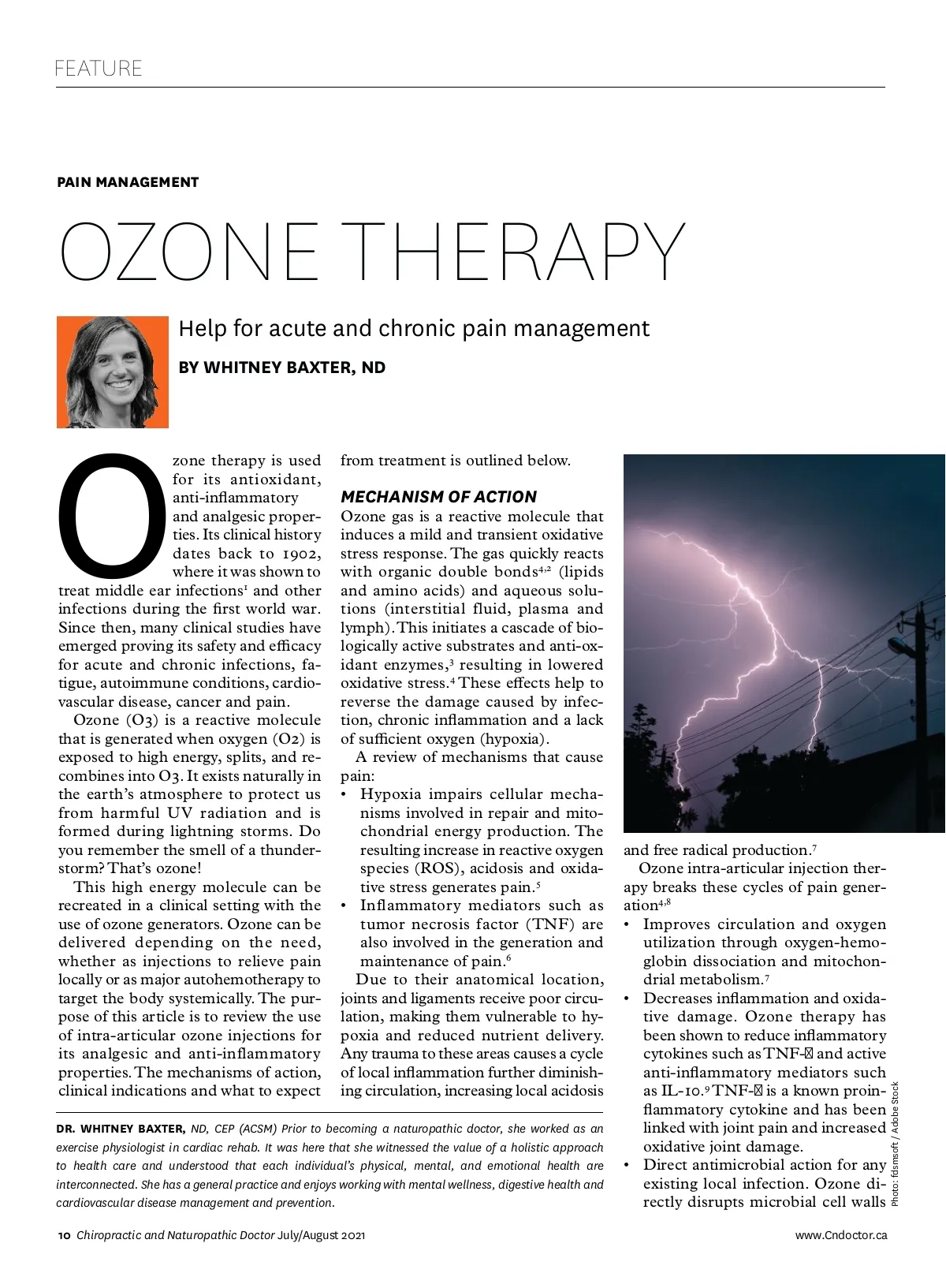
FEATURE PAIN MANAGEMENT OZONE THERAPY Help for acute and chronic pain management BY WHITNEY BAXTER, ND O DR. WHITNEY BAXTER, ND, CEP (ACSM) Prior to becoming a naturopathic doctor, she worked as an exercise physiologist in cardiac rehab. It was here that she witnessed the value of a holistic approach to health care and understood that each individual’s physical, mental, and emotional health are interconnected. She has a general practice and enjoys working with mental wellness, digestive health and cardiovascular disease management and prevention. 10 Chiropractic and Naturopathic Doctor July/August 2021 www.Cndoctor.ca Photo: fdsmsoft / Adobe Stock zone therapy is used for its antioxidant, anti-inflammatory and analgesic proper-ties. Its clinical history dates back to 1902, where it was shown to treat middle ear infections 1 and other infections during the first world war. Since then, many clinical studies have emerged proving its safety and efficacy for acute and chronic infections, fa-tigue, autoimmune conditions, cardio-vascular disease, cancer and pain. Ozone (O3) is a reactive molecule that is generated when oxygen (O2) is exposed to high energy, splits, and re-combines into O3. It exists naturally in the earth’s atmosphere to protect us from harmful UV radiation and is formed during lightning storms. Do you remember the smell of a thunder-storm? That’s ozone! This high energy molecule can be recreated in a clinical setting with the use of ozone generators. Ozone can be delivered depending on the need, whether as injections to relieve pain locally or as major autohemotherapy to target the body systemically. The pur-pose of this article is to review the use of intra-articular ozone injections for its analgesic and anti-inflammatory properties. The mechanisms of action, clinical indications and what to expect from treatment is outlined below. Ozone gas is a reactive molecule that induces a mild and transient oxidative stress response. The gas quickly reacts with organic double bonds 4,2 (lipids and amino acids) and aqueous solu-tions (interstitial fluid, plasma and lymph). This initiates a cascade of bio-logically active substrates and anti-ox-idant enzymes, 3 resulting in lowered oxidative stress. 4 These effects help to reverse the damage caused by infec-tion, chronic inflammation and a lack of sufficient oxygen (hypoxia). A review of mechanisms that cause pain: • Hypoxia impairs cellular mecha-nisms involved in repair and mito-chondrial energy production. The resulting increase in reactive oxygen species (ROS), acidosis and oxida-tive stress generates pain. 5 • Inflammatory mediators such as tumor necrosis factor (TNF) are also involved in the generation and maintenance of pain. 6 Due to their anatomical location, joints and ligaments receive poor circu-lation, making them vulnerable to hy-poxia and reduced nutrient delivery. Any trauma to these areas causes a cycle of local inflammation further diminish-ing circulation, increasing local acidosis MECHANISM OF ACTION and free radical production. 7 Ozone intra-articular injection ther-apy breaks these cycles of pain gener-ation 4,8 • Improves circulation and oxygen utilization through oxygen-hemo-globin dissociation and mitochon-drial metabolism. 7 • Decreases inflammation and oxida-tive damage. Ozone therapy has been shown to reduce inflammatory cytokines such as TNF- and active anti-inflammatory mediators such as IL-10. 9 TNF- is a known proin-flammatory cytokine and has been linked with joint pain and increased oxidative joint damage. • Direct antimicrobial action for any existing local infection. Ozone di-rectly disrupts microbial cell walls
Chiropractic + Naturopathic Doctor July/August 2021: Page 10