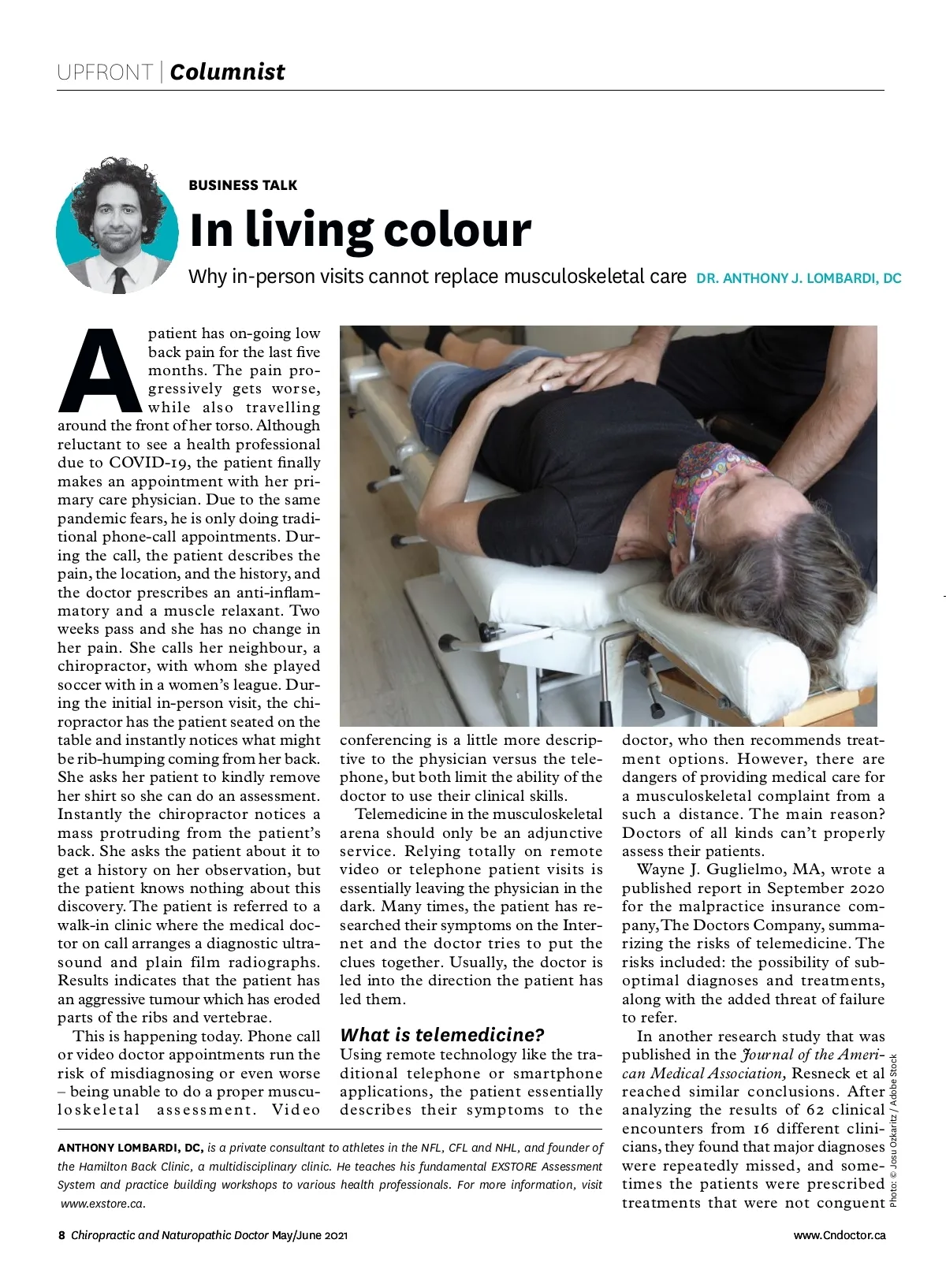
UPFRONT | Columnist BUSINESS TALK In living colour A Why in-person visits cannot replace musculoskeletal care DR. ANTHONY J. LOMBARDI, DC ANTHONY LOMBARDI, DC, is a private consultant to athletes in the NFL, CFL and NHL, and founder of the Hamilton Back Clinic, a multidisciplinary clinic. He teaches his fundamental EXSTORE Assessment System and practice building workshops to various health professionals. For more information, visit www.exstore.ca. 8 Chiropractic and Naturopathic Doctor May/June 2021 www.Cndoctor.ca Photo: © Josu Ozkaritz / Adobe Stock patient has on-going low back pain for the last five months. The pain pro-gressively gets worse, while also travelling around the front of her torso. Although reluctant to see a health professional due to COVID-19, the patient finally makes an appointment with her pri-mary care physician. Due to the same pandemic fears, he is only doing tradi-tional phone-call appointments. Dur-ing the call, the patient describes the pain, the location, and the history, and the doctor prescribes an anti-inflam-matory and a muscle relaxant. Two weeks pass and she has no change in her pain. She calls her neighbour, a chiropractor, with whom she played soccer with in a women’s league. Dur-ing the initial in-person visit, the chi-ropractor has the patient seated on the table and instantly notices what might be rib-humping coming from her back. She asks her patient to kindly remove her shirt so she can do an assessment. Instantly the chiropractor notices a mass protruding from the patient’s back. She asks the patient about it to get a history on her observation, but the patient knows nothing about this discovery. The patient is referred to a walk-in clinic where the medical doc-tor on call arranges a diagnostic ultra-sound and plain film radiographs. Results indicates that the patient has an aggressive tumour which has eroded parts of the ribs and vertebrae. This is happening today. Phone call or video doctor appointments run the risk of misdiagnosing or even worse – being unable to do a proper muscu-loskeletal assessment. Video conferencing is a little more descrip-tive to the physician versus the tele-phone, but both limit the ability of the doctor to use their clinical skills. Telemedicine in the musculoskeletal arena should only be an adjunctive service. Relying totally on remote video or telephone patient visits is essentially leaving the physician in the dark. Many times, the patient has re-searched their symptoms on the Inter-net and the doctor tries to put the clues together. Usually, the doctor is led into the direction the patient has led them. What is telemedicine? Using remote technology like the tra-ditional telephone or smartphone applications, the patient essentially describes their symptoms to the doctor, who then recommends treat-ment options. However, there are dangers of providing medical care for a musculoskeletal complaint from a such a distance. The main reason? Doctors of all kinds can’t properly assess their patients. Wayne J. Guglielmo, MA, wrote a published report in September 2020 for the malpractice insurance com-pany, The Doctors Company, summa-rizing the risks of telemedicine. The risks included: the possibility of sub-optimal diagnoses and treatments, along with the added threat of failure to refer. In another research study that was published in the Journal of the Ameri-can Medical Association, Resneck et al reached similar conclusions. After analyzing the results of 62 clinical encounters from 16 different clini-cians, they found that major diagnoses were repeatedly missed, and some-times the patients were prescribed treatments that were not conguent
Chiropractic + Naturopathic Doctor May/June 2021: Page 8