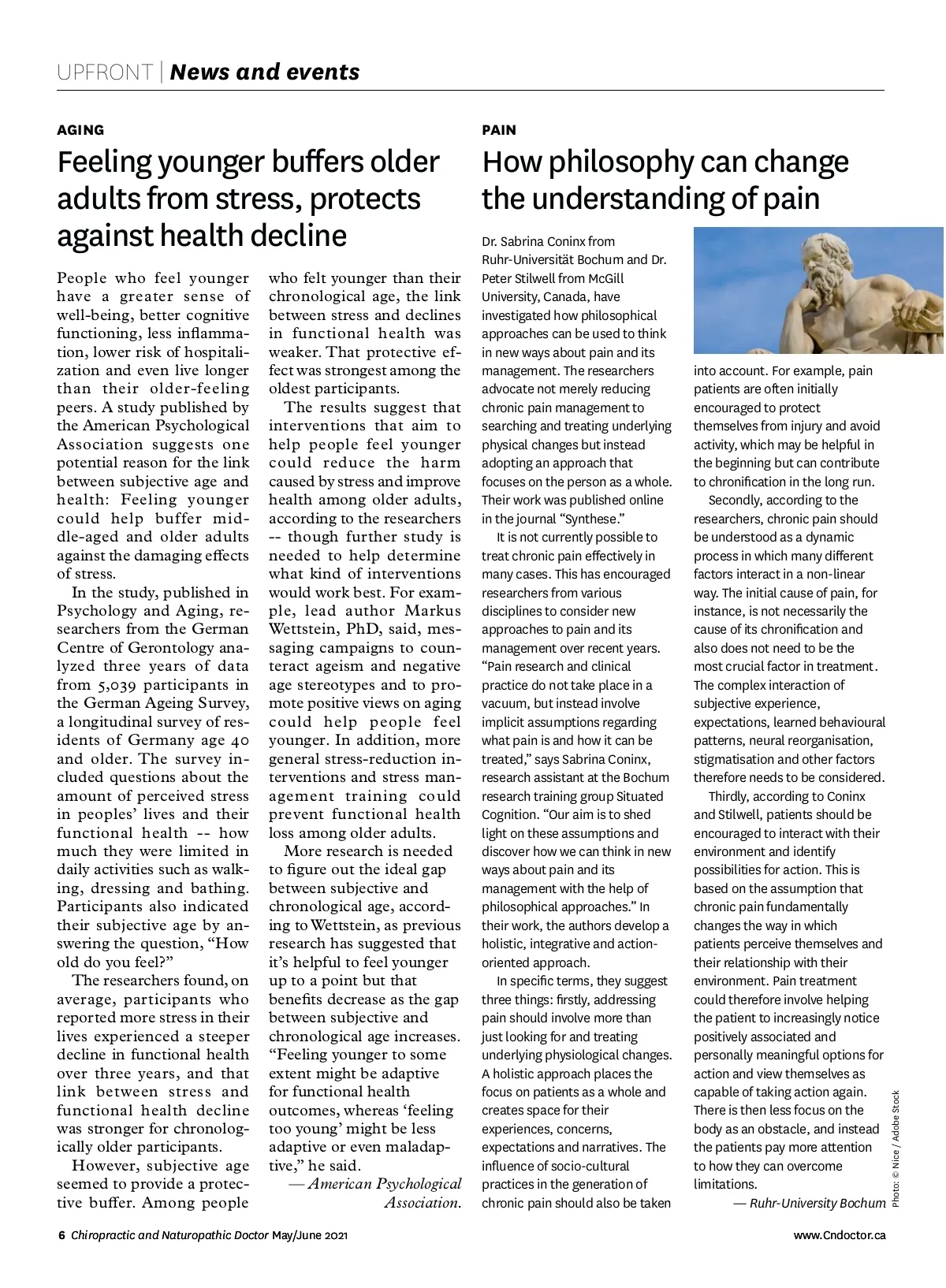
UPFRONT | News and events AGING Feeling younger buffers older adults from stress, protects against health decline People who feel younger have a greater sense of well-being, better cognitive functioning, less inflamma-tion, lower risk of hospitali-zation and even live longer than their older-feeling peers. A study published by the American Psychological Association suggests one potential reason for the link between subjective age and health: Feeling younger could help buffer mid-dle-aged and older adults against the damaging effects of stress. In the study, published in Psychology and Aging, re-searchers from the German Centre of Gerontology ana-lyzed three years of data from 5,039 participants in the German Ageing Survey, a longitudinal survey of res-idents of Germany age 40 and older. The survey in-cluded questions about the amount of perceived stress in peoples’ lives and their functional health --how much they were limited in daily activities such as walk-ing, dressing and bathing. Participants also indicated their subjective age by an-swering the question, “How old do you feel?” The researchers found, on average, participants who reported more stress in their lives experienced a steeper decline in functional health over three years, and that link between stress and functional health decline was stronger for chronolog-ically older participants. However, subjective age seemed to provide a protec-tive buffer. Among people who felt younger than their chronological age, the link between stress and declines in functional health was weaker. That protective ef-fect was strongest among the oldest participants. The results suggest that interventions that aim to help people feel younger could reduce the harm caused by stress and improve health among older adults, according to the researchers --though further study is needed to help determine what kind of interventions would work best. For exam-ple, lead author Markus Wettstein, PhD, said, mes-saging campaigns to coun-teract ageism and negative age stereotypes and to pro-mote positive views on aging could help people feel younger. In addition, more general stress-reduction in-terventions and stress man-agement training could prevent functional health loss among older adults. More research is needed to figure out the ideal gap between subjective and chronological age, accord-ing to Wettstein, as previous research has suggested that it’s helpful to feel younger up to a point but that benefits decrease as the gap between subjective and chronological age increases. “Feeling younger to some extent might be adaptive for functional health outcomes, whereas ‘feeling too young’ might be less adaptive or even maladap-tive,” he said. — American Psychological Association. PAIN How philosophy can change the understanding of pain Dr. Sabrina Coninx from Ruhr-Universität Bochum and Dr. Peter Stilwell from McGill University, Canada, have investigated how philosophical approaches can be used to think in new ways about pain and its management. The researchers advocate not merely reducing chronic pain management to searching and treating underlying physical changes but instead adopting an approach that focuses on the person as a whole. Their work was published online in the journal “Synthese.” It is not currently possible to treat chronic pain effectively in many cases. This has encouraged researchers from various disciplines to consider new approaches to pain and its management over recent years. “Pain research and clinical practice do not take place in a vacuum, but instead involve implicit assumptions regarding what pain is and how it can be treated,” says Sabrina Coninx, research assistant at the Bochum research training group Situated Cognition. “Our aim is to shed light on these assumptions and discover how we can think in new ways about pain and its management with the help of philosophical approaches.” In their work, the authors develop a holistic, integrative and action-oriented approach. In specific terms, they suggest three things: firstly, addressing pain should involve more than just looking for and treating underlying physiological changes. A holistic approach places the focus on patients as a whole and creates space for their experiences, concerns, expectations and narratives. The influence of socio-cultural practices in the generation of chronic pain should also be taken into account. For example, pain patients are often initially encouraged to protect themselves from injury and avoid activity, which may be helpful in the beginning but can contribute to chronification in the long run. Secondly, according to the researchers, chronic pain should be understood as a dynamic process in which many different factors interact in a non-linear way. The initial cause of pain, for instance, is not necessarily the cause of its chronification and also does not need to be the most crucial factor in treatment. The complex interaction of subjective experience, expectations, learned behavioural patterns, neural reorganisation, stigmatisation and other factors therefore needs to be considered. Thirdly, according to Coninx and Stilwell, patients should be encouraged to interact with their environment and identify possibilities for action. This is based on the assumption that chronic pain fundamentally changes the way in which patients perceive themselves and their relationship with their environment. Pain treatment could therefore involve helping the patient to increasingly notice positively associated and personally meaningful options for action and view themselves as capable of taking action again. There is then less focus on the body as an obstacle, and instead the patients pay more attention to how they can overcome limitations. — Ruhr-University Bochum www.Cndoctor.ca 6 Chiropractic and Naturopathic Doctor May/June 2021 Photo: © Nice / Adobe Stock
Chiropractic + Naturopathic Doctor May/June 2021: Page 6