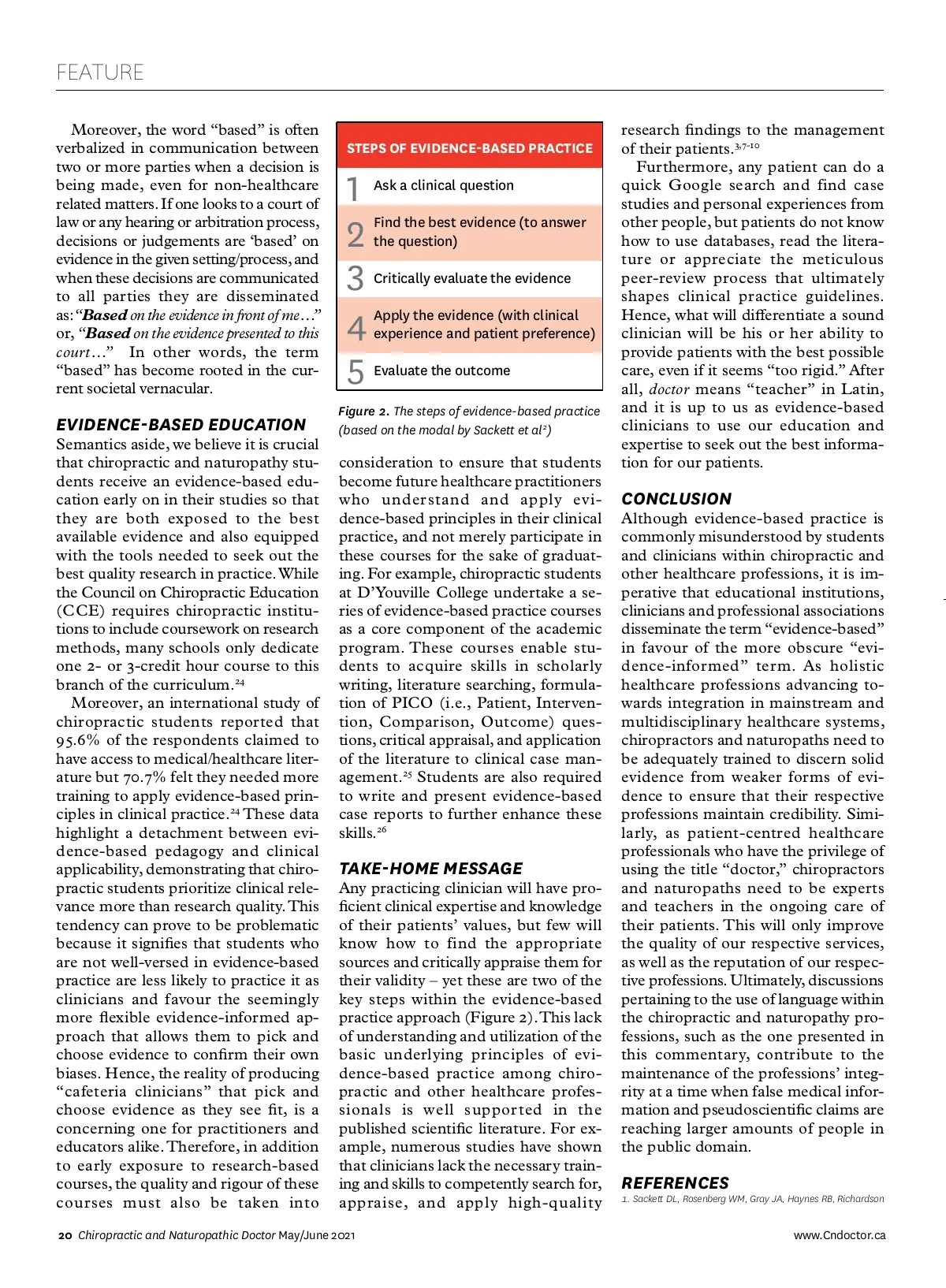
FEATURE Moreover, the word “based” is often verbalized in communication between two or more parties when a decision is being made, even for non-healthcare related matters. If one looks to a court of law or any hearing or arbitration process, decisions or judgements are ‘based’ on evidence in the given setting/process, and when these decisions are communicated to all parties they are disseminated as: “ Based on the evidence in front of me…” or, “ Based on the evidence presented to this court…” In other words, the term “based” has become rooted in the cur-rent societal vernacular. Semantics aside, we believe it is crucial that chiropractic and naturopathy stu-dents receive an evidence-based edu-cation early on in their studies so that they are both exposed to the best available evidence and also equipped with the tools needed to seek out the best quality research in practice. While the Council on Chiropractic Education (CCE) requires chiropractic institu-tions to include coursework on research methods, many schools only dedicate one 2-or 3-credit hour course to this branch of the curriculum. 24 Moreover, an international study of chiropractic students reported that 95.6% of the respondents claimed to have access to medical/healthcare liter-ature but 70.7% felt they needed more training to apply evidence-based prin-ciples in clinical practice. 24 These data highlight a detachment between evi-dence-based pedagogy and clinical applicability, demonstrating that chiro-practic students prioritize clinical rele-vance more than research quality. This tendency can prove to be problematic because it signifies that students who are not well-versed in evidence-based practice are less likely to practice it as clinicians and favour the seemingly more flexible evidence-informed ap-proach that allows them to pick and choose evidence to confirm their own biases. Hence, the reality of producing “cafeteria clinicians” that pick and choose evidence as they see fit, is a concerning one for practitioners and educators alike. Therefore, in addition to early exposure to research-based courses, the quality and rigour of these courses must also be taken into STEPS OF EVIDENCE-BASED PRACTICE 1 2 3 4 5 Ask a clinical question Find the best evidence (to answer the question) Critically evaluate the evidence Apply the evidence (with clinical experience and patient preference) Evaluate the outcome EVIDENCE-BASED EDUCATION Figure 2. The steps of evidence-based practice (based on the modal by Sackett et al 2 ) consideration to ensure that students become future healthcare practitioners who understand and apply evi-dence-based principles in their clinical practice, and not merely participate in these courses for the sake of graduat-ing. For example, chiropractic students at D’Youville College undertake a se-ries of evidence-based practice courses as a core component of the academic program. These courses enable stu-dents to acquire skills in scholarly writing, literature searching, formula-tion of PICO (i.e., Patient, Interven-tion, Comparison, Outcome) ques-tions, critical appraisal, and application of the literature to clinical case man-agement. 25 Students are also required to write and present evidence-based case reports to further enhance these skills. 26 research findings to the management of their patients. 3,7-10 Furthermore, any patient can do a quick Google search and find case studies and personal experiences from other people, but patients do not know how to use databases, read the litera-ture or appreciate the meticulous peer-review process that ultimately shapes clinical practice guidelines. Hence, what will differentiate a sound clinician will be his or her ability to provide patients with the best possible care, even if it seems “too rigid.” After all, doctor means “teacher” in Latin, and it is up to us as evidence-based clinicians to use our education and expertise to seek out the best informa-tion for our patients. CONCLUSION TAKE-HOME MESSAGE Any practicing clinician will have pro-ficient clinical expertise and knowledge of their patients’ values, but few will know how to find the appropriate sources and critically appraise them for their validity – yet these are two of the key steps within the evidence-based practice approach (Figure 2). This lack of understanding and utilization of the basic underlying principles of evi-dence-based practice among chiro-practic and other healthcare profes-sionals is well supported in the published scientific literature. For ex-ample, numerous studies have shown that clinicians lack the necessary train-ing and skills to competently search for, appraise, and apply high-quality Although evidence-based practice is commonly misunderstood by students and clinicians within chiropractic and other healthcare professions, it is im-perative that educational institutions, clinicians and professional associations disseminate the term “evidence-based” in favour of the more obscure “evi-dence-informed” term. As holistic healthcare professions advancing to-wards integration in mainstream and multidisciplinary healthcare systems, chiropractors and naturopaths need to be adequately trained to discern solid evidence from weaker forms of evi-dence to ensure that their respective professions maintain credibility. Simi-larly, as patient-centred healthcare professionals who have the privilege of using the title “doctor,” chiropractors and naturopaths need to be experts and teachers in the ongoing care of their patients. This will only improve the quality of our respective services, as well as the reputation of our respec-tive professions. Ultimately, discussions pertaining to the use of language within the chiropractic and naturopathy pro-fessions, such as the one presented in this commentary, contribute to the maintenance of the professions’ integ-rity at a time when false medical infor-mation and pseudoscientific claims are reaching larger amounts of people in the public domain. REFERENCES 1. Sackett DL, Rosenberg WM, Gray JA, Haynes RB, Richardson 20 Chiropractic and Naturopathic Doctor May/June 2021 www.Cndoctor.ca
Chiropractic + Naturopathic Doctor May/June 2021: Page 20